CBFC Certification Latest News
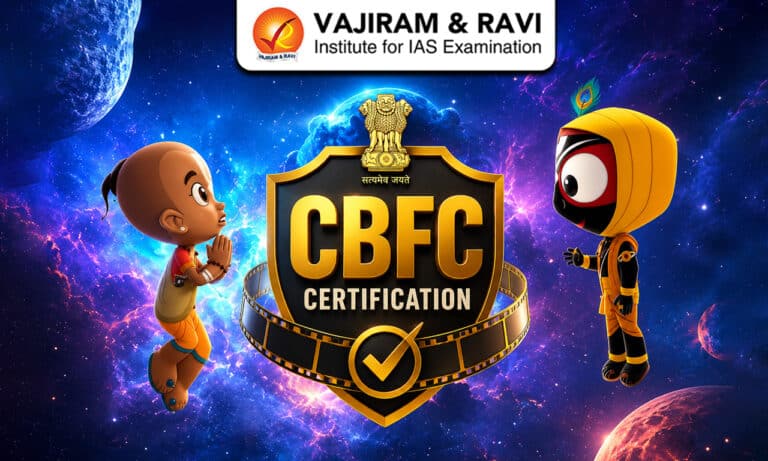
- The Supreme Court declined to permit the release of the animated film Mahaprabhu Jagannath on its scheduled date of July 17, and instead directed the producer to postpone release until after July 27, when the annual Rath Yatra in Puri concludes.
- This came after the Orissa High Court had restrained the film’s release over concerns about its depiction of Lord Jagannath.
What Triggered the Dispute?
- The Orissa High Court held that the film’s portrayal of Lord Jagannath’s childhood and adventures was “not in tune with the religious texts of the Skandha Purana and the Brahma Purana,” and that releasing it during the Rath Yatra would be “counterproductive.”
- The producer challenged this order before the Supreme Court, questioning both the High Court’s jurisdiction and whether a court can override CBFC certification based on apprehended public disorder.
- The producer’s plea argued that the High Court “committed a grave jurisdictional error” by going beyond the scope of the original petition:
- The original petitioners had sought to restrain the film’s release only within Odisha.
- Instead, the High Court imposed a blanket, nationwide stay.
- The film held three separate ‘U’ (universal) certificates from the CBFC for its Hindi, Telugu, and Odia versions (issued in May, June, and July respectively).
- The stay halted the Hindi and Telugu versions even in states “where no cause of action existed and no relief was ever sought.”


The Weight of CBFC Certification
- The plea argued that once an expert statutory body like the CBFC certifies a film for unrestricted public exhibition, there is a “strong legal presumption of validity,” and courts should not override this based on “unverified apprehensions.”
- Key precedents cited:
- Union of India v K.M. Shankarappa (2000): The Supreme Court held that once an expert body certifies a film, the executive cannot revisit that decision merely due to apprehended law-and-order concerns; maintaining order is the state government’s responsibility, not a ground to withhold certification.
- S. Rangarajan v P. Jagjivan Ram (1989): The Court ruled that freedom of expression cannot be suppressed due to threats of demonstrations or violence, and that the state has an “obligatory duty” to prevent disruption rather than curb free speech, calling yielding to such threats a “negation of the rule of law.”
Limits on this Deference
- Certification is not entirely immune from judicial review.
- Courts can examine whether certification followed due legal process, statutory grounds, and fair procedure.
- Where the CBFC acts within its statutory framework, courts generally defer to it.
- Separately, the Cinematograph Act allows the government to suspend or revoke certification post-approval, and permits criminal liability and seizure for violations.
Disputed Facts on Screening and Timing
- The High Court’s order noted that the producer released the film “out of the blue” without incorporating changes assured during a screening before the Gajapati Maharaja and the Shree Jagannath Temple Administration.
- The producer’s petition disputes this, claiming the review committee walked out after watching just 10-15 minutes without giving specific feedback, and that the release, originally set for July 10, was voluntarily deferred to July 17 out of respect.
- The plea also highlighted the commercial stakes: an investment of around ₹10 crore, a two-month public campaign, and released trailers, arguing the PIL was filed two days before release to cause “maximum commercial and financial damage.”
- It further contended that the film’s central character, “Jagan,” is a fictional child figure and not a literal human portrayal of the deity, reinforcing its status as a fictional devotional work.
The Free Speech Argument
- The High Court had reasoned that even though films enjoy freedom of expression, a balance is needed when content could “shatter the sentiments, emotions and religious belief” of the public, especially where it risks unrest.
- The producer’s plea countered this by invoking artistic licence, arguing that:
- Creative freedom in a devotional, animated work meant for children deserves to be “placed on a high pedestal.”
- The Madras High Court’s ruling on The Da Vinci Code (2006) held that a fictional work with a clear disclaimer cannot be treated as a genuine threat to public order.
- Free speech “cannot be held hostage to a heckler’s veto.”
- Neither the PIL petitioners nor the temple administration have statutory power under the Shree Jagannath Temple Act, 1955 to block the screening of a certified film.
Conclusion
- The case highlights a recurring tension in Indian constitutional law: balancing religious sentiment against artistic freedom once a film has cleared statutory certification.
- By deferring release rather than banning the film outright, the Supreme Court signalled restraint, leaving the larger question of judicial power over CBFC-certified content for further hearing.

 Last updated on Oct, 2026
→ UPSC 2027 Notification will be released on 13 January 2027 at upsconline.nic.in.
→ Asian Games 2026 are being held in Aichi-Nagoya, Japan, from 19 September to 4 October.
→ Check Nobel Prize 2026 Winners List here.
→ Download PIB PRiSM Monthly Magazine 2026 here.
→ Check UPSC Monthly Current Affairs Magazine The Recitals here.
→ Check out the latest UPSC Syllabus here.
→ Download UPSC Model Answers for Mains 2026
→ UPSC Mains Question Paper 2026 is out now for Essay & GS Paper 1, 2, 3 & 4.
→ UPSC Calendar 2027 has been released.
→ Enroll in Vajiram & Ravi’s UPSC Mains Test Series 2027 for structured answer writing practice, expert evaluation, and exam-oriented feedback.
→ Join Vajiram & Ravi’s UPSC Mentorship Program 2027 for personalized guidance, strategy planning, and one-to-one support from experienced mentors.
→ Go through the UPSC Mains Previous Year Papers to enhance your preparation.
→ UPSC has released UPSC Toppers List 2025 with the Civil Services final result on its official website.
→ Also check Best UPSC Coaching in India
CBFC Certification FAQ
Q1. What legal significance does CBFC Certification have in India?+
Q2. Can courts interfere with CBFC Certification after a film has been certified? +
Q3. Which Supreme Court judgments strengthen the authority of CBFC Certification? +
Q4. Why has the Jagannath film case revived the debate on CBFC Certification?+
Q5. Why is CBFC Certification important for freedom of expression?+
Tags: CBFC Certification mains articles upsc current affairs upsc mains current affairs