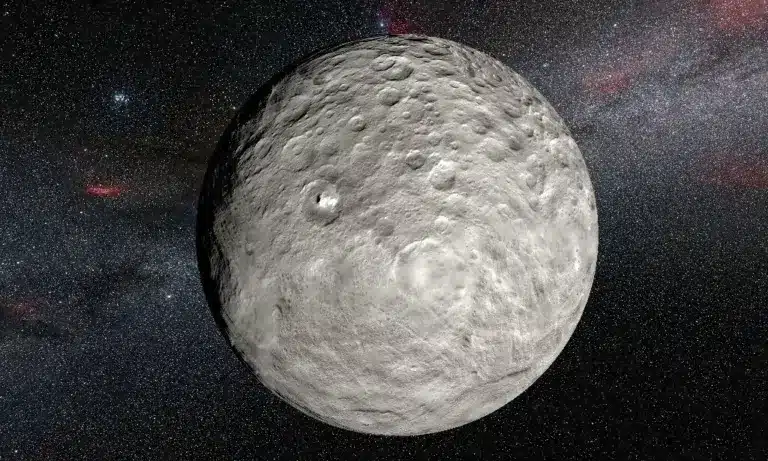
About Ceres:
- It is a dwarf planet and the largest object in the asteroid belt between Mars and Jupiter.
- It’s the only dwarf planet located in the inner solar system.
- It was the first member of the asteroid belt to be discovered when Giuseppe Piazzi spotted it in 1801.
- Ceres is named for the Roman goddess of corn and harvests. The word cereal comes from the same name.
- Called an asteroid for many years, Ceres is so much bigger and so different from its rocky neighbors that scientists classified it as a dwarf planet in 2006.
- When NASA’s Dawn arrived in 2015, Ceres became the first dwarf planet to be explored by a spacecraft.
- Features:
- With a radius of 296 miles (476 kilometers), Ceres is 1/13 the radius of Earth.
- Ceres is 2.8 astronomical units (AU) away from the Sun. One AU is the distance from the Sun to Earth.
- Ceres takes 1,682 Earth days to make one trip around the Sun.
- As Ceres orbits the Sun, it completes one rotation every 9 hours, making its day length one of the shortest in the solar system.
- Ceres formed along with the rest of the solar system about 4.5 billion years ago when gravity pulled swirling gas and dust in to become a small dwarf planet.
- Ceres is more similar to the terrestrial planets (Mercury, Venus, Earth, and Mars) than its asteroid neighbors, but it is much less dense.
- Ceres probably has a solid core and a mantle made of water ice. Ceres’ crust is rocky and dusty with large salt deposits.
What is a Dwarf Planet?
- A dwarf planet is a body, other than a natural satellite (moon), that orbits the Sun and that is, for practical purposes, smaller than the planet Mercury yet large enough for its own gravity to have rounded its shape substantially.
- The International Astronomical Union (IAU)adopted this category of solar system bodies in August 2006,designating Pluto, the even more-remote object Eris, and the asteroid Ceres as the first members of the category.
- Unlike major planets, these bodies are not massive enough to have swept up most smaller nearby bodies by gravitational attraction; they thus failed to grow larger.
- In June 2008, the IAU created a new category, plutoids, within the dwarf planet category.
- Plutoids are dwarf planets that are farther from the Sun than Neptune.
- All the dwarf planets except Ceres are plutoids.
Q1: What is an asteroid?
Asteroids, sometimes called minor planets, are rocky, airless remnants left over from the early formation of our solar system about 4.6 billion years ago. Most asteroids can be found orbiting the Sun between Mars and Jupiter within the main asteroid belt.
Source: Dwarf planet Ceres might have been a muddy ocean world






 Last updated on April, 2026
→ UPSC Final Result 2025 is now out.
→ UPSC has released UPSC Toppers List 2025 with the Civil Services final result on its official website.
→ Anuj Agnihotri secured AIR 1 in the UPSC Civil Services Examination 2025.
→ UPSC Marksheet 2025 is now out.
→ UPSC Notification 2026 & UPSC IFoS Notification 2026 is now out on the official website at upsconline.nic.in.
→ UPSC Calendar 2026 has been released.
→ Check out the latest UPSC Syllabus 2026 here.
→ UPSC Prelims 2026 will be conducted on 24th May, 2026 & UPSC Mains 2026 will be conducted on 21st August 2026.
→ The UPSC Selection Process is of 3 stages-Prelims, Mains and Interview.
→ Prepare effectively with Vajiram & Ravi’s UPSC Prelims Test Series 2026 featuring full-length mock tests, detailed solutions, and performance analysis.
→ Enroll in Vajiram & Ravi’s UPSC Mains Test Series 2026 for structured answer writing practice, expert evaluation, and exam-oriented feedback.
→ Join Vajiram & Ravi’s Best UPSC Mentorship Program for personalized guidance, strategy planning, and one-to-one support from experienced mentors.
→ Shakti Dubey secures AIR 1 in UPSC CSE Exam 2024.
→ Also check Best UPSC Coaching in India