Kalyana Chalukyas Latest News
Three Kannada inscriptions from the Kalyana Chalukya era were noticed for the first time in Kankal village in the Pudur mandal of Vikarabad district.
About Chalukyas
- The Chalukyas ruled over the central Indian plateau of the Deccan between the sixth and twelfth centuries.
- During that period, they ruled as three closely related but individual dynasties.
- The Chalukyas of Badami, who ruled between the sixth and eighth centuries, and the two sibling dynasties of the Chalukyas of Kalyani, or the Western Chalukyas, and the Chalukyas of Vengi, or the Eastern Chalukyas.





About Kalyana Chalukyas
- Primarily a Kannadiga dynasty, they were known after their capital city, Kalyani. It is present in the modern-day Bidar district of Karnataka.
- The empire was established by Tailapa II when the Western Chalukya was a feudatory of the Rashtrakuta Empire and Tailapa II governed Tardavadi in the Bijapur district of Karnataka.
- In the 300 years long rule in the western Deccan and southern part of the Indian peninsula, Chalukya of Kalyani expanded and reached the zenith of power during the rule of Vikramaditya VI (1076-1126 CE).
- It is considered the most successful period of the later Chalukya rulers in Karnataka’s history, and many scholars refer to this period as the ‘Chalukya Vikrama era’.
- Vikramaditya VI was not only controlling feudatories in the northern region, such as Kadamba Jayakesi II of Goa, Silhara Bhoja, and the Yadava King; he won several battles against the Chola dynasty.
Kalyana Chalukyas Decline
- After Vikramaditya VI’s death, the consistent confrontation with the Chola dynasty exploited both empires and gave opportunities to their subordinates to rebel.
- After 1126, the Western Chalukya empire started declining, and by the time of Jagadhekamalla II, everything was falling apart.
Kalyana Chalukyas Administration, Art, and Architecture
- The Western Chalukya administration was mainly hereditary, where the king passed his powers to the male heir and brother in the absence of a male heir.
- The whole kingdom was divided and managed by feudatories such as the Hoysala and the Kakatiya.
- While the Chalukya Dynasty maintained a great army of infantries, cavalries, elephant units, etc, the Western Chalukyas followed the trend and achieved a great extent of power.
- They were primarily Hindus but also acknowledged and tolerant of Buddhism and Jainism.
- The Chalukyas contributed greatly to the development of Kannada and Telugu literature.
- The Western Chalukya minted punch-marked gold coinscalled pagodas with Kannada legends.
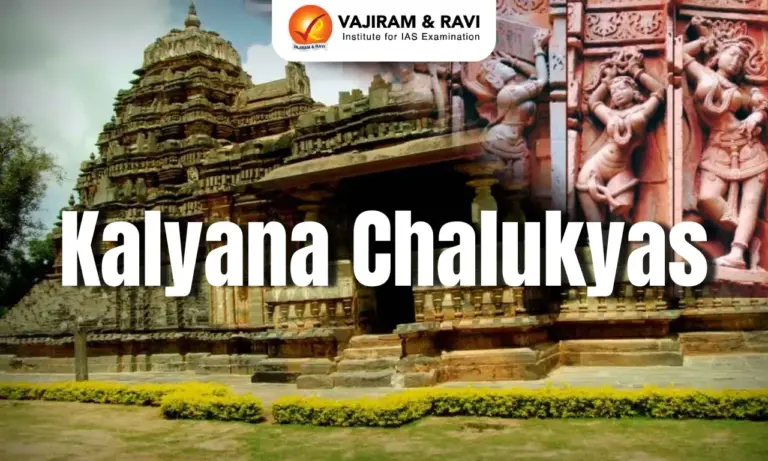
- The Western Chalukya dynasty is considered to be a crucial era for the evolution of Deccan architecture.
- Their art is also called the ‘Gadag style’ because numerous temples were built in the Tungabhadra-Krishna doab region in the present-day Gadag district.
- The Mallikarjuna temple of Bellary, Siddeshvara temple in Haveri, Kallesvara temple in Davangere district, etc are a few of the finest examples of later Chalukya architecture.
Kalyana Chalukyas FAQs
Q1. Who was the founder of Kalyani Chalukyas?
Ans. Tailapa-II
Q2. Who was the most famous king among the Kalyani Chalukyas?
Ans. Vikramaditya-VI
Q3. Who built Badami Caves?
Ans. The Badami Caves were built by Mangalesha, a ruler of the Early Chalukya dynasty, in the 6th century CE.
Source: TOI

 Last updated on March, 2026
→ UPSC Final Result 2025 is now out.
→ UPSC has released UPSC Toppers List 2025 with the Civil Services final result on its official website.
→ Anuj Agnihotri secured AIR 1 in the UPSC Civil Services Examination 2025.
→ UPSC Marksheet 2025 is now out.
→ UPSC Notification 2026 & UPSC IFoS Notification 2026 is now out on the official website at upsconline.nic.in.
→ UPSC Calendar 2026 has been released.
→ Check out the latest UPSC Syllabus 2026 here.
→ UPSC Prelims 2026 will be conducted on 24th May, 2026 & UPSC Mains 2026 will be conducted on 21st August 2026.
→ The UPSC Selection Process is of 3 stages-Prelims, Mains and Interview.
→ Prepare effectively with Vajiram & Ravi’s UPSC Prelims Test Series 2026 featuring full-length mock tests, detailed solutions, and performance analysis.
→ Enroll in Vajiram & Ravi’s UPSC Mains Test Series 2026 for structured answer writing practice, expert evaluation, and exam-oriented feedback.
→ Join Vajiram & Ravi’s Best UPSC Mentorship Program for personalized guidance, strategy planning, and one-to-one support from experienced mentors.
→ Shakti Dubey secures AIR 1 in UPSC CSE Exam 2024.
→ Also check Best UPSC Coaching in India