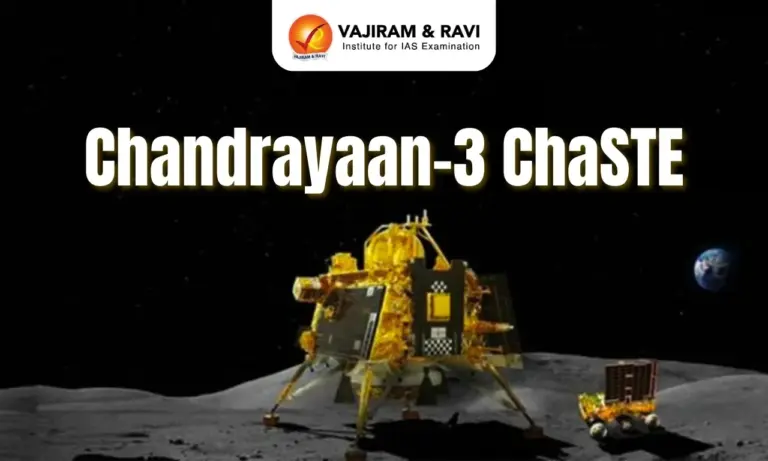
Chandrayaan-3 ChaSTE Latest News
Chandrayaan-3’s Surface Thermophysical Experiment (ChaSTE) became the first instrument to measure in situ temperatures near the moon’s south pole.
- It successfully penetrated lunar soil and deployed a thermal probe, achieving what two previous missions—ESA’s Philae (2014) and NASA’s InSight HP3 (2018)—could not.
- This experiment provided crucial data on lunar surface temperatures, strengthening evidence of water ice deposits.
How ChaSTE Works
- ChaSTE’s thermal probe was integrated into the Vikram lander of Chandrayaan-3, which landed on August 23, 2023.
- The probe is equipped with 10 temperature sensors placed 1 cm apart along its length, near the nose-tip.
- It uses a rotation-based deployment mechanism instead of a hammering device, which played a crucial role in its success.
- The motor rotates, pushing the probe downward until the tip touches the Moon’s surface.
- As the probe continues to penetrate deeper, the increasing resistance from the lunar soil helps determine how far it has descended.
- ChaSTE successfully reached a depth of 10 cm in the Moon’s regolith, where it continuously monitored temperature variations until September 2, 2023.
- The final temperature readings from the deep lunar soil confirmed thermal properties essential for lunar exploration.
Comparisons with Previous Missions
- ESA’s Philae lander (2014) on Comet 67P: It carried the MUPUS instrument to measure surface and subsurface temperatures. Failed due to an awkward landing, preventing the probe from being deployed properly.
- NASA’s InSight lander (2018) on Mars: Included the Heat Flow and Physical Properties Package (HP3), featuring a self-hammering nail nicknamed “The Mole” designed to penetrate 5 meters underground.
- Encountered low friction in Martian sand, preventing it from burrowing deep enough to collect meaningful temperature data.
- The temperature sensors were attached to a tether, not on the mole itself, which made data collection impossible.





Chandrayaan-3 ChaSTE FAQs
Q1. What is Chandrayaan-3?
Ans. It is India’s third lunar mission, launched by ISRO, with the objective of soft-landing near the Moon’s south pole.
Q2. What does ChaSTE stand for?
Ans. ChaSTE (Chandra’s Surface Thermophysical Experiment) is an instrument on the Vikram lander to measure lunar soil temperature.
Q3. Why is ChaSTE important?
Ans. It provides data on temperature variations beneath the lunar surface, helping in future Moon exploration missions.
Source: TH

 Last updated on March, 2026
→ UPSC Final Result 2025 is now out.
→ UPSC has released UPSC Toppers List 2025 with the Civil Services final result on its official website.
→ Anuj Agnihotri secured AIR 1 in the UPSC Civil Services Examination 2025.
→ UPSC Marksheet 2025 is now out.
→ UPSC Notification 2026 & UPSC IFoS Notification 2026 is now out on the official website at upsconline.nic.in.
→ UPSC Calendar 2026 has been released.
→ Check out the latest UPSC Syllabus 2026 here.
→ UPSC Prelims 2026 will be conducted on 24th May, 2026 & UPSC Mains 2026 will be conducted on 21st August 2026.
→ The UPSC Selection Process is of 3 stages-Prelims, Mains and Interview.
→ Prepare effectively with Vajiram & Ravi’s UPSC Prelims Test Series 2026 featuring full-length mock tests, detailed solutions, and performance analysis.
→ Enroll in Vajiram & Ravi’s UPSC Mains Test Series 2026 for structured answer writing practice, expert evaluation, and exam-oriented feedback.
→ Join Vajiram & Ravi’s Best UPSC Mentorship Program for personalized guidance, strategy planning, and one-to-one support from experienced mentors.
→ Shakti Dubey secures AIR 1 in UPSC CSE Exam 2024.
→ Also check Best UPSC Coaching in India