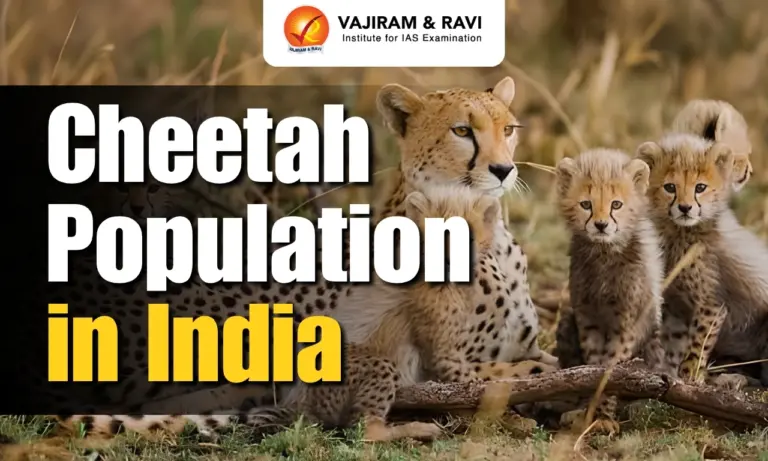
Cheetah Population in India has increased to 52 four years after the launch of Project Cheetah, marking a major phase in the country’s efforts to restore the species after its extinction in India.
According to the four-year status review covering September 2022 to September 2026, the population includes 32 cheetahs born in India. At present, 49 cheetahs are in Kuno National Park and three are in Gandhi Sagar Sanctuary, both in Madhya Pradesh.
How Did the Cheetah Population in India Reach 52?
India began the reintroduction programme in September 2022, when eight cheetahs were brought from Namibia to Kuno National Park. In February 2023, another 12 cheetahs arrived from South Africa. In February 2026, India added nine cheetahs from Botswana.
The growth of the population has increasingly come from natural breeding in India. The four-year review records 32 cubs born in the country after the reintroduction programme began.
Cheetahs from Namibia
- 8 cheetahs were introduced from Namibia in September 2022.
- 3 of these cheetahs are currently surviving.
- They have produced 22 India-born offspring.
- The surviving Namibian-origin population and its progeny therefore account for 25 cheetahs.
Cheetahs from South Africa
- 12 cheetahs were introduced from South Africa in February 2023.
- 8 are currently surviving.
- They have produced 10 India-born offspring.
- The South African-origin population and its progeny total 18.
- Of these, 15 are in Kuno National Park and three are in Gandhi Sagar Sanctuary.
Cheetahs from Botswana
- 9 cheetahs were introduced from Botswana in February 2026.
- The group consisted of six females and three males.
- Their introduction was intended to strengthen the genetic diversity and long-term viability of the Indian cheetah population.
Project Cheetah
Project Cheetah was launched on 17 September 2022 to reintroduce cheetahs in India after the species became extinct in the country in 1952. The programme focuses on establishing a self-sustaining cheetah population through translocation, breeding, habitat management and scientific monitoring.
- Launch: Project Cheetah was launched on 17 September 2022 at Kuno National Park, Madhya Pradesh.
- First batch: Eight cheetahs were brought from Namibia in September 2022.
- South African cheetahs: Another 12 cheetahs were introduced from South Africa in February 2023.
- Botswana: Nine cheetahs were brought from Botswana in 2026 to strengthen the population and genetic diversity.
- Current population: India’s cheetah population has reached 52 as of September 17, 2026.
- India-born cubs: 32 cheetahs have been born in India since the programme began.
- Major locations: Kuno National Park remains the primary cheetah habitat, while Gandhi Sagar Sanctuary has also become part of the programme.
- Scientific monitoring: Cheetahs are monitored for their health, movement, breeding, survival and adaptation to Indian environmental conditions.
- Long-term objective: The programme aims to establish a viable and self-sustaining cheetah population across suitable landscapes in India.
- Ecological objective: The reintroduction is also intended to help restore the ecological role of the cheetah in grassland, savanna and open-forest ecosystems.


Role of Gandhi Sagar Sanctuary
Gandhi Sagar Sanctuary in Madhya Pradesh is an important second habitat under Project Cheetah, helping expand the reintroduction programme beyond Kuno National Park. It provides additional space for cheetahs to establish territories, breed and contribute to the development of a self-sustaining cheetah population in India.
- Second major cheetah habitat: It complements Kuno National Park and helps diversify the geographical distribution of cheetahs.
- Current population: Three cheetahs are currently housed in Gandhi Sagar Sanctuary.
- Habitat expansion: Its inclusion allows the programme to gradually expand into additional landscapes suitable for cheetah conservation.
- Population management: Having more than one conservation site can help reduce excessive dependence on a single protected area.
- Breeding potential: The sanctuary can support future breeding and the establishment of additional cheetah groups.
- Landscape connectivity: Gandhi Sagar can contribute to the development of a larger network of suitable habitats and movement corridors.
- Long-term conservation: Its role is linked to India’s broader objective of creating a viable and genetically diverse cheetah meta-population.
Why Is the Rise in Cheetah Population Significant?
The increase in the cheetah population in India is important for several ecological and conservation reasons:
- Restoration of an extinct species: The cheetah was declared extinct in India in 1952.
- Natural breeding: The presence of 32 India-born cheetahs indicates that reproduction has occurred successfully after reintroduction.
- Second-generation survival: The survival of cubs born to India-born cheetahs represents a further step towards population establishment.
- Expansion of habitat: The programme has moved beyond Kuno towards Gandhi Sagar and other potential landscapes.
- Ecological restoration: Cheetahs occupy an important position as predators in grassland and open-forest ecosystems.
- Scientific conservation: Continuous monitoring provides data on behaviour, movement, health, breeding and adaptation.
- Long-term population building: The objective is gradually shifting from bringing animals to India towards establishing a sustainable population.
About Cheetah
The cheetah (Acinonyx jubatus) is the world’s fastest land animal and is highly adapted to open landscapes. Its slender body, long legs, flexible spine and specialised claws help it achieve high speeds while hunting.
- Habitat: Cheetahs mainly inhabit open grasslands, savannas, scrublands, semi-arid areas and open woodlands, where visibility is important for hunting.
- Speed: They can reach around 100–120 km/h over short distances, making them the fastest land animals.
- Physical features: A cheetah has a slender body, long legs, long tail and semi-retractable claws that provide grip while running.
- Tear marks: The distinctive black tear-like lines from the eyes towards the mouth may help reduce sunlight glare and improve focus during hunting.
- Diet: Cheetahs primarily feed on small and medium-sized mammals, including gazelles, antelopes and hares.
- Scent marking: They use urine, faeces and scent to communicate and may mark prominent objects such as trees, bushes, rocks and termite mounds.
- Social behaviour: Females generally live alone with their cubs, while males may form coalitions, often with brothers.

 Last updated on Oct, 2026
→ UPSC 2027 Notification will be released on 13 January 2027 at upsconline.nic.in.
→ Asian Games 2026 are being held in Aichi-Nagoya, Japan, from 19 September to 4 October.
→ Check Nobel Prize 2026 Winners List here.
→ Download PIB PRiSM Monthly Magazine 2026 here.
→ Check UPSC Monthly Current Affairs Magazine The Recitals here.
→ Check out the latest UPSC Syllabus here.
→ Download UPSC Model Answers for Mains 2026
→ UPSC Mains Question Paper 2026 is out now for Essay & GS Paper 1, 2, 3 & 4.
→ UPSC Calendar 2027 has been released.
→ Enroll in Vajiram & Ravi’s UPSC Mains Test Series 2027 for structured answer writing practice, expert evaluation, and exam-oriented feedback.
→ Join Vajiram & Ravi’s UPSC Mentorship Program 2027 for personalized guidance, strategy planning, and one-to-one support from experienced mentors.
→ Go through the UPSC Mains Previous Year Papers to enhance your preparation.
→ UPSC has released UPSC Toppers List 2025 with the Civil Services final result on its official website.
→ Also check Best UPSC Coaching in India
Cheetah Population in India FAQs
Q1. How many cheetahs are there in India in 2026?+
Q2. How many cheetahs were born in India?+
Q3. Where are cheetahs found in India?+
Q4. When was Project Cheetah launched?+
Q5. From which countries were cheetahs brought to India?+
Q6. When did cheetahs become extinct in India?+
Tags: cheetah population cheetah population in india