What’s in Today’s Article?
- Why in News?
- What is the Cheetah Reintroduction Plan/Project Cheetah?
- What is the Significance of Bringing Back Cheetahs?
- Why are Cheetahs Coming from Southern Africa and Challenges?
- News Summary Regarding Acclimatisation of Cheetahs at KNP
Why in News?
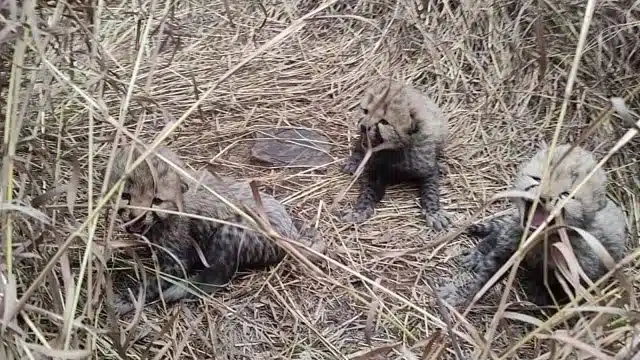
- Three cubs were born to the Namibian cheetah Aasha at Kuno National Park in Madhya Pradesh’s Sheopur district, indicating that animals are acclimatising.





What is the Cheetah Reintroduction Plan/Project Cheetah?
- Discussions to bring the Cheetah back to India were initiated in 2009 by the Wildlife Trust of India.
- Under the ‘Action Plan for Reintroduction of Cheetah in India’, 50 cheetahs will be brought from African countries to various national parks over 5 years.
- Most suitable site – Kuno Palpur National Park (KNP) in Madhya Pradesh:
- Amongst the surveyed sites of the central Indian states, KNP has been rated the highest, because of its suitable habitat and adequate prey base.
- It is assessed to be capable of supporting 21 Cheetahs and is likely the only wildlife site in the country where villages have been completely relocated from within the park.
- Kuno also provides the possibility of harbouring four of India’s big cats – tiger, lion, leopard and Cheetah, enabling them to coexist as they have in the past.
- The other sites recommended are – Nauradehi Wildlife Sanctuary, Madhya Pradesh; Gandhi Sagar Wildlife Sanctuary – Bhainsrorgarh Wildlife Sanctuary complex, Madhya Pradesh; Shahgarh bulge in Jaisalmer, Rajasthan; Mukundara Tiger Reserve, Rajasthan.
- As part of this project, 20 Cheetahs (8 from Namibia and 12 from South Africa) were Introduced in the KNP (since last year) to establish a free-ranging population for the first time since their extinction in India 70 years ago.
What is the Significance of Bringing Back Cheetahs?
- Besides conserving the big cat, the initiative in itself is a boon to the ecosystem.
- In saving Cheetahs, it is necessary to save not just its prey base (including certain threatened species), but also other endangered species of grasslands.
- They are not a threat to humans and do not attack large livestock either.
Why are Cheetahs Coming from Southern Africa and Challenges?
- Reasons behind re-introducing cheetah from southern Africa:
- The locally extinct Cheetah-subspecies of India is found in Iran and is categorised as critically endangered.
- Since it is not possible to source the critically endangered Asiatic Cheetah from Iran without affecting this subspecies, India will source Cheetahs from Southern Africa.
- Southern African Cheetahs have the highest observed genetic variety among extant Cheetah lineages, which is critical for a founding population stock.
- Furthermore, Southern African Cheetahs have been determined to be the ancestors of all other Cheetah lineages, making them suitable for India’s reintroduction programme.
- Challenges of bringing back Cheetahs:
- Based on the evidence available, it is impossible to conclude that the choice to bring the African Cheetah into India is scientifically sound.
- As a result, the Supreme Court of India (in 2020) permitted an experimental release of Cheetahs in a suitable habitat.
News Summary Regarding Acclimatisation of Cheetahs at KNP
- It was over a year ago, on Sept 17 2022, that 20 cheetahs from Namibia and South Africa were relocated to Kuno National Park. Six have died since March 2023.
- Aasha arrived in a crate marked “Aasha – The Hope”. It is said to be a confident animal that has travelled over 200 km after being released into the wild in March last year.
- The cheetah has also troubled the wildlife monitoring team in the past – after it ventured into Shivpuri district. A team which tracked it down to a village was attacked by angry villagers who mistook them for dacoits.
- The birth of 3 cubs to Aasha is a roaring success for Project Cheetah, envisioned to restore ecological balance.
- The birth of the cubs is an important indicator that the cheetahs are acclimatising to the Indian climate and have made Kuno their habitat.
- This is good news for wildlife officials who have been grappling with a string of deaths at Kuno National Park.
- Last year, Namibian cheetah Jwala gave birth to four cubs. However, three of its cubs died in May due to extreme weather conditions.
- The surviving ten-month-old cub is being looked after by Kuno park officials since its mother rejected it, after it was taken away by wildlife officials for treatment.
Q1) What is Project Tiger?
Project Tiger was first initiated on April 1, 1973, from the Jim Corbett National Park, Uttarakhand, under the leadership of Indira Gandhi. The objective of the Project Tiger is clear – saving Royal Bengal Tigers from getting extinct.
Q2) What do you mean by acclimatisation?
Acclimatisation is the process in which an individual organism adjusts to a change in its environment (such as a change in altitude, temperature, humidity, photoperiod, or pH), allowing it to maintain fitness across a range of environmental conditions.
Source: Namibian cheetah Aasha gives birth to 3 cubs in Kuno; ‘indicator that animals are acclimatising’

 Last updated on April, 2026
→ UPSC Final Result 2025 is now out.
→ UPSC has released UPSC Toppers List 2025 with the Civil Services final result on its official website.
→ Anuj Agnihotri secured AIR 1 in the UPSC Civil Services Examination 2025.
→ UPSC Marksheet 2025 is now out.
→ UPSC Notification 2026 & UPSC IFoS Notification 2026 is now out on the official website at upsconline.nic.in.
→ UPSC Calendar 2026 has been released.
→ Check out the latest UPSC Syllabus 2026 here.
→ UPSC Prelims 2026 will be conducted on 24th May, 2026 & UPSC Mains 2026 will be conducted on 21st August 2026.
→ The UPSC Selection Process is of 3 stages-Prelims, Mains and Interview.
→ Prepare effectively with Vajiram & Ravi’s UPSC Prelims Test Series 2026 featuring full-length mock tests, detailed solutions, and performance analysis.
→ Enroll in Vajiram & Ravi’s UPSC Mains Test Series 2026 for structured answer writing practice, expert evaluation, and exam-oriented feedback.
→ Join Vajiram & Ravi’s Best UPSC Mentorship Program for personalized guidance, strategy planning, and one-to-one support from experienced mentors.
→ Shakti Dubey secures AIR 1 in UPSC CSE Exam 2024.
→ Also check Best UPSC Coaching in India