Chemotherapy Latest News
A landmark study published recently has reported that about a fifth of chemotherapy drugs tested failed quality tests; 16 of the 17 implicated manufacturers are India-based.
About Chemotherapy
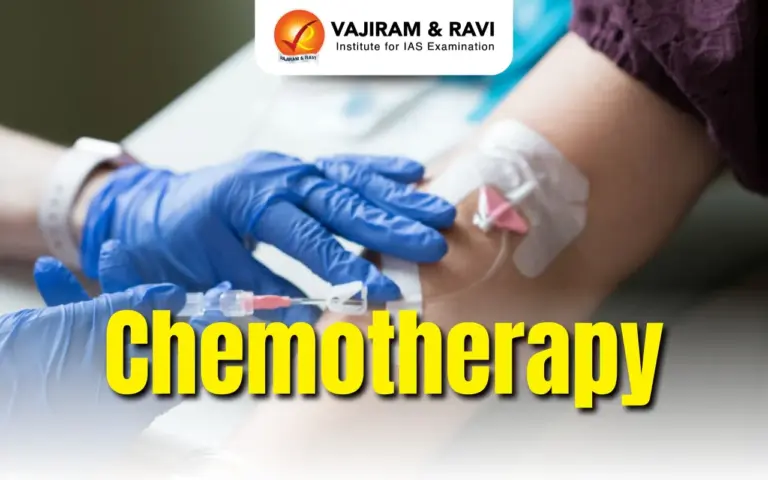
- Chemotherapy is a treatment that uses medicines to destroy cancer cells.
- There are many different types of chemo. They don’t all work exactly the same way, so different types of chemo might be used for different types of cancer.
- Most are given as an infusion into a vein (IV), but some are given as an injection, taken as pills, or applied to the skin.





How is Chemo Different from Other Cancer treatments?
- Chemo is a systemic treatment.
- It travels through the bloodstream to reach all parts of your body.
- It can kill cancer cells that have spread (metastasized) to parts of the body far away from the original (primary) tumor or cancer cells in blood cancers, such as leukemia, that have spread throughout the body.
- This makes chemo different from local treatments like surgery and radiation, which only affect one part of the body.
How Does Chemotherapy Work?
- Chemotherapy works by affecting cells when they are growing and dividing to make new cells. During this process (called the cell cycle), cells:
- Grow in size.
- Make copies of their genetic material (DNA).
- Divide to form new cells.
- Some cells, such as skin cells, are fast-growing, meaning they move through this process quickly. Other cells, such as muscle cells, complete it more slowly.
- Cancer cells tend to be faster growing, moving through the cell cycle very quickly.
- Different types of chemo target cells at different phases of the cell cycle. This is why certain chemo drugs work better for different types of cancer cells, and sometimes different combinations of chemo work better together.
- Understanding how chemo works also helps doctors plan how often each chemo should be given, and how those doses should be timed.
Chemotherapy Side Effects
- Chemo interrupts the cell cycles of normal cells, too–especially cells that grow faster.
- Blood cells and the cells in your skin, hair follicles, and digestive tract are examples of cells that grow and multiply quickly.
- That’s why some common side effects of chemotherapy occur in these areas, including:
- Anemia.
- Bleeding.
- Constipation.
- Diarrhea.
- Fatigue.
- Hair loss.
- Infection.
- Loss of appetite.
- Nausea and vomiting.
Source: TH

 Last updated on April, 2026
→ UPSC Final Result 2025 is now out.
→ UPSC has released UPSC Toppers List 2025 with the Civil Services final result on its official website.
→ Anuj Agnihotri secured AIR 1 in the UPSC Civil Services Examination 2025.
→ UPSC Marksheet 2025 is now out.
→ UPSC Notification 2026 & UPSC IFoS Notification 2026 is now out on the official website at upsconline.nic.in.
→ UPSC Calendar 2026 has been released.
→ Check out the latest UPSC Syllabus 2026 here.
→ UPSC Prelims 2026 will be conducted on 24th May, 2026 & UPSC Mains 2026 will be conducted on 21st August 2026.
→ The UPSC Selection Process is of 3 stages-Prelims, Mains and Interview.
→ Prepare effectively with Vajiram & Ravi’s UPSC Prelims Test Series 2026 featuring full-length mock tests, detailed solutions, and performance analysis.
→ Enroll in Vajiram & Ravi’s UPSC Mains Test Series 2026 for structured answer writing practice, expert evaluation, and exam-oriented feedback.
→ Join Vajiram & Ravi’s Best UPSC Mentorship Program for personalized guidance, strategy planning, and one-to-one support from experienced mentors.
→ Shakti Dubey secures AIR 1 in UPSC CSE Exam 2024.
→ Also check Best UPSC Coaching in India
Chemotherapy FAQs
Q1. What is the main purpose of chemotherapy in cancer treatment?+
Q2. How is chemotherapy typically administered?+
Q3. Why is chemotherapy effective in treating blood cancers like leukemia?+
Tags: chemotherapy prelims pointers upsc current affairs upsc prelims current affairs