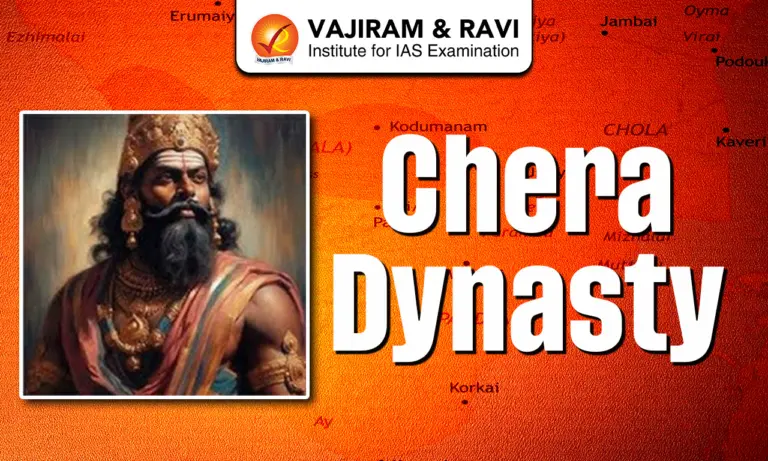
The Chera Dynasty was one of the three important kingdoms of ancient South India, along with the Chola Dynasty and the Pandya Dynasty. They ruled mainly in present-day Kerala and parts of western Tamil Nadu from around the 4th century BCE to the 12th century CE. They were also called Keralaputras.
The Cheras became powerful mainly because of their location near the sea, which helped them develop strong trade relations, especially with the Roman Empire. Their history is mostly known from Sangam literature.
Chera Dynasty Geographical Extent
- The Chera kingdom was located in the south-western part of the Indian subcontinent, mainly covering present-day Kerala and parts of western Tamil Nadu.
- Its territory lay to the west and north of the Pandya Dynasty.
- Geographically, the Chera land was bounded by the Arabian Sea on the west, which gave it direct access to maritime trade routes.
- To the east, it was bordered by the Western Ghats, which acted as a natural barrier separating it from the interior regions of Tamil Nadu.
- Beyond the Ghats, the Cheras expanded into the Kongu region (modern western Tamil Nadu), with important centres like Karur serving as inland trade hubs.
- The northern limits of the Chera territory are generally associated with the region around present-day northern Kerala, while the southern boundary extended close to the areas near Kanyakumari, though this region often overlapped with Pandya influence.
- One of the most important geographical features of the Chera kingdom was its coastal location, which included major ports such as Muziris (Muchiri). This port acted as a gateway for trade with the Roman Empire and West Asia, making the Chera region a key centre of international commerce.
Chera Dynasty Political History and Major Rulers
The political history of the Chera Dynasty is mainly known from Sangam literature and is marked by powerful rulers, military expansion, and frequent conflicts with neighbouring kingdoms like the Chola Dynasty and the Pandya Dynasty. The Cheras were constantly involved in wars to expand their territory and maintain their position among the three major powers of ancient South India.
Uthiyan Cheralathan
The earliest known ruler of the Chera dynasty was Uthiyan Cheralathan.
- He is generally regarded as the founder of the Chera dynasty.
- He is believed to have ruled around the 3rd century BCE.
- He played an important role in establishing the Chera kingdom.
- Under him, the Chera state began to take shape as a political power in the region.
Nedunjeral Adan
Nedunjeral Adan was one of the most important rulers of the Chera dynasty and is remembered for his military strength and achievements.
- He is portrayed in Sangam literature as a powerful monarch who defeated several rival kings and assumed the prestigious title of Adhiraja, which means a supreme ruler.
- He also led successful campaigns along the Malabar Coast. During one such campaign, he is said to have captured a number of Yavana (Greek or Roman) traders. However, instead of harming them, he later released them after receiving ransom, which shows both his authority and the value of foreign traders in the region.
- Nedunjeral Adan is also known to have fought a major battle against a ruler of the Chola Dynasty. This war is particularly notable because it ended with the deaths of both kings.
- The expansion of the Chera kingdom continued under his family. His younger brother, Kuttuvan, played an important role in extending Chera power by conquering the Kongu region. This helped the Cheras expand their influence from the eastern parts of South India to the western coast.
- In addition, one of Nedunjeral Adan’s sons is also described as a powerful ruler who claimed the title of Adhiraja. He is said to have worn a symbolic garland representing seven crowns and achieved victory over Anji, a local chieftain of Tagadur, further strengthening the reputation of the Chera dynasty.
Senguttuvan Chera (The Greatest Chera King)
Senguttuvan Chera, the son of Nedunjeral Adan, is considered the greatest ruler of the Chera dynasty.
- He is often referred to as the “Red Chera” and is remembered for both his military achievements and cultural contributions.
- As a military leader, Senguttuvan led several successful campaigns. He defeated regional chieftains such as the ruler of Mokur and carried out expeditions in areas like Viyalur. He also captured important strongholds such as the Kodukur fortress in the Kongu region.
- His influence extended beyond his kingdom, as he intervened in a succession dispute in the Chola kingdom and supported one claimant by defeating the others.
- Senguttuvan’s reign is also important for its cultural significance. He is closely associated with the Tamil epic Silappadikaram, which narrates the story of Kannagi.
- According to tradition, he undertook a northern expedition, crossed the Ganga, and brought back a sacred stone to build an idol of Kannagi, who came to be worshipped as a goddess of chastity.
Kudakko Ilanjeral Irumporai (Last Important Sangam Ruler)
- Kudakko Ilanjeral Irumporai is considered one of the last important rulers mentioned in Sangam texts.
- His reign continued to witness conflicts with both the Cholas and the Pandyas, showing that warfare remained a constant feature of Chera politics.
- His period marks the declining phase of the early Chera dynasty.
After the 2nd century CE, the power of the early Chera dynasty declined significantly. This decline was mainly due to continuous wars with rival kingdoms and internal weaknesses. For several centuries, there is limited historical information about the Cheras.
However, the dynasty revived again around the 8th century CE under a new line of rulers known as the Kulasekharas. One of the important rulers of this later phase was Kulasekhara Alvar, who was not only a king but also a famous Vaishnavite saint. His rule reflects the growing influence of religion and the Bhakti movement in South India during the early medieval period.





Chera Dynasty Administration and Political Structure
The Chera polity was essentially monarchical, with power concentrated in the hands of the king. However, it was not a rigidly centralized system. Instead, it exhibited a decentralized structure in which local chieftains exercised considerable autonomy.
- Monarchy: The Chera king was the supreme authority, responsible for law, trade, military campaigns, and overall governance. The king was assisted by a council of ministers, while the queen held a respected and influential position, participating in religious and ceremonial affairs.
- Regional Administration: The kingdom was divided into regions governed by local chieftains or governors. These rulers collected taxes, maintained law and order, and provided military support to the king during wars.
- Village Administration: At the village level, local councils called Manrams managed day-to-day affairs, resolved disputes, supervised community projects, and oversaw resource management.
- Military Organization: The Cheras maintained a strong army. Local chieftains were required to contribute soldiers during campaigns, ensuring the kingdom could defend itself and expand its territory.
Chera Dynasty Economy
- The Chera economy was primarily based on maritime trade, which thrived due to the kingdom’s strategic location along the Arabian Sea and the Indian Ocean.
- They were skilled sailors and developed a well-organized network of ports and harbours, enabling safe and efficient trade with distant regions.
- Muziris (modern Kodungallur) was the most important port, serving as the main hub for commerce and foreign interactions.
- The Cheras traded a variety of goods, including spices like pepper, textiles, precious stones, metals, ivory, pearls, and exotic items such as peacocks, which brought wealth and prosperity to the kingdom.
- Trade with the Roman Empire was particularly significant, with evidence of Roman coins, artifacts, and even temporary Roman settlements in Chera territory to protect commercial interests.
- Agriculture was another key part of the economy, with rice as the main crop, cultivated using advanced irrigation systems that supported farming even in areas with low rainfall.
- The Cheras collected taxes in grain, cattle, and other goods, which funded military campaigns, infrastructure development, and trade activities.
- The combination of maritime trade, agriculture, and an organized taxation system made the Chera kingdom prosperous, politically strong, and capable of supporting cultural and religious development.
Chera Dynasty Society
- The Chera society was primarily agrarian, with most people engaged in rice cultivation supported by advanced irrigation systems.
- There was a significant presence of traders, artisans, and craftsmen, contributing to economic growth and cultural richness.
- Education, literature, and arts were highly valued; Sangam poetry provides insights into customs, morals, and daily life.
- Music and dance were widely appreciated, with talented performers often attached to royal courts and temples.
- Society was hierarchical, with kings, nobles, and chieftains at the top, and farmers, traders, and laborers forming the lower strata, though social mobility was possible through bravery, merit, or economic success.
- Women enjoyed a relatively respected position, could inherit property, participate in religious ceremonies, and were praised in literature for intelligence and virtue.
- Festivals, fairs, and public performances reinforced community bonds and cultural identity.
Chera Dynasty Culture
The Chera dynasty had a rich cultural heritage, excelling in literature, music, dance, and art.
- The Cheras were strong patrons of the Tamil language, and many renowned works of Tamil literature, including Sangam poems and songs, were composed during their rule.
- The Cheras valued music and dance, and the Natyashastra mentions the Chera kingdom as a region where performing arts were highly developed. Their style of music and dance was known for its grace and elegance, and many accomplished musicians and dancers emerged under their patronage.
- The dynasty made significant contributions to architecture, including the construction of temples, palaces, and other monumental buildings. Their architectural style was largely Dravidian, with detailed carvings and sculptural work.
- The famous Sabarimala Temple in Kerala, one of the most important Hindu pilgrimage sites, is closely associated with the Cheras. According to legend, it was built by Chera king Rajasekhara, who was a devotee of Lord Ayyappa. The temple continues to attract millions of devotees, and the Makaravilakku festival, which involves lighting a lamp on the hilltop, is said to have been initiated during the Chera period.
- The Cheras were also expert shipbuilders, which supported their thriving maritime trade with regions across the Indian Ocean, including West Asia and the Roman Empire.
- Religion played an important role in Chera culture. They were strong supporters of Hinduism, commissioning many temples and supporting religious activities. At the same time, they displayed tolerance towards other religions, with evidence suggesting that Buddhism and Jainism were also practiced in the kingdom.
- Overall, Chera culture reflected a blend of literary excellence, artistic expression, religious devotion, and maritime expertise, which contributed to the prosperity and prominence of their kingdom in ancient South India.

 Last updated on April, 2026
→ UPSC Final Result 2025 is now out.
→ UPSC has released UPSC Toppers List 2025 with the Civil Services final result on its official website.
→ Anuj Agnihotri secured AIR 1 in the UPSC Civil Services Examination 2025.
→ UPSC Marksheet 2025 is now out.
→ UPSC Notification 2026 & UPSC IFoS Notification 2026 is now out on the official website at upsconline.nic.in.
→ UPSC Calendar 2026 has been released.
→ Check out the latest UPSC Syllabus 2026 here.
→ UPSC Prelims 2026 will be conducted on 24th May, 2026 & UPSC Mains 2026 will be conducted on 21st August 2026.
→ The UPSC Selection Process is of 3 stages-Prelims, Mains and Interview.
→ Prepare effectively with Vajiram & Ravi’s UPSC Prelims Test Series 2026 featuring full-length mock tests, detailed solutions, and performance analysis.
→ Enroll in Vajiram & Ravi’s UPSC Mains Test Series 2026 for structured answer writing practice, expert evaluation, and exam-oriented feedback.
→ Join Vajiram & Ravi’s Best UPSC Mentorship Program for personalized guidance, strategy planning, and one-to-one support from experienced mentors.
→ Shakti Dubey secures AIR 1 in UPSC CSE Exam 2024.
→ Also check Best UPSC Coaching in India
Chera Dynasty FAQs
Q1. What was the geographical extent of the Chera Dynasty?+
Q2. Who were the major rulers of the Chera Dynasty?+
Q3. How was the Chera Dynasty administered?+
Q4. What was the economy of the Chera Dynasty based on?+
Q5. How was society structured under the Chera Dynasty?+
Tags: chera dynasty