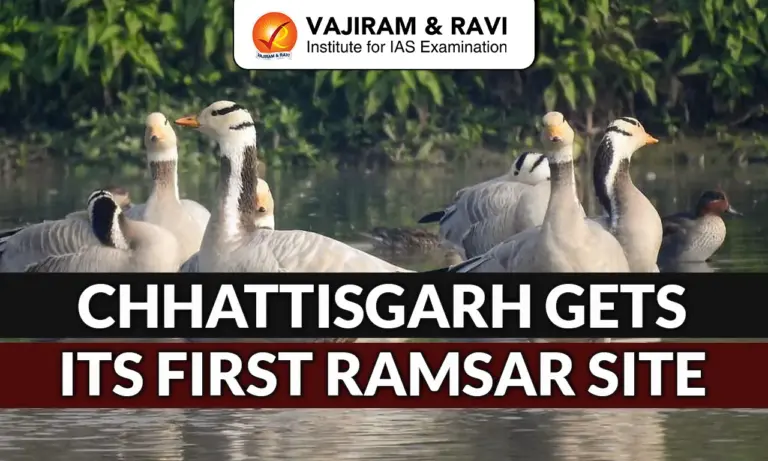
Chhattisgarh has entered India’s wetland conservation map with the declaration of Kopra Reservoir as its first Ramsar site. Ramsar recognition is given only to wetlands of international importance, and this step highlights the growing role of central Indian wetlands in biodiversity protection and climate resilience.
For Chhattisgarh, this recognition brings better protection, scientific management, and sustainable livelihood opportunities for local communities dependent on the reservoir.
Kopra Reservoir: Location and Features
Kopra Reservoir is located in the Baloda Bazar-Bhatapara district of Chhattisgarh, a region dominated by agriculture and seasonal rivers. The reservoir was originally constructed for irrigation and water storage, but over time, it developed the characteristics of a natural wetland.
Ecological Importance of Kopra Reservoir
Kopra Reservoir plays a vital role in maintaining the ecological balance of the surrounding region. Wetlands like Kopra act as natural buffers against climate-related disasters such as floods and droughts.
- Absorbs excess rainwater during monsoon and reduces flooding
- Recharges groundwater used for drinking and farming
- Regulates local temperature and humidity
- Improves water quality by trapping sediments and pollutants
- Stores carbon and helps reduce the impact of climate change





Biodiversity and Species Found in Kopra Wetland
Kopra Wetland (Jalashay) located in Bilaspur district of Chhattisgarh is an ecologically important freshwater wetland known for its rich bird diversity. The wetland supports a wide range of resident and migratory bird species due to the availability of food, nesting sites, and safe resting areas.
- Documented presence of 161 bird species, showing high avian diversity
- 103 resident species that depend on the wetland throughout the year
- 58 migratory species that use it as a seasonal stopover site
- Endangered species recorded include the Egyptian Vulture (Neophron percnopterus)
- Vulnerable species include Common Pochard, Woolly-necked Stork, and Lesser Adjutant Stork
- Near Threatened species such as Painted Stork, Black-headed Ibis, and Black-tailed Godwit
- Aquatic plants like Ipomea carnea, Otellia alismoides, and Cyperaceae species support food chains
- Surrounding tree species such as Acacia nilotica (Babool) and Ficus religiosa (Peepal) provide nesting and roosting sites
Significance of the First Ramsar Site for Chhattisgarh
- Brings international recognition to Chhattisgarh for wetland conservation under the Ramsar Convention
- Strengthens legal and policy protection for Kopra Wetland against encroachment and degradation
- Helps in scientific management and regular monitoring of the wetland ecosystem
- Conserves rich biodiversity, especially migratory and endangered bird species
- Supports climate change mitigation and adaptation by regulating floods and storing carbon
- Improves groundwater recharge and water availability for nearby villages
- Promotes eco-tourism and bird-watching, creating local employment opportunities
- Encourages community participation in conservation and sustainable livelihood activities
What is the Ramsar Convention?
The Ramsar Convention is an international environmental treaty adopted in 1971 at Ramsar, Iran, with the aim of conserving wetlands and promoting their wise and sustainable use. It recognizes wetlands as vital ecosystems for biodiversity conservation, water security, climate regulation, and human livelihoods.
India became a signatory to the Ramsar Convention in 1982, and since then has actively designated wetlands to strengthen ecological protection and biodiversity conservation.

 Last updated on March, 2026
→ UPSC Final Result 2025 is now out.
→ UPSC has released UPSC Toppers List 2025 with the Civil Services final result on its official website.
→ Anuj Agnihotri secured AIR 1 in the UPSC Civil Services Examination 2025.
→ UPSC Marksheet 2025 is now out.
→ UPSC Notification 2026 & UPSC IFoS Notification 2026 is now out on the official website at upsconline.nic.in.
→ UPSC Calendar 2026 has been released.
→ Check out the latest UPSC Syllabus 2026 here.
→ UPSC Prelims 2026 will be conducted on 24th May, 2026 & UPSC Mains 2026 will be conducted on 21st August 2026.
→ The UPSC Selection Process is of 3 stages-Prelims, Mains and Interview.
→ Prepare effectively with Vajiram & Ravi’s UPSC Prelims Test Series 2026 featuring full-length mock tests, detailed solutions, and performance analysis.
→ Enroll in Vajiram & Ravi’s UPSC Mains Test Series 2026 for structured answer writing practice, expert evaluation, and exam-oriented feedback.
→ Join Vajiram & Ravi’s Best UPSC Mentorship Program for personalized guidance, strategy planning, and one-to-one support from experienced mentors.
→ Shakti Dubey secures AIR 1 in UPSC CSE Exam 2024.
→ Also check Best UPSC Coaching in India
Chhattisgarh Gets Its First Ramsar Site FAQs
Q1. Which is the first Ramsar site of Chhattisgarh?+
Q2. In which district is Kopra Reservoir located?+
Q3. Why is Ramsar status important?+
Q4. When was the Ramsar Convention adopted?+
Q5. Which ministry oversees wetland conservation in India?+
Tags: chhattisgarh gets its first ramsar site