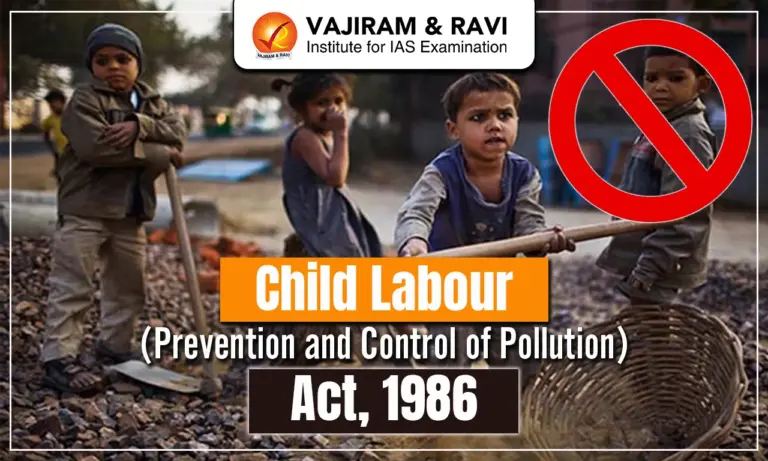
Child labour is a serious problem in India. Many children are forced to work due to poverty, lack of schools, or family pressure. To protect children, the Indian government made the Child Labour (Prohibition and Regulation) Act, 1986 (CLPRA).
The Act aims to stop children from working in dangerous jobs and regulate safe work for children in other jobs. It also connects with India’s Constitution and international agreements like ILO Conventions.
Child Labour (Prohibition and Regulation) Act, 1986 Historical Background
Child labour has been a long-standing problem in India, especially in factories, mines, and informal sectors during colonial times. After independence, India needed a specific law to protect children from exploitation and hazardous work.
- Colonial Era: Children were widely employed in factories, mines, workshops, and agriculture under poor working conditions.
- Post-Independence: Despite constitutional provisions, child labour remained widespread due to poverty and lack of education.
- Constitutional Safeguards: Articles 24, 39(e), and 45 provided legal protection for children.
- Need for a Law: Reports by labour commissions highlighted the continued exploitation of children, emphasizing the need for legislation.
- Enactment of CLPRA (1986): Introduced to prohibit employment in hazardous jobs and regulate work in non-hazardous sectors.
- International Commitments: The Act aligned India with ILO Conventions No. 138 and No. 182, promoting child rights and minimum age standards.
Also Read: Wetland (Conservation and Management) Rules 2010 & 2017
Definition of Child Labour under the Act
The Child Labour (Prohibition and Regulation) Act, 1986 defines a child as any person below 14 years of age. It prohibits children from working in hazardous occupations like mines, factories, and beedi or fireworks industries. In non-hazardous sectors, children may work under strict rules regarding hours, breaks, and safety.





Constitutional Provisions Related to Child Labour in India
The Indian Constitution provides strong protection to children by prohibiting hazardous work, promoting education, and ensuring their health and development. These provisions form the legal foundation for laws like the Child Labour (Prohibition and Regulation) Act, 1986.
| Constitutional Provisions Related to Child Labour in India | |
| Particulars | Details |
|
Constitutional Provisions |
Article 21A: Guarantees free and compulsory education for all children aged 6 to 14 years. Article 24: Prohibits employment of children under 14 in factories, mines, or any hazardous occupations. Article 39(e): Directs the State to ensure children are not forced into work harmful to health or development. Article 45: It directs the State to provide free and compulsory education to all children until they complete the age of 14 years. |
|
Committee on Child Labour |
Gurupadswamy Committee (1979): Established to study child labour in India and recommend measures for its elimination. |
|
Legislation on Child Labour |
Child Labour (Prohibition and Regulation) Act, 1986: First comprehensive law banning child labour in hazardous sectors and regulating conditions for non-hazardous work. |
|
Government Initiatives |
Operation Smile / Muskaan: Launched by the Ministry of Home Affairs to trace, rescue, and rehabilitate missing or working children. |
|
International Conventions |
ILO Convention No. 138 (1973): Minimum age for employment. ILO Convention No. 182 (1999): Prohibits worst forms of child labour.Both conventions are ratified by India and guide national policies. |
|
Other Key Measures |
Right to Education Act (2009): Ensures all rescued children are enrolled in schools. Child Protection Schemes: Various state and central programs provide financial aid, vocational training, and rehabilitation. |
Child Labour (Prohibition and Regulation) Amendment Act, 2016
- The Child Labour (Prohibition and Regulation) Amendment Act, 2016 states that the Act aims to prohibit the engagement of children in all occupations and adolescents in hazardous occupations or processes.
- The Government of India will provide stricter punishments for employers who violate the Act.
- Employing a child or adolescent in contravention of the Act is made cognizable, allowing authorities to take immediate legal action.
- The government has the power to bar the employment of adolescents in hazardous conditions to ensure their safety and welfare.
Also Read: Indian Forest Act 1927
Child Labour (Prohibition and Regulation) Amendment Rules, 2017
- The amendment provides a broad and specific framework for the prevention, prohibition, rescue, and rehabilitation of children and adolescent workers.
- It gives clarity on the engagement of children in family-run enterprises.
- Safeguards for child artists or creative workers regarding working hours and conditions are clearly defined.
- It outlines specific duties and responsibilities for law enforcement agencies to ensure effective implementation and compliance of the Act.
Child Labour (Prohibition and Regulation) Act, 1986 Impact
- Reduction in Child Labour: The Act has helped reduce the number of children employed in hazardous and formal sector occupations.
- Education Promotion: Encouraged children to attend school by restricting work that interferes with education.
- Improved Working Conditions: For adolescents legally allowed to work, the Act ensures safer working hours and conditions.
- Legal Awareness: Increased awareness among employers and society about the rights of children.
- Rehabilitation Measures: Facilitated the rescue and rehabilitation of child labourers through government schemes and NGOs.
- Monitoring and Enforcement: Empowered labour inspectors and authorities to take action against violators, making child labour a cognizable offence.
Child Labour (Prohibition and Regulation) Act, 1986 Challenges
- Widespread Informal Work: Most child labour occurs in agriculture, domestic work, and small enterprises, making enforcement difficult.
- Weak Enforcement: Few labour inspectors and low conviction rates (less than 10% cases result in conviction) reduce deterrence.
- Socio-Economic Causes: Poverty, dependence on child income, and lack of awareness among families drive children to work.
- Legal Loopholes: Exemptions for family-run non-hazardous businesses are often misused to employ children.
- Data Gaps: Latest full Census data is from 2011 (10.1 million children aged 5-14 working), and many informal workers are uncounted.
- Rehabilitation Challenges: Rescue operations (44,902 children rescued in recent years) are not always followed by sustained education or skill development.
Child Labour (Prohibition and Regulation) Act, 1986 Way Forward
- Stronger Enforcement: Increase labour inspectors and ensure strict action against those employing children.
- Education for All Children: Provide free and compulsory schooling so children do not have to work.
- Support Families: Give financial help, scholarships, and other support so families don’t rely on child income.
- Awareness Campaigns: Educate parents, employers, and communities about the dangers of child labour.
- Focus on Informal Work: Pay attention to child labour in agriculture, domestic work, small businesses, and family-run enterprises.
- Rehabilitation Programs: Help rescued children with education, skills, and counselling.
- Better Data Collection: Keep updated statistics to track child labour and plan solutions effectively.

 Last updated on April, 2026
→ UPSC Final Result 2025 is now out.
→ UPSC has released UPSC Toppers List 2025 with the Civil Services final result on its official website.
→ Anuj Agnihotri secured AIR 1 in the UPSC Civil Services Examination 2025.
→ UPSC Marksheet 2025 is now out.
→ UPSC Notification 2026 & UPSC IFoS Notification 2026 is now out on the official website at upsconline.nic.in.
→ UPSC Calendar 2026 has been released.
→ Check out the latest UPSC Syllabus 2026 here.
→ UPSC Prelims 2026 will be conducted on 24th May, 2026 & UPSC Mains 2026 will be conducted on 21st August 2026.
→ The UPSC Selection Process is of 3 stages-Prelims, Mains and Interview.
→ Prepare effectively with Vajiram & Ravi’s UPSC Prelims Test Series 2026 featuring full-length mock tests, detailed solutions, and performance analysis.
→ Enroll in Vajiram & Ravi’s UPSC Mains Test Series 2026 for structured answer writing practice, expert evaluation, and exam-oriented feedback.
→ Join Vajiram & Ravi’s Best UPSC Mentorship Program for personalized guidance, strategy planning, and one-to-one support from experienced mentors.
→ Shakti Dubey secures AIR 1 in UPSC CSE Exam 2024.
→ Also check Best UPSC Coaching in India
Child Labour (Prohibition and Regulation) Act 1986 FAQs
Q1. What is the Child Labour (Prohibition and Regulation) Act, 1986?+
Q2. Who is considered a ‘child’ under the Act?+
Q3. Who is considered an ‘adolescent’?+
Q4. What jobs are children prohibited from doing?+
Q5. Are there any exceptions?+
Tags: child labour prohibition and regulation act 1986