Child Leprosy Latest News
- India recorded 3,832 new leprosy cases among children in 2025–26, including 37 cases with Grade-2 Disability (G2D) at diagnosis — a marker of delayed detection. This child caseload is 91.6% higher than the National Leprosy Eradication Programme‘s (NLEP) target of 2,000 cases for the year.
- These figures, drawn from the latest NLEP annual report, emerge even as India pursues its National Strategic Plan for Leprosy 2023–27, which aims to interrupt transmission at the district level by 2027.
Understanding the Target Framework
- Under the national roadmap:
- A district is considered to have “interrupted transmission” after reporting zero new indigenous child cases for five consecutive years.
- NLEP’s programme objectives include:
- Zero disability among new child cases.
- A national G2D rate of less than one case per million population.
- The roadmap had projected just 1,000 child cases and a G2D rate of 0.5 per million for 2026–27 — targets the current data suggest are now far out of reach.


Why Child Cases and Disability Matter: The Epidemiological Logic
- The World Health Organisation (WHO) treats two specific indicators as critical markers of disease control progress:
- New cases among children below 15 years indicate recent transmission — since children typically wouldn’t have been infected long ago, their diagnosis signals the disease is still actively spreading.
- G2D among newly detected patients indicates delayed diagnosis — visible disability only develops after the infection has progressed significantly, meaning the patient wasn’t caught early.
- Together, WHO notes, disabilities among newly detected child cases signal both delayed detection and ongoing transmission simultaneously — making this one of the most sensitive indicators for tracking whether a leprosy programme is truly working.
A Troubling Trend Over Time
- India’s G2D figures among children, year by year:
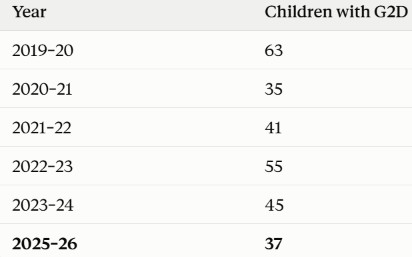
- While the latest figure (37) is lower than several earlier years, the persistent detection of children with disability — year after year — directly contradicts NLEP’s stated objective of “zero disability among new child cases.”
- This raises a fundamental question: if India is working to interrupt transmission by 2027, why are children still developing leprosy, and why are some only being diagnosed after visible disability has appeared?
The National Picture
- According to the Union Health Ministry, India detected 91,783 new leprosy cases overall in 2025–26.
- Prevalence rate: 0.56 per 10,000 population.
- 1,945 patients had Grade-2 Disability at diagnosis — 2.12% of all newly detected cases.
- National G2D rate: 1.34 per million — above the NLEP’s target of less than one case per million.
India’s Position Globally
- According to the WHO’s latest global update, India reported the world’s largest number of newly detected leprosy cases in 2025:
- India – 91,783
- Brazil – 22,901
- Indonesia – 16,292
- Together, these three countries accounted for 78.3% of all new cases reported globally.
- India also reported the world’s largest number of new child leprosy cases globally — the same 3,832 cases, with 37 children having G2D, as recorded in WHO’s table.
Where the Burden Is Concentrated
- The Health Ministry has identified specific high-priority states and districts where leprosy prevalence remains concentrated — defined as districts with a prevalence rate above one case per 10,000 population:
- Chhattisgarh: 23 districts
- Jharkhand: 21 districts
- Maharashtra: 18 districts
- Odisha: 18 districts
- Madhya Pradesh: 10 districts
- These high-endemic and hard-to-reach areas are being prioritised for intensified case detection.
The Programme’s Response Strategy
- NLEP’s current approach emphasises:
- Active case detection
- Household contact surveys
- Focused campaigns in high-burden areas
- Special plans for hard-to-reach areas
- The programme also explicitly identifies stigma and discrimination as continuing concerns that likely contribute to delayed self-reporting and diagnosis.
About the Disease
- Leprosy, also known as Hansen’s disease, is a chronic bacterial infection caused mainly by Mycobacterium leprae.
- It primarily affects the skin and peripheral nerves. Transmission occurs mainly through prolonged, close contact with an untreated person.
- Importantly, the disease is curable with multidrug therapy (MDT).
Conclusion
- The numbers tell two stories at once — overall case detection may be improving, but children are still being infected and some are still reaching diagnosis only after visible disability sets in.
- That combination points squarely at gaps in early detection and persistent transmission, not a disease in retreat.
- With 2027 just a year away, closing this gap in high-burden districts like Chhattisgarh and Jharkhand will determine whether India’s elimination goal is met or merely postponed.
Source: TH

 Last updated on Oct, 2026
→ UPSC 2027 Notification will be released on 13 January 2027 at upsconline.nic.in.
→ Check Nobel Prize 2026 Winners List here.
→ Download PIB PRiSM Monthly Magazine 2026 here.
→ Check UPSC Monthly Current Affairs Magazine The Recitals here.
→ Check out the latest UPSC Syllabus here.
→ Download UPSC Model Answers for Mains 2026
→ UPSC Mains Question Paper 2026 is out now for Essay & GS Paper 1, 2, 3 & 4.
→ UPSC Calendar 2027 has been released.
→ Enroll in Vajiram & Ravi’s UPSC Mains Test Series 2027 for structured answer writing practice, expert evaluation, and exam-oriented feedback.
→ Join Vajiram & Ravi’s UPSC Mentorship Program 2027 for personalized guidance, strategy planning, and one-to-one support from experienced mentors.
→ Go through the UPSC Mains Previous Year Papers to enhance your preparation.
→ UPSC has released UPSC Toppers List 2025 with the Civil Services final result on its official website.
→ Also check Best UPSC Coaching in India
Child leprosy FAQs
Q1. Why are child leprosy cases important for assessing disease transmission? +
Q2. How many new child leprosy cases did India report in 2025–26? +
Q3. What does Grade-2 Disability indicate among child leprosy patients? +
Q4. Which states have concentrated child leprosy and overall leprosy burdens? +
Q5. What measures are being used to address child leprosy in India? +
Tags: Child leprosy mains articles upsc current affairs upsc mains current affairs