China Brahmaputra Dam Latest News
- China has officially started building a massive $167.8 billion hydropower dam on the Brahmaputra River, near the Indian border in Arunachal Pradesh.
- The groundbreaking ceremony was attended by Premier Li Qiang. Once completed, this will be the world’s largest dam.
- The project has raised concerns in India and Bangladesh over its potential impact on the river’s natural flow and downstream water availability.
Arunachal Raises Alarm Over China’s Brahmaputra Dam Project
- China’s construction of a massive 60,000 MW hydropower dam on the Yarlung Zangbo (Brahmaputra) near the “Great Bend” in Tibet, just before the river enters Arunachal Pradesh as the Siang, has sparked serious concerns in India.
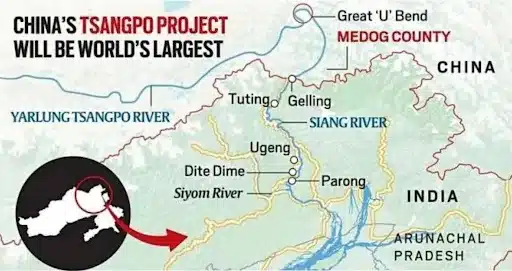
- Arunachal Pradesh Chief Minister has called it an “existential threat” and likened the project to a potential “water bomb” that could devastate tribal communities and local livelihoods.
- He warned that sudden water release could flood the entire Siang region and drastically reduce river flow in the long term.
- Experts echo these fears, citing risks of flooding from dam operations, as well as the danger posed by the seismically active and ecologically fragile zone where the dam is being built.
- The project raises broader environmental and geopolitical anxieties for downstream countries like India and Bangladesh.





China’s Brahmaputra Dam: The View From Assam
- Assam Chief Minister has downplayed immediate concerns about China’s dam on the Brahmaputra, highlighting that the river becomes a major waterway only after entering Assam, where it is nourished by tributaries from Bhutan, Arunachal Pradesh, and heavy monsoon rains.
- He noted that China’s contribution to the Brahmaputra’s flow is limited—about 30–35%—mostly from glacial melt and Tibetan rainfall.
- He suggested that even if China were to reduce water flow, it might help manage Assam’s annual floods.
- Still, he acknowledged the existence of multiple theories about the dam’s impact and expressed confidence that the central government is either already engaged in talks with China or will initiate discussions soon.
India’s Cautious Response to China’s Brahmaputra Dam Project
- India has not issued an official response to the recent groundbreaking ceremony of China’s massive dam on the Brahmaputra River, but continues to closely monitor the developments.
- The Ministry of External Affairs (MEA) has reiterated India’s concerns as a lower riparian state with established rights, emphasizing the need for transparency and consultation with downstream countries like India and Bangladesh.
- MEA had underscored India’s position in January, urging China to avoid actions that could harm downstream interests.
- In contrast, China has maintained that the project falls within its sovereign rights and assured ongoing cooperation with downstream nations on hydrological data and disaster management.
Diplomatic Efforts on Multiple Fronts
- Diplomatic efforts between India and China have continued on multiple fronts.
- In October 2024, both nations had agreed on patrolling arrangements along the LAC to resolve past tensions.
- Additionally, talks in March 2025 included discussions on cross-border cooperation, including river management.
- India also resumed issuing tourist visas to Chinese nationals recently and restarted the Kailash Mansarovar Yatra, signaling a cautious yet active engagement despite the concerns surrounding the dam project.
India’s Mitigation Strategy Amid China’s Brahmaputra Dam Concerns
- Experts recommend scientific assessment and capacity-building to anticipate any deliberate Chinese actions.
- They have proposed constructing storage infrastructure on Brahmaputra tributaries to manage erratic flows.
- The Upper Siang project in Arunachal Pradesh, with a 300-metre-high dam, is considered crucial both for hydropower and as a buffer against sudden water releases, although local opposition over environmental concerns has delayed progress.
- Additional strategies include developing inland channels for excess water diversion and pursuing long-term interlinking projects between the Brahmaputra and Ganga basins, as proposed by the National Water Development Authority.
- On the diplomatic front, experts advocate for continuous access to hydrological and project data from China, while also urging coordination with downstream neighbours like Bangladesh, Bhutan, and Myanmar to establish protocols for early warning and disaster preparedness.

 Last updated on March, 2026
→ UPSC Final Result 2025 is now out.
→ UPSC has released UPSC Toppers List 2025 with the Civil Services final result on its official website.
→ Anuj Agnihotri secured AIR 1 in the UPSC Civil Services Examination 2025.
→ UPSC Marksheet 2025 is now out.
→ UPSC Notification 2026 & UPSC IFoS Notification 2026 is now out on the official website at upsconline.nic.in.
→ UPSC Calendar 2026 has been released.
→ Check out the latest UPSC Syllabus 2026 here.
→ UPSC Prelims 2026 will be conducted on 24th May, 2026 & UPSC Mains 2026 will be conducted on 21st August 2026.
→ The UPSC Selection Process is of 3 stages-Prelims, Mains and Interview.
→ Prepare effectively with Vajiram & Ravi’s UPSC Prelims Test Series 2026 featuring full-length mock tests, detailed solutions, and performance analysis.
→ Enroll in Vajiram & Ravi’s UPSC Mains Test Series 2026 for structured answer writing practice, expert evaluation, and exam-oriented feedback.
→ Join Vajiram & Ravi’s Best UPSC Mentorship Program for personalized guidance, strategy planning, and one-to-one support from experienced mentors.
→ Shakti Dubey secures AIR 1 in UPSC CSE Exam 2024.
→ Also check Best UPSC Coaching in India
China Brahmaputra Dam FAQs
Q1. What is the Brahmaputra dam project in China?+
Q2. Why is Arunachal Pradesh worried?+
Q3. What is Assam’s view on the dam?+
Q4. How has India responded diplomatically?+
Q5. What are India’s mitigation strategies?+
Tags: China Brahmaputra dam mains articles upsc current affairs upsc mains current affairs