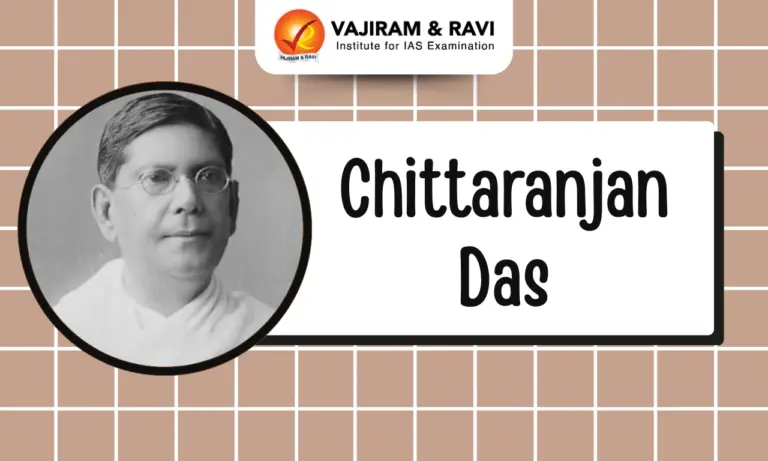
Chittaranjan Das, popularly known as “Deshbandhu”, was a prominent leader of India’s freedom struggle who worked tirelessly for the country’s independence. He played a key role in spreading nationalist ideas and political awareness, especially in Bengal. Apart from being a political leader, he was also a respected lawyer and social reformer who believed in unity and self-governance. Overall, he is remembered for his strong commitment to democratic values and the cause of national freedom.
Chittaranjan Das Early Life & Education
- Chittaranjan Das (1870-1925), popularly known as “Deshbandhu”, was born in Calcutta in an educated and reform-oriented family that valued learning and social service.
- His father, Bhuban Mohan Das, was a reputed lawyer and a member of the Brahmo Samaj, which influenced Das towards progressive thinking and reformist ideas.
- He received his early education in Calcutta and later studied at Presidency College, where he developed an interest in literature, politics, and public speaking.
- He went to England to prepare for the I.C.S., but after not succeeding, he chose to pursue law at the Inner Temple, shaping his future career.
- During his student life, he was influenced by leaders like Surendranath Banerjee and writers like Bankim Chandra Chattopadhyay, which shaped his nationalist outlook.
Chittaranjan Das Legal Career & Rise to Fame
- After returning to India, he started practicing at the Calcutta High Court and soon became known for his sharp legal mind and persuasive arguments.
- His major breakthrough came when he defended Aurobindo Ghose in the Alipore Bomb Case (1908), leading to Aurobindo’s acquittal and bringing Das into national prominence.
- He also handled important cases like the Dacca Conspiracy Case, showcasing his expertise in both civil and criminal law.
- Within a short time, he built a highly successful and lucrative legal practice, becoming one of the leading lawyers of his time.
- His courtroom skills and commitment to justice earned him wide respect among both the public and the legal community.


Chittaranjan Das Entry into Politics & National Movement
- Though he joined the Indian National Congress earlier, he became actively involved in politics around 1917, quickly emerging as a mass leader in Bengal.
- He strongly opposed colonial laws like the Rowlatt Act (1919) and supported nationwide protests against British repression.
- He actively participated in the Non-Cooperation Movement (1920) and made significant personal sacrifices, including giving up his profitable legal career.
- He adopted a simple lifestyle, symbolizing his commitment to the national cause, and even encouraged his family members to participate in the movement.
- His leadership helped mobilize youth, students, and common people, turning the freedom struggle into a mass movement.
Chittaranjan Das Political Ideas & Contributions
- He strongly believed in “Swaraj for the masses, not for the classes”, emphasizing that freedom should benefit all sections of society.
- He supported Hindu-Muslim unity and introduced the Bengal Pact (1923) to reduce communal tensions and promote cooperation.
- He emphasized the importance of national education, especially through vernacular languages, so that common people could actively participate in the freedom movement.
- He advocated social reforms such as women’s education, widow remarriage, and removal of untouchability, showing his progressive outlook.
- He believed in constitutional and non-violent methods, but also supported active political participation to challenge British rule.
Swaraj Party & Leadership Role
- Along with Motilal Nehru and others, he founded the Swaraj Party in 1923 to enter legislative councils and oppose colonial policies from within.
- The party achieved significant success in elections and became an important voice against British governance inside the councils.
- In 1924, he became the first elected Mayor of Calcutta, marking a major step in local self-governance.
- As Mayor, he introduced reforms in public health, sanitation, education, and urban infrastructure, aiming to improve living conditions.
- He also worked towards making the administration more efficient, transparent, and people-oriented.
Chittaranjan Das Literary Contributions & Journalism
- Apart from politics, he was a talented poet, writer, and thinker, contributing to India’s intellectual and cultural life.
- He published and edited the newspaper ‘Forward’, which became the mouthpiece of the Swaraj Party and influenced political opinion.
- He was associated with journals like ‘Bande Mataram’, helping spread nationalist ideas among the masses.
- His literary works, including ‘Mala’, ‘Antaryami’, and ‘Kishore Kishori’, reflect his creative and philosophical side.
- Through his writings, he aimed to awaken national consciousness and inspire people towards freedom.
Chittaranjan Das Values, Personality & Legacy
- He is remembered for his patriotism, sacrifice, leadership, and dedication to public service, which made him a beloved national figure.
- His life reflected strong values of unity, social justice, and democratic ideals, influencing future leaders.
- He believed in inclusive nationalism, where all communities could work together for a common goal.
- His sacrifices, including donating his wealth for public causes, showed his selflessness and commitment.
- Leaders like Rabindranath Tagore praised him for his vision and inspiring personality, which left a lasting impact.
Chittaranjan Das Death & Historical Importance
- Chittaranjan Das passed away on 16 June 1925 in Darjeeling, at a relatively young age, cutting short a powerful political career.
- Despite his short active period in politics, he became one of the most influential leaders of Bengal and the national movement.
- His role in shaping mass politics, legislative opposition, and communal harmony remains highly significant.
- He is remembered as a bridge between moderate and extremist approaches, combining idealism with practical politics.
- His legacy continues to inspire India’s democratic and nationalist traditions, making him a key figure in modern Indian history.

 Last updated on Oct, 2026
→ UPSC 2027 Notification will be released on 13 January 2027 at upsconline.nic.in.
→ Check Nobel Prize 2026 Winners List here.
→ Download PIB PRiSM Monthly Magazine 2026 here.
→ Check UPSC Monthly Current Affairs Magazine The Recitals here.
→ Check out the latest UPSC Syllabus here.
→ Download UPSC Model Answers for Mains 2026
→ UPSC Mains Question Paper 2026 is out now for Essay & GS Paper 1, 2, 3 & 4.
→ UPSC Calendar 2027 has been released.
→ Enroll in Vajiram & Ravi’s UPSC Mains Test Series 2027 for structured answer writing practice, expert evaluation, and exam-oriented feedback.
→ Join Vajiram & Ravi’s UPSC Mentorship Program 2027 for personalized guidance, strategy planning, and one-to-one support from experienced mentors.
→ Go through the UPSC Mains Previous Year Papers to enhance your preparation.
→ UPSC has released UPSC Toppers List 2025 with the Civil Services final result on its official website.
→ Also check Best UPSC Coaching in India
Chittaranjan Das FAQs
Q1. Who was Chittaranjan Das?+
Q2. Why is Chittaranjan Das called “Deshbandhu”?+
Q3. What was Chittaranjan Das’s role in the freedom struggle?+
Q4. What is the Swaraj Party and what was his role in it?+
Q5. What was his contribution as a lawyer?+
Tags: chittaranjan das history history notes