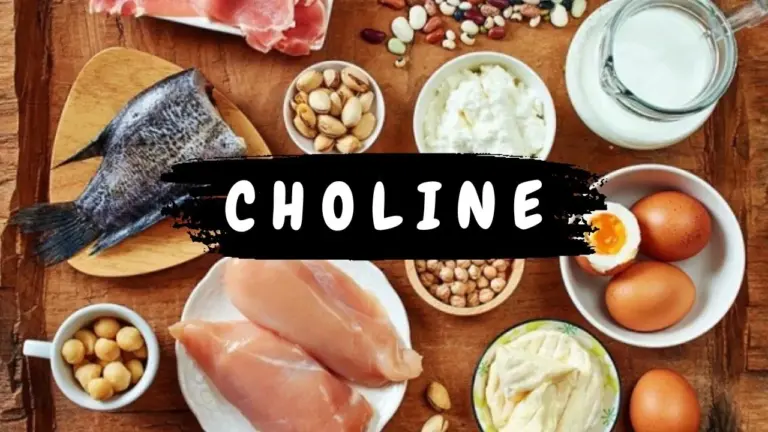
About Choline:
- It is an essential nutrient that supports various bodily functions, including cellular growth and metabolism.
- It exists as both water-soluble and fat-soluble molecules. The body transports and absorbs choline differently depending on its form.
- The body can also produce small amounts of choline on its own in the liver, but not enough to meet daily needs. As a result, humans must obtain some choline from the diet.
- The richest dietary sources of choline are meat, fish, dairy, and eggs. Many fruits, vegetables, and whole grains contain choline as well.
- Functions:
- Cell structure: It is a constituent of an important class of lipids (fats) called phospholipids (e.g., lecithin), which form structural elements of cell membranes. Therefore, all plant and animal cells need choline to preserve their structural integrity.
- It serves as a source of the methyl groups (―CH3 groups), which are required in various metabolic processes.
- Liver Health: Choline is also required to clear cholesterol from your liver. Deficiencies cause fat and cholesterol accumulation in your liver, which puts you at risk for nonalcoholic fatty liver disease.
- A healthy nervous system: This nutrient is required to make acetylcholine, an important neurotransmitter. It’s involved in memory, muscle movement, regulating the heartbeat, and other basic functions.
- Choline also plays important roles in modulating gene expression, cell membrane signaling, lipid transport and metabolism, and early brain development.
- It is also “food” for beneficial gut bacteria.
Choline deficiency can lead to health conditions, such as cardiovascular disease and muscular damage.
Q1: What are neurotransmitters?
Neurotransmitters are chemical messengers that your body can’t function without. Their job is to carry chemical signals (“messages”) from one neuron (nerve cell) to the next target cell. The next target cell can be another nerve cell, a muscle cell or a gland.
Source: UQ research finds molecular doorways to help deliver drugs into the brain






 Last updated on March, 2026
→ UPSC Final Result 2025 is now out.
→ UPSC has released UPSC Toppers List 2025 with the Civil Services final result on its official website.
→ Anuj Agnihotri secured AIR 1 in the UPSC Civil Services Examination 2025.
→ UPSC Marksheet 2025 is now out.
→ UPSC Notification 2026 & UPSC IFoS Notification 2026 is now out on the official website at upsconline.nic.in.
→ UPSC Calendar 2026 has been released.
→ Check out the latest UPSC Syllabus 2026 here.
→ UPSC Prelims 2026 will be conducted on 24th May, 2026 & UPSC Mains 2026 will be conducted on 21st August 2026.
→ The UPSC Selection Process is of 3 stages-Prelims, Mains and Interview.
→ Prepare effectively with Vajiram & Ravi’s UPSC Prelims Test Series 2026 featuring full-length mock tests, detailed solutions, and performance analysis.
→ Enroll in Vajiram & Ravi’s UPSC Mains Test Series 2026 for structured answer writing practice, expert evaluation, and exam-oriented feedback.
→ Join Vajiram & Ravi’s Best UPSC Mentorship Program for personalized guidance, strategy planning, and one-to-one support from experienced mentors.
→ Shakti Dubey secures AIR 1 in UPSC CSE Exam 2024.
→ Also check Best UPSC Coaching in India