Circular Economy Latest News
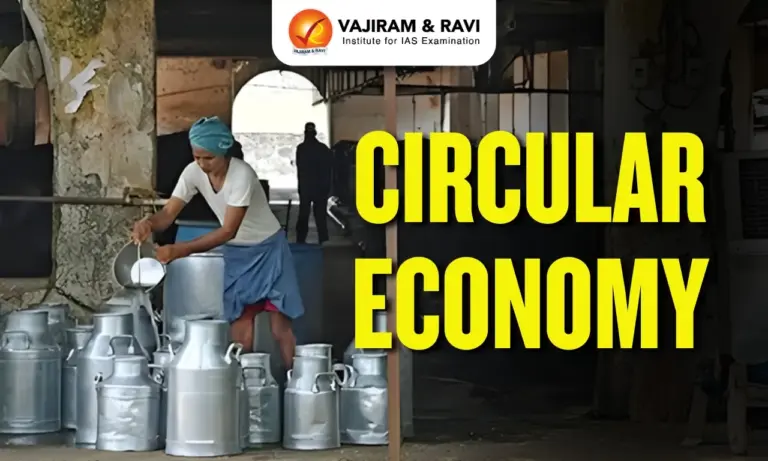
- The Union Home and Cooperation Minister, during an event at Sanadar village, Vav-Tharad district (Gujarat), highlighted the potential of a circular economy model in the dairy sector to raise farmers’ income by 20% in the next five years.
- The event marked the inauguration of Banas Dairy’s bio-CNG and fertiliser plant and the groundbreaking of its milk-powder plant.
- Banas Dairy—Asia’s largest dairy cooperative—serves as a national model under the vision of White Revolution 2.0.
Circular Economy (CE)
- Meaning: It is a system shifting from “take-make-dispose” to keeping resources in use longer via reuse, repair, refurbishing, and recycling, aiming to eliminate waste and regenerate nature.
- Key features:
- Closed-loop system: Designs out waste and pollution, keeps products and materials in use, and regenerates natural systems.
- Contrast to linear model: Moves away from consuming resources, making products, and discarding them.
- Key actions: Involves sharing, leasing, repairing, refurbishing, remanufacturing, and recycling.
- Initiatives in India: India promotes CE through policies like the-
- Vehicle Scrappage Policy,
- Mission LiFE for behavioural change,
- Promoting bio-CNG/fertilizer plants (like Banas Dairy’s model), and
- Initiatives under Swachh Bharat, focusing on resource efficiency, waste-to-wealth, and sustainable consumption.





The Circular Economy Model in Dairy
- Towards a sustainable dairy economy:
- India’s dairy sector has historically focused on milk procurement and processing.
- The emphasis is now shifting to resource efficiency, waste-to-wealth, and diversification of dairy products.
- The circular economy model: It represents a major structural reform linked to income enhancement, rural livelihoods, climate action, and cooperative federalism.
- Waste-to-wealth approach:
- Example, from cattle dung to biogas (bio-CNG) and bio-fertiliser.
- It provides additional income streams to farmers, and reduces reliance on chemical fertilisers and fossil fuels, aiding energy security and soil health.
- Dairy product diversification:
- Global demand exists for several value-added dairy products not widely produced in India.
- Diversification into global dairy products, milk powder, nutraceuticals, and specialty cheeses can boost exports.
- It supports MSME growth, rural supply chains, and Make in India.
- Leather from naturally deceased cattle:
- Use of cattle hides from naturally deceased animals within a regulated, cooperative-based system.
- Envisaged as part of the circular model to prevent waste and generate farmer income.
Role of Banas Dairy as a National Model
- Asia’s largest dairy cooperative: With an annual turnover of ₹24,000 crore, it demonstrates integrated circular systems – bio-CNG plant, organic fertiliser production, milk-processing and powder plant expansion.
- Capacity building and knowledge sharing: MPs were invited to Banaskantha to study the circular model for national replication. The chairpersons/MDs of major cooperative dairies will visit Banas Dairy for model adoption.
Government Interventions and Institutional Support
- Strengthening the cooperative structure: Creation of three agriculture cooperatives and three dairy cooperatives by the Union Government. Policy push under Ministry of Cooperation.
- Financial and technological support: The Indian government has ensured a system where dairies receive –
- Affordable finance
- Advanced technology
- Regulatory and institutional backing
- Alignment with national initiatives: Supporting White Revolution 2.0, Doubling Farmers’ Income, Atmanirbhar Bharat, Circular Economy Mission, etc.
Women’s Role in the Dairy Sector
- Women dairy farmers in arid Gujarat have shown remarkable entrepreneurship.
- Their income is directly credited to bank accounts, reflecting –
- Financial inclusion
- Women-led development
- Demonstration effect for global NGOs advocating women empowerment
Challenges and Way Forward
- Technological readiness: Small dairies may lack access to biogas plants and modern processing facilities. Promoting scaling circular economy plants across all major cooperative dairies.
- Initial capital costs for waste-to-energy infrastructure: Dedicated funds for renewable energy and bio-fertiliser plants under NABARD and cooperative banks.
- Training and skilling requirements for rural dairy communities: Skill training for farmers in waste management, organic fertiliser use, and value addition.
- Market linkages and export standards for global dairy products: Promotion of niche/global dairy products for exports under APEDA.
- Logistics and cold chain gaps in remote areas: Strengthening women-led dairy cooperatives as part of Lakhpati Didi and SHG models. Improving cold chain infrastructure through PPPs and FPOs.
- Regulation of leather from natural death cattle: Ensure ethical and legal compliance.
Conclusion
- The circular economy model in the dairy sector marks a transformational shift under White Revolution 2.0, aligning sustainability with rural prosperity.
- As India aims to boost farmers’ income and position itself as a global dairy leader, Banas Dairy’s success illustrates the potential for scalable, inclusive, and environmentally sustainable growth in the dairy economy.
Source: TH

 Last updated on March, 2026
→ UPSC Final Result 2025 is now out.
→ UPSC has released UPSC Toppers List 2025 with the Civil Services final result on its official website.
→ Anuj Agnihotri secured AIR 1 in the UPSC Civil Services Examination 2025.
→ UPSC Marksheet 2025 is now out.
→ UPSC Notification 2026 & UPSC IFoS Notification 2026 is now out on the official website at upsconline.nic.in.
→ UPSC Calendar 2026 has been released.
→ Check out the latest UPSC Syllabus 2026 here.
→ UPSC Prelims 2026 will be conducted on 24th May, 2026 & UPSC Mains 2026 will be conducted on 21st August 2026.
→ The UPSC Selection Process is of 3 stages-Prelims, Mains and Interview.
→ Prepare effectively with Vajiram & Ravi’s UPSC Prelims Test Series 2026 featuring full-length mock tests, detailed solutions, and performance analysis.
→ Enroll in Vajiram & Ravi’s UPSC Mains Test Series 2026 for structured answer writing practice, expert evaluation, and exam-oriented feedback.
→ Join Vajiram & Ravi’s Best UPSC Mentorship Program for personalized guidance, strategy planning, and one-to-one support from experienced mentors.
→ Shakti Dubey secures AIR 1 in UPSC CSE Exam 2024.
→ Also check Best UPSC Coaching in India
Circular Economy FAQs
Q1. What is the significance of adopting a circular economy model in India’s dairy sector?+
Q2. How does Banas Dairy serve as a model for White Revolution 2.0?+
Q3. What is the role of cooperative institutions in enhancing dairy farmers’ income?+
Q4. Why is diversification into global dairy products important for India’s dairy sector?+
Q5. What is the contribution of women dairy farmers to the dairy sector’s transformation in arid regions of Gujarat?+
Tags: circular economy mains articles upsc current affairs upsc mains current affairs