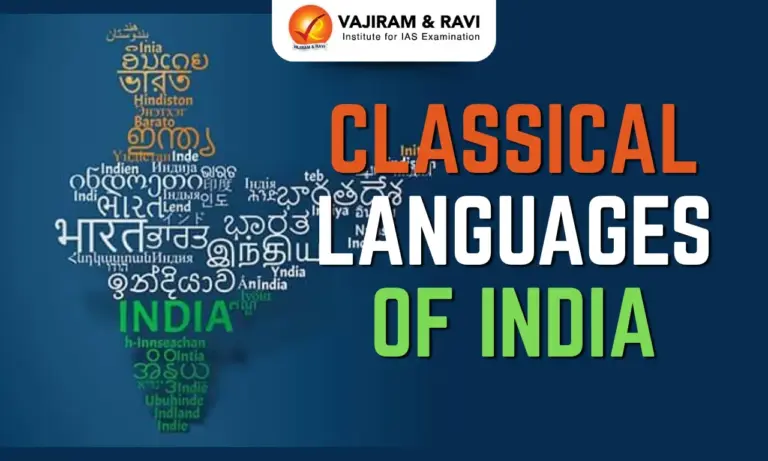
India has a very old and diverse linguistic tradition, with many languages contributing to its cultural identity. The government recognises this heritage by granting Classical Language status to languages that show high antiquity, deep literary traditions, and historical value. This status helps preserve ancient knowledge for future generations. On October 3, 2024, the government added Marathi, Pali, Prakrit, Assamese, and Bengali to the Classical list. With these additions, India now has eleven officially recognised Classical Languages as of October 2025.
Classical Languages of India
Classical Languages of India represent the country’s oldest linguistic roots, containing some of the world’s earliest texts, inscriptions, and philosophical works. These languages have shaped literature, religion, science, mathematics, arts, and governance for thousands of years. Their recognition strengthens cultural continuity and encourages academic research. Six languages were recognised as Classical between 2004 and 2014, and five more were added in 2024. Together, these eleven languages reflect the country’s strong commitment to safeguarding its ancient intellectual and cultural heritage.
Also Read: Longest Rivers in India
Classical Languages of India List
India has eleven Classical Languages recognised for their antiquity, literature, and cultural value. The list below shows their year of recognition, historic time, language family, branch, and their living or dead status.
| Classical Languages of India | ||||||
|
Serial |
Language |
Year of Recognition |
Historic Attribution Time |
Language Family |
Language Branch |
Living/Dead |
|
1 |
Tamil |
2004 |
300 BCE-700 CE |
Dravidian |
South Dravidian |
Living |
|
2 |
Sanskrit |
2005 |
~1500 BCE |
Indo-European |
Indo-Aryan |
Dead |
|
3 |
Kannada |
2008 |
450-1200 CE |
Dravidian |
South Dravidian |
Living |
|
4 |
Telugu |
2008 |
575 CE |
Dravidian |
South-Central Dravidian |
Living |
|
5 |
Malayalam |
2013 |
~830 CE |
Dravidian |
South Dravidian |
Living |
|
6 |
Odia |
2014 |
600-700 CE |
Indo-European |
Eastern Indo-Aryan |
Living |
|
7 |
Assamese |
2024 |
600-700 CE |
Indo-European |
Eastern Indo-Aryan |
Living |
|
8 |
Bengali |
2024 |
600-700 CE |
Indo-European |
Eastern Indo-Aryan |
Living |
|
9 |
Marathi |
2024 |
500-700 CE |
Indo-European |
Southern Indo-Aryan |
Living |
|
10 |
Pali |
2024 |
300-100 BCE |
Indo-European |
Middle Indo-Aryan |
Dead |
|
11 |
Prakrit |
2024 |
500-100 BCE |
Indo-European |
Middle Indo-Aryan |
Dead |





What are Classical Languages of India?
The Classical Languages of India include Tamil, Sanskrit. Kannada, Telugu, Malayalam, Odia, Assamese, Bengali, Marathi, Pali and Prakrit:
Tamil
Tamil, recognised in 2004 as India’s first Classical Language, has one of the world’s longest continuous literary traditions. Its early texts date between 300 BCE and 700 CE. Tamil belongs to the Dravidian family and preserves ancient Sangam literature, grammar, poetry, and philosophy. Works like Tolkappiyam and the Sangam poems show the richness of early Tamil culture. Tamil inscriptions, manuscripts, and classical texts provide strong evidence of its antiquity and influence on South Indian society, arts, administration, and temple traditions.
Sanskrit
Sanskrit, recognised as a Classical Language in 2005, dates back to around 1500 BCE with Vedic literature. It is one of the world’s oldest Indo-European languages and contains sacred Hindu texts like the Vedas, Upanishads, epics, and philosophical works. Sanskrit shaped early Indian knowledge systems, including mathematics, astronomy, grammar, and medicine. Though considered a dead spoken language, it continues to thrive in scholarship, rituals, and classical studies. Its influence extends to many modern Indian languages due to its foundational literary and linguistic structure.
Kannada
Kannada, recognised as a Classical Language in 2008, has early records from 450-1200 CE. As a major Dravidian language, it carries a strong literary tradition reflected in inscriptions, poetry, and philosophical works. Old Kannada appears in Halmidi inscription and early literary compositions. Kannada later expanded with great writers, philosophers, and poets who shaped its cultural growth. Today, classical Kannada studies continue through Centres of Excellence, preserving manuscripts, editing texts, and promoting academic research to maintain the language’s historical and literary continuity across centuries.
Telugu
Telugu, recognised as a Classical Language in 2008, has written records from 575 CE. As a South-Central Dravidian language, it has a deep heritage built through poetry, philosophy, temple inscriptions, and grammatical works. Early grammar texts like Andhra Sabda Chintamani and prosody works like Kavijanasramam provide strong evidence of Telugu’s antiquity. The Centre for Classical Telugu has documented nearly 10,000 classical works, inscriptions, and temple records. Telugu continues to reflect cultural continuity while preserving ancient literary works for research and education.
Malayalam
Malayalam, granted Classical Language status in 2013, emerged around 830 CE. It is a Dravidian language with deep connections to early Tamil and later developed its own grammar, script, and literature. Classical Malayalam texts include poems, commentaries, and literary works written on palm leaves and stone inscriptions. The Centre for Classical Malayalam at Tirur works to preserve manuscripts, inscriptions, and ancient texts. Malayalam’s classical tradition remains influential in literature, performing arts, temple culture, and Kerala’s historical identity shaped across centuries.
Odia
Odia, recognised in 2014, has early works from the 600-700 CE period. As an Eastern Indo-Aryan language, Odia evolved with a strong literary and cultural base seen in inscriptions, mural paintings, palm-leaf manuscripts, and Apabhramsa forms. Classical Odia literature includes philosophical, religious, and poetic works. The Centre for Classical Odia works on documenting inscriptions, manuscripts, and archaeological sources. This strengthens the understanding of Odia’s long-standing heritage and its major contribution to eastern India’s intellectual, artistic, and cultural development.
Assamese
Assamese, recognised in 2024, traces its origin to Magadhi Apabhramsa, with development beginning around the 7th century AD. Its early influence is found in the Charyapadas, which show linguistic features of Assamese. Assamese evolved through inscriptions, literary works, and socio-cultural traditions of the Brahmaputra valley. The language has links with Bengali and Odia due to shared origins in Eastern Indo-Aryan languages. As one of India’s oldest regional languages, Assamese preserves heritage through poetry, texts, and historical sources reflecting early regional identity.
Bengali
Bengali, recognised in 2024, developed from Magadhi Prakrit and Apabhramsa traditions. With early records from 600-700 CE, Bengali later produced great literary works, including Charyapadas, epics, devotional literature, and modern writings. Bengal’s 19th and 20th century figures like Rabindranath Tagore, Bankim Chandra, and others shaped India’s national consciousness. Bengali literature contributed slogans like Jai Hind and Vande Mataram and produced India’s national anthem and national song. Its literary heritage influenced political, social, and intellectual movements across India for centuries.
Marathi
Marathi, recognised in 2024, has early roots from 500-700 CE and evolved from Maharastri Prakrit and Apabhramsa forms. With nearly 110 million speakers, it is one of the world’s major languages. Ancient inscriptions like the Naneghata inscription show its antiquity. Works like Gathasaptasati, Lilacharitra, and Jnanesvari reflect strong literary traditions. Marathi literature includes devotional works by saints like Dnyaneshwar, Namdev, and Tukaram. Its historical continuity makes Marathi one of India’s most culturally influential and linguistically rich languages.
Pali
Pali, given Classical status in 2024, dates back to 300-100 BCE. It is central to Buddhist literature, containing the entire Tipitaka, including Vinaya, Sutta, and Abhidhamma Pitakas. Pali was used by Buddha to deliver sermons, making it crucial for understanding ancient Indian thought. Jataka tales, inscriptions, and canonical texts preserve early social, ethical, and philosophical traditions. Although a dead language, Pali is studied globally in Buddhist countries, enabling reconstruction of ancient Indian history and spiritual traditions across Asia.
Prakrit
Prakrit, recognised in 2024, dates back to 500-100 BCE and represents a group of Middle Indo-Aryan languages. It shaped many modern Indian languages and appears in inscriptions of Ashoka, Kharavela, and early literary works. Scholars like Panini, Vararuchi, and Bharatmuni recognised Prakrit’s importance. Prakrit was used by Buddha and Mahavira to communicate with ordinary people. It influenced poetry, drama, philosophy, and sciences like astronomy and botany. Understanding Prakrit is essential to trace India’s linguistic, cultural, and literary evolution.
Also Read: National Symbols of India
Classical Languages of India Contributions
Classical Languages of India have contributed greatly to literature, philosophy, culture, and knowledge systems for thousands of years.
1. Tamil Contributions
Tamil has one of the world’s oldest continuous literary traditions, with texts dating over 2000 years. Key Contributions:
- Sangam literature covering ethics, society, polity, and early Tamil culture.
- Tirukkural offering universal moral teachings.
- Devotional works of Alvars and Nayanmars shaping Bhakti philosophy.
- Rich grammar tradition through Tolkappiyam.
- Strong influence on art, temple inscriptions, and performing traditions.
2. Sanskrit Contributions
Sanskrit shaped Indian knowledge systems for over 3000 years through extensive philosophical, scientific, and literary works. Key Contributions:
- Vedas, Upanishads, and Puranas forming core Indian thought.
- Classical dramas like Kalidasa’s works.
- Foundational texts on astronomy, mathematics, medicine, and grammar (Panini’s Ashtadhyayi).
- Rich epics- Ramayana and Mahabharata influencing society and culture.
- Preserved in thousands of manuscripts across the country.
3. Telugu Contributions
Telugu has a millennium-old literary tradition with a strong poetic and courtly culture. Key Contributions:
- Early copper plate inscriptions demonstrating linguistic maturity.
- Classical poets like Nannaya, Tikkana, Errana shaping Telugu Mahabharata.
- Rich devotional and musical literature under Vijayanagara rulers.
- Development of classical prosody and distinctive musical metres.
- Major contribution to temple inscriptions and regional histories.
4. Kannada Contributions
Kannada literature spans over 1500 years, beginning with early inscriptions and Jain poetic works. Key Contributions:
- Kavirajamarga (850 CE) establishing early literary norms.
- Rich Jain literature emphasising philosophy and poetry.
- Medieval works by Pampa, Ranna, and Ponna forming the “three gems.”
- Vachana movement of Basavanna promoting social reform.
- Extensive inscriptional heritage contributing to historical knowledge.
5. Malayalam Contributions
Malayalam evolved from the western coastal dialects of Old Tamil and later developed its independent script and literature. Key Contributions:
- Earliest Ramacharitam showing linguistic transition.
- Manipravalam literature combining Tamil and Sanskrit influences.
- Devotional poetry by Cherusseri and Ezhuthachan.
- Advanced grammatical works like Lilatilakam.
- Strong literary modernism from 19th century onward.
6. Odia Contributions
Odia has a documented history of more than 1500 years, with inscriptions and texts showing early maturity. Key Contributions:
- Early Charyapada links demonstrating antiquity.
- Sarala Mahabharata shaping Odia literary and cultural identity.
- Works of Jagannath Das deeply influencing devotional tradition.
- Temple inscriptions of Odisha preserving socio-political history.
- Rich medieval poetry and philosophical writings.
7. Marathi Contributions
Marathi’s literary history spans over a thousand years, with roots going back 2500 years through Maharastri Prakrit and Apabhramsa. Key Contributions:
- Gathasaptasati (1st century CE), one of the earliest poetic works.
- Mature literature through Lilacharitra and Jnanesvari.
- Numerous inscriptions, plates, and manuscripts showing early use.
- Naneghata inscription proving ancient antiquity.
- References in Vinayapitaka, Dipavamsa, Mahavamsa, and works of Kalidasa.
- Rich Bhakti literature by Sant Dnyaneshwar, Namdev, Tukaram.
8. Pali Contributions
Pali played a central role in spreading Buddhist philosophy and documenting Indian cultural history. Key Contributions:
- Buddha’s sermons forming the foundation of the language’s significance.
- Complete Buddhist canon (Tipitaka) preserved in Pali.
- Vinaya Pitaka laying monastic rules.
- Sutta Pitaka preserving philosophical dialogues.
- Abhidhamma Pitaka analysing knowledge, ethics, and mind.
- Jataka tales illustrating moral and cultural traditions.
- Primary source for reconstructing early Indian history.
9. Prakrit Contributions
Prakrit shaped major Indian languages and preserved cultural and philosophical traditions. Key Contributions:
- Grammar shaped by scholars like Panini, Vararuchi, Samantbhadra.
- Used by Buddha and Mahavira to communicate with masses.
- Significant role in drama, poetry, philosophy, and sciences.
- Influenced linguistic development of Hindi, Bengali, Marathi.
- Inscriptions from Ashoka, Kharavela, and pre-Mauryan rulers preserved in Prakrit.
- Recognized in Bharatmuni’s Natyashastra as language of common people.
10. Assamese Contributions
Assamese evolved from Magadhi Apabhramsa and developed a strong literary heritage. Key Contributions:
- Charyapadas showing early Assamese vocabulary and structure.
- Strong link with other eastern Indo-Aryan languages.
- Growth in Assam valley from early medieval period.
- Rich script and manuscript tradition.
- Words, phonetics, and morphology preserved in modern Assamese.
- Katha Gurucharit offering early references.
11. Bengali Contributions
Bengali possesses a vibrant literary tradition with deep cultural and political influence. Key Contributions:
- Charyapada hymns (8th-12th century) forming early base.
- Translations of Sanskrit epics marking early literature.
- Bhakti movement led by Chaitanya shaping religious literature.
- Masters like Mukunda Ram, Bharat Chandra shaping medieval works.
- Reformers like Raja Ram Mohan Roy and Vidyasagar shaping modern prose.
- Tagore’s literature influencing national identity.
- National Anthem and National Song emerging from Bengali poets.
Recently Added Classical Languages of India
In October 2024, the Government of India added five new languages- Marathi, Pali, Prakrit, Assamese, and Bengali, to the list of Classical Languages of India. These languages were recognised after meeting criteria such as high antiquity, ancient literature, inscriptions, and cultural influence. Their inclusion strengthens India’s linguistic heritage by acknowledging their historical importance. With these additions, India now has eleven Classical Languages, which has expanded research opportunities, preservation work, and national cultural recognition at academic and institutional levels. Recently Added Languages:
- Marathi
- Pali
- Prakrit
- Assamese
- Bengali
Demands for Classical Language Status
Several languages with strong literary history continue to seek classical status because they meet major antiquity and cultural heritage requirements. Key Ongoing Demands on Classical Languages of India Status are for Meitei (Manipuri) and Maithili:
- Meitei (Manipuri): A Sino-Tibetan language with a long and established literary tradition, supported by ancient Meitei texts.
- Maithili: An Eastern Indo-Aryan language with roots in the 7th-8th centuries, shown through the Mandar Hill Sen inscription and the Charyapada.
- Maithili has a rich heritage of epic poetry, philosophy, devotional works, and contributions by Vidyapati (14th century).
- Spoken mainly in Mithila region of Bihar, Jharkhand, and Nepal, with Tirhuta as its traditional script.
- Both languages are culturally significant but still not recognised as classical by the Government of India.
Classical Languages of India Criteria
The criteria for granting Classical Languages of India status evolved over time, reflecting the need to verify antiquity, literature, and historical linguistic evidence.
Criteria as of 2004:
- Early texts must show over 1000 years of antiquity.
- Rich ancient literature valued across generations.
- Literary tradition must be original, not borrowed.
Revised Criteria as of 2005:
- Antiquity raised to 1500-2000 years.
- Clear distinction between classical and modern forms.
Updated Criteria as of 2024:
- Evidence from prose, poetry, inscriptions, and knowledge texts.
- Allows discontinuity between classical and later forms.
- Assamese, Bengali, Marathi, Pali, Prakrit declared classical in 2024.
- Expert Committee removed “originality” rule due to shared ancient influences.
Also Read: National Sport of India
Classical Languages of India Benefits
Recognising a language as “classical” helps protect its ancient literature, promotes research, and ensures long-term preservation of manuscripts and traditional knowledge. This status also brings institutional support through specialized centres and expert-led academic programmes.
- Encourages detailed research on ancient literature, inscriptions, and grammar.
- Supports translation of classical texts into Indian and foreign languages.
- Helps digitize old manuscripts with help from museums and archives.
- Promotes interdisciplinary studies linking language with archaeology, history, epigraphy, and anthropology.
- Creates university-level courses and research projects on classical languages.
- Strengthens global awareness by establishing language chairs in international universities.
- Improves accessibility by publishing texts in Braille and producing documentaries.
- Protects linguistic heritage by supporting comparative grammar and dialect studies.
- Two major international awards annually for eminent scholars.
- Establishment of a Centre of Excellence for each classical language.
- UGC to create Professional Chairs in universities for advanced research.
- More jobs in teaching, research, archiving, and manuscript preservation.
- Opportunities in translation, digitisation, publishing, and documentation.
- Increased demand for scholars in epigraphy, linguistics, and classical studies.
Classical Languages of India Funding
The Indian government provides financial assistance to promote classical languages through dedicated centres, language universities, research projects, and manuscript preservation. These funds support research centres, digitisation of manuscripts, academic publications, training programmes, and translation projects.
Funding Details (Based on 2012-13 data):
- Kannada: 0.25 million pounds
- Telugu: 0.25 million pounds
- Tamil: 0.745 million pounds
- Sanskrit: 21.22 million pounds
Classical Languages of India Government Initiatives
Promotion of Classical Languages of India is carried out mainly through the Central Institute of Indian Languages (CIIL) and its specialized centres across India. Major Government Initiatives:
- CIIL-led Promotion: Supports all classical languages through research, training, documentation, and academic activities.
- Dedicated Centres: Centres of Excellence established for Classical Tamil, Kannada, Telugu, Malayalam, and Odia.
- New Sanskrit Universities (2020):
- Central Sanskrit University (New Delhi)
- Shri Lal Bahadur Shastri National Sanskrit University (New Delhi)
- National Sanskrit University (Tirupati)
- Support to Institutions: Funding for Adarsh Sanskrit Mahavidyalayas and Shodha Sansthans.
- Classical Tamil Initiatives:
- Translation of Tolkāppiyam and 41 ancient Tamil texts.
- Tirukkural translated into 28 Indian and 30+ world languages, including Braille.
- Research on Dravidian grammar and Tamil dialects.
- Classical Telugu Initiatives:
- Database of 10,000 classical epics, inscriptions, temple histories, village records.
- Editing and publishing Telugu inscriptions (Telugu Sasanaalu).
- Translation of early grammar texts (Andhra Sabda Chintamani, Kavijanasramam).
- Classical Kannada Initiatives:
- Research, teaching, documentation, and dissemination activities.
- Publication of 7 books, 22 more ready for release.
- Translation of musical text Sankeerthana Lakshanam into Kannada.
- Classical Odia Initiatives:
- Projects on inscriptions, mural paintings, archaeological remains, palm-leaf manuscripts.
- Compilation of references from ancient Odia texts.
- Classical Malayalam Initiatives:
- Centre established at Thunchath Ezhuthachan Malayalam University, Kerala.
- Focus on research, documentation, and preservation of Malayalam’s classical heritage.
Classical Languages of India Court Cases
A legal challenge was brought questioning the official Classical Languages of Indiastatus of Malayalam and Odia.
- In 2015, a lawyer from the Madras High Court filed a petition challenging the granting of classical language status to Malayalam and Odia.
- The case continued for nearly one year, examining the criteria and recognition process.
- In 2016, the Madras High Court dismissed the petition, upholding the official classical status of both languages.
Classical Languages of India UPSC
India’s Classical Languages reflect thousands of years of cultural, literary, and intellectual development. These languages preserve ancient texts, inscriptions, philosophical works, and historical knowledge that form the foundation of Indian civilisation. With eleven recognised Classical Languages, India shows strong commitment to linguistic preservation and academic research. Recent recognitions in 2024 highlight the inclusive approach toward diverse linguistic traditions. Continued government support ensures that these languages remain alive through education, research, digitisation, and cultural promotion for future generations.
Political involvement has influenced several demands for classical language recognition, with regional parties strongly advocating for their linguistic heritage. Tamil received support from DMK and the UPA, while Telugu was backed by TDP and the UPA at state and national levels. Kannada gained support from BJP and the UPA in Karnataka, and Odia was promoted by BJD with national approval. Bengali saw advocacy from TMC, BJP, and Amra Bangali, whereas Marathi was pushed by MNS, Shiv Sena, BJP, and INC.

 Last updated on March, 2026
→ UPSC Final Result 2025 is now out.
→ UPSC has released UPSC Toppers List 2025 with the Civil Services final result on its official website.
→ Anuj Agnihotri secured AIR 1 in the UPSC Civil Services Examination 2025.
→ UPSC Marksheet 2025 is now out.
→ UPSC Notification 2026 & UPSC IFoS Notification 2026 is now out on the official website at upsconline.nic.in.
→ UPSC Calendar 2026 has been released.
→ Check out the latest UPSC Syllabus 2026 here.
→ UPSC Prelims 2026 will be conducted on 24th May, 2026 & UPSC Mains 2026 will be conducted on 21st August 2026.
→ The UPSC Selection Process is of 3 stages-Prelims, Mains and Interview.
→ Prepare effectively with Vajiram & Ravi’s UPSC Prelims Test Series 2026 featuring full-length mock tests, detailed solutions, and performance analysis.
→ Enroll in Vajiram & Ravi’s UPSC Mains Test Series 2026 for structured answer writing practice, expert evaluation, and exam-oriented feedback.
→ Join Vajiram & Ravi’s Best UPSC Mentorship Program for personalized guidance, strategy planning, and one-to-one support from experienced mentors.
→ Shakti Dubey secures AIR 1 in UPSC CSE Exam 2024.
→ Also check Best UPSC Coaching in India
Classical Languages of India FAQs
Q1. What are Classical Languages of India?+
Q2. How many Classical Languages are officially recognised?+
Q3. Who grants Classical Language status?+
Q4. What benefits come with Classical Language status?+
Q5. Why do some languages still demand Classical status?+
Tags: classical languages of india