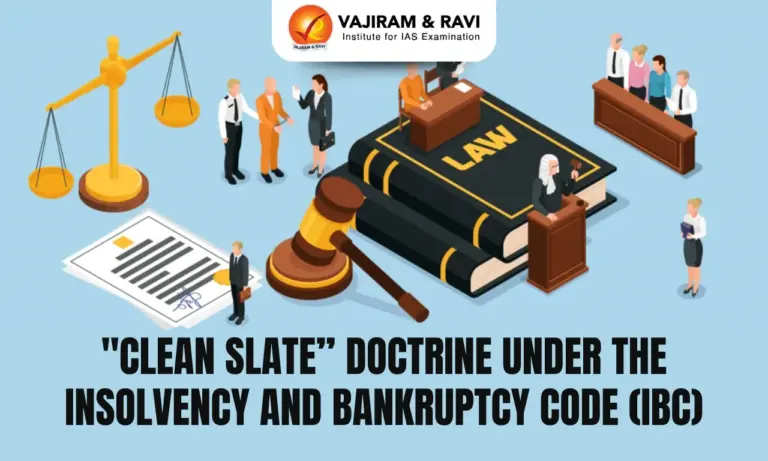
Clean Slate Doctrine under the Insolvency and Bankruptcy Code (IBC) Latest News
The Delhi High Court recently confirmed the “clean slate” doctrine under the Insolvency and Bankruptcy Code (IBC) by holding that a successful resolution applicant cannot be burdened with the criminal liabilities of a corporate debtor’s past management.
About Clean Slate Doctrine under the Insolvency and Bankruptcy Code
- The Clean Slate Doctrine is a key legal principle embedded in the Insolvency and Bankruptcy Code, 2016 (“IBC”), which plays a pivotal role in the corporate insolvency process in India.
- The doctrine suggests that once a company successfully undergoes the insolvency resolution process and is taken over by a new buyer, the new owner should not be held accountable for any of the company’s pre-existing debts, penalties, or liabilities.
- This principle is designed to give the company a fresh start, essentially, a “clean slate” free from the baggage of its prior financial troubles.
- The Clean Slate Doctrine has been upheld in several landmark rulings by India’s Supreme Court (SC), reaffirming its crucial role in the IBC framework.
- In the Essar Steel India case, the SC emphasized that one of the primary objectives of the IBC is to streamline insolvency procedures in India and bring all claims under a unified system.
- The SC ruled that once a resolution plan is approved by the National Company Law Tribunal (NCLT), any and all previous liabilities, including debts and penalties, are extinguished.
- This means no party can initiate or continue any legal proceedings related to a claim that is not included in the approved resolution plan.
- In the Edelweiss Asset Reconstruction case, the SC held that government dues, such as taxes and duties, are extinguished if they are not part of the resolution plan.
- In the Surya Exim case, the Gujarat High Court, following the SC rulings, held that any tax demands issued after the NCLT’s approval of a resolution plan should be cancelled, reinforcing the idea that claims not included in the approved plan are no longer valid.
- In the Essar Steel India case, the SC emphasized that one of the primary objectives of the IBC is to streamline insolvency procedures in India and bring all claims under a unified system.
Source: TAXS






 Last updated on March, 2026
→ UPSC Final Result 2025 is now out.
→ UPSC has released UPSC Toppers List 2025 with the Civil Services final result on its official website.
→ Anuj Agnihotri secured AIR 1 in the UPSC Civil Services Examination 2025.
→ UPSC Marksheet 2025 is now out.
→ UPSC Notification 2026 & UPSC IFoS Notification 2026 is now out on the official website at upsconline.nic.in.
→ UPSC Calendar 2026 has been released.
→ Check out the latest UPSC Syllabus 2026 here.
→ UPSC Prelims 2026 will be conducted on 24th May, 2026 & UPSC Mains 2026 will be conducted on 21st August 2026.
→ The UPSC Selection Process is of 3 stages-Prelims, Mains and Interview.
→ Prepare effectively with Vajiram & Ravi’s UPSC Prelims Test Series 2026 featuring full-length mock tests, detailed solutions, and performance analysis.
→ Enroll in Vajiram & Ravi’s UPSC Mains Test Series 2026 for structured answer writing practice, expert evaluation, and exam-oriented feedback.
→ Join Vajiram & Ravi’s Best UPSC Mentorship Program for personalized guidance, strategy planning, and one-to-one support from experienced mentors.
→ Shakti Dubey secures AIR 1 in UPSC CSE Exam 2024.
→ Also check Best UPSC Coaching in India
Clean Slate Doctrine under the Insolvency and Bankruptcy Code (IBC) FAQs
Q1. What is the Clean Slate Doctrine under the Insolvency and Bankruptcy Code (IBC)?+
Q2. What is the main purpose of the Clean Slate Doctrine?+
Q3. According to the Clean Slate Doctrine, what happens to claims not included in the approved resolution plan?+
Tags: prelims pointers upsc current affairs upsc prelims current affairs