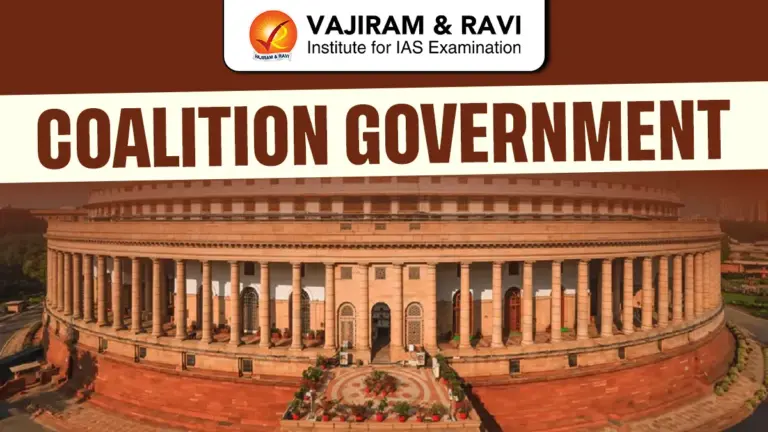
A coalition government is formed when no single political party secures a clear majority in the legislature, and two or more parties come together to form the government. These parties agree on a Common Minimum Programme (CMP) to run the administration collectively. Coalition governments are common in multi-party democracies like India, reflecting political diversity and regional representation.
Coalition Government
A coalition government is formed when two or more political parties come together to secure the majority required to form a government, usually when no single party wins an absolute majority. Such coalitions may be pre-poll or post-election alliances, where partners agree on a common programme to ensure stable governance and implement shared policies. At the Union level, coalition governments have existed since 1977, with regionalism and the rise of regional parties playing a major role in their emergence in India.
Coalition Government Features
The features of the Coalition Government are:
- Multi-party composition: Formed by two or more political parties when no single party gets a majority.
- Common Minimum Programme (CMP): Partners agree on a shared policy agenda to run the government.
- Power sharing: Cabinet posts and responsibilities are distributed among coalition partners.
- Consensus-based decision making: Major policies require consultation and agreement among allies.
- Role of regional parties: Regional and smaller parties gain influence in governance.
- Flexible political arrangements: Alliances may change based on political support and interests.
- Limited stability: Government survival depends on the continued support of coalition partners.
- Checks on dominance: Prevents concentration of power in a single party, strengthening democracy.





Formation of Coalition Governments in India
Coalition governments in India are formed when no single political party secures an absolute majority in the Lok Sabha or a State Assembly.
Morarji Desai (March 1977 – July 1979): Morarji Desai became the Prime Minister in March 1977, heading India’s first major coalition government. The Janata Party, a coalition of several opposition groups, came to power after defeating the Congress in the post-Emergency elections. His tenure marked a historic shift from one-party dominance to coalition politics at the national level.
Charan Singh (July 1979 – January 1980): Charan Singh assumed office as Prime Minister on 28 July 1979 after Morarji Desai’s resignation. He was the founder of the Bharatiya Kranti Dal and had earlier served as the Union Home Minister. His government was short-lived as it collapsed before a confidence vote, making him the only Indian Prime Minister who never faced Parliament.
P. Singh (December 1989 – November 1990): Vishwanath Pratap Singh led the National Front coalition government after the 1989 general elections. His government was supported from outside by the BJP and Left parties, reflecting a complex coalition arrangement. His tenure is especially remembered for the implementation of the Mandal Commission recommendations, which had a lasting impact on Indian politics.
Chandra Shekhar (November 1990 – June 1991): Chandra Shekhar became Prime Minister on 10 November 1990, leading a minority government with external support from the Congress. Although his administration aimed to provide political stability, it faced continuous challenges. The government eventually fell after Congress withdrew its support, leading to fresh elections.
D. Deve Gowda (June 1996 – April 1997): H. D. Deve Gowda took oath as Prime Minister on 2 June 1996, heading the United Front coalition government. The Congress extended external support to this coalition, allowing it to form the government at the Centre. However, disagreements with Congress led to the withdrawal of support, bringing his tenure to an end.
Inder Kumar Gujral (April 1997 – March 1998): Inder Kumar Gujral succeeded Deve Gowda as Prime Minister after Congress temporarily restored support to the United Front. A former External Affairs Minister, he is well known for the Gujral Doctrine in India’s foreign policy. His government collapsed when Congress withdrew its support again in November 1997, ending his short tenure.
Atal Bihari Vajpayee (March 1998 – May 2004): Atal Bihari Vajpayee led the BJP-led National Democratic Alliance (NDA) government from 1998 to 2004. After an initial brief term, he successfully completed a full five-year tenure (1999-2004), bringing stability to coalition politics. His leadership demonstrated that coalition governments could provide effective and durable governance.
Manmohan Singh (May 2004 – May 2014): Manmohan Singh served as Prime Minister for two consecutive terms, heading the Congress-led United Progressive Alliance (UPA) from 2004 to 2014. His coalition government focused on economic growth, social welfare schemes, and inclusive development. Completing ten years in office, his tenure remains one of the most stable coalition governments in India.
Coalition Government Significance
- Coalition governments represent India’s diversity by including national and regional parties, ensuring wider social and regional representation in governance.
- They strengthen federalism by giving states and regional parties a greater role in decision-making at the Centre.
- Coalition governments reflect the true mandate of voters when no single party secures a clear majority.
- They prevent concentration of power by promoting power-sharing and reducing the risk of authoritarian rule.
- Coalition politics encourage consensus and dialogue, leading to more consultative and democratic policy-making.
- By involving multiple parties, coalition governments increase accountability and checks within the political system.
Coalition Government Challenges
- Coalition governments often suffer from political instability due to frequent withdrawal of support by allies. The fall of the V. P. Singh government (1990) after support was withdrawn.
- Ideological differences among partners make consensus difficult and delay decision-making. Conflicting views within the National Front coalition on economic and social policies.
- Policy paralysis occurs when major reforms are diluted or postponed to keep coalition partners satisfied. Slow reforms during the United Front governments (1996–98).
- The authority of the Prime Minister may weaken due to dependence on coalition partners. Leadership constraints faced during H. D. Deve Gowda’s tenure.
- Regional interests may dominate national priorities as regional parties press for local demands. Influence of regional parties in UPA coalition decision-making.
- Coalition instability can lead to frequent elections and administrative disruption. Multiple governments between 1989 and 1991.
Recommendations on Coalition Government in India
- The Second Administrative Reforms Commission (ARC) recommended the need for stable and principled coalitions, supported by a clear Common Minimum Programme to ensure policy continuity and effective governance.
- The ARC emphasized ethical coalition management, suggesting transparency in power-sharing and decision-making to avoid opportunistic politics.
- The National Commission to Review the Working of the Constitution (NCRWC) highlighted the importance of pre-poll alliances to reduce post-election instability and frequent government collapse.
- The NCRWC suggested strengthening the Anti-Defection Law to prevent misuse of defections that destabilize coalition governments.
- The Sarkaria Commission indirectly supported coalition stability by stressing cooperative federalism, which helps manage Centre-State relations in coalition eras.
Way Forward
- Strengthen pre-poll alliances with clear ideological understanding and long-term policy goals to reduce post-election instability.
- Formulate a clear and binding Common Minimum Programme (CMP) to ensure policy clarity and coordination among coalition partners.
- Enforce the Anti-Defection Law strictly to prevent opportunistic withdrawals and political instability.
- Establish institutional coordination mechanisms for regular consultation and dispute resolution within the coalition.
- Balance regional aspirations with national interest through cooperative and competitive federalism.
- Promote electoral and political reforms, such as simultaneous elections, to ensure continuity and stability in governance.

 Last updated on March, 2026
→ UPSC Final Result 2025 is now out.
→ UPSC has released UPSC Toppers List 2025 with the Civil Services final result on its official website.
→ Anuj Agnihotri secured AIR 1 in the UPSC Civil Services Examination 2025.
→ UPSC Marksheet 2025 is now out.
→ UPSC Notification 2026 & UPSC IFoS Notification 2026 is now out on the official website at upsconline.nic.in.
→ UPSC Calendar 2026 has been released.
→ Check out the latest UPSC Syllabus 2026 here.
→ UPSC Prelims 2026 will be conducted on 24th May, 2026 & UPSC Mains 2026 will be conducted on 21st August 2026.
→ The UPSC Selection Process is of 3 stages-Prelims, Mains and Interview.
→ Prepare effectively with Vajiram & Ravi’s UPSC Prelims Test Series 2026 featuring full-length mock tests, detailed solutions, and performance analysis.
→ Enroll in Vajiram & Ravi’s UPSC Mains Test Series 2026 for structured answer writing practice, expert evaluation, and exam-oriented feedback.
→ Join Vajiram & Ravi’s Best UPSC Mentorship Program for personalized guidance, strategy planning, and one-to-one support from experienced mentors.
→ Shakti Dubey secures AIR 1 in UPSC CSE Exam 2024.
→ Also check Best UPSC Coaching in India
Coalition Government FAQs
Q1. What is a coalition government?+
Q2. When did coalition politics begin in India?+
Q3. Is a coalition government good for democracy?+
Q4. What is a Common Minimum Programme (CMP)?+
Q5. Name two major coalition governments in India.+
Tags: coalition government