Communism is a transformative ideology that seeks to restructure society by prioritizing equality and collective welfare over individual ownership. Emerging during the industrial era, it challenged the growing economic disparities and exploitation of labor. Over time, it developed into multiple forms with distinct approaches to governance and economic organization. Its principles, features, and impacts remain highly relevant in understanding modern political and economic debates.
What is Communism?
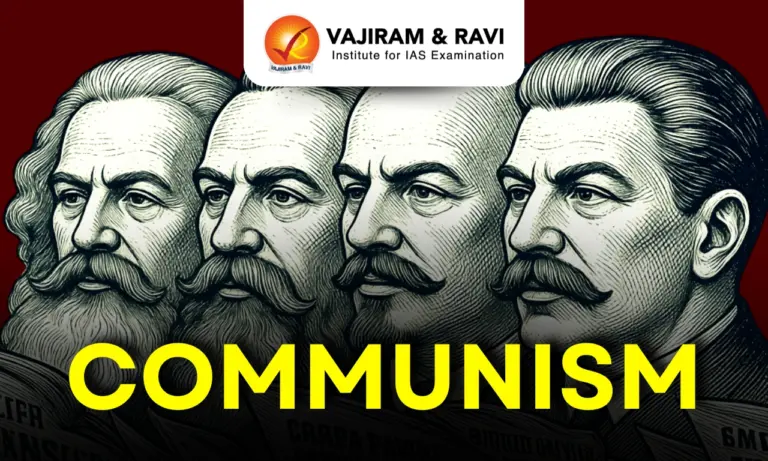
Communism is a political and economic system where all property and resources are owned collectively rather than by individuals. It was developed by Karl Marx and Friedrich Engels to promote equality in society. The main aim of communism is to create a classless society where there is no rich or poor. In this system, people contribute according to their ability and receive according to their needs. Over time, communism has influenced various countries and political movements across the world.
Communism Origin
Communism originated in the 19th century as a response to the inequalities created by industrial capitalism in Europe. The modern concept was systematically developed by Karl Marx and Friedrich Engels, especially through their work The Communist Manifesto. The ideology was influenced by earlier socialist thinkers and the harsh conditions faced by workers during the Industrial Revolution. It is based on the theory of class struggle between the bourgeoisie and the proletariat, aiming to establish equality. Communism later gained practical shape after events like the Russian Revolution, spreading to different parts of the world.





Communism Types
Communism has evolved into different forms based on how leaders and thinkers adapted its core ideas to real-world conditions. These variations reflect differences in strategy, leadership style, and the role of the state in achieving a classless society.
- Marxism: The foundational theory by Karl Marx, which argues that no economic class should dominate another. It is based on the principle that individuals should contribute according to their ability and receive according to their needs, aiming for a classless society.
- Marxism-Leninism: Developed by Vladimir Lenin, this became the dominant communist ideology in the 20th century. It adapts Marxism to practical governance, emphasizing a vanguard party and forming the ideological base of the Soviet Union.
- Trotskyism: Proposed by Leon Trotsky, it advocates for permanent international revolution and criticizes centralized control under Stalin. It emphasizes a true proletarian dictatorship based on workers’ participation.
- Luxemburgism: Based on the ideas of Rosa Luxemburg, it opposes the concept of strict centralization and promotes democratic participation of the working class in revolutionary movements.
- Maoism: Developed by Mao Zedong, it emphasizes the role of peasants in revolution. It introduced concepts like the Mass Line, Cultural Revolution, and criticism of Soviet-style dominance.
- Left Communism: A group of radical communist views that claim to be more strictly Marxist than Leninism. While supporting the Russian Revolution, they opposed the methods of the Bolsheviks.
- Council Communism: Originating in countries like Germany and Netherlands, it promotes workers’ councils as the basis of governance rather than political parties.
- Anarchist Communism: Led by thinkers like Mikhail Bakunin and Peter Kropotkin, it seeks the complete abolition of both the state and capitalism, favoring voluntary cooperation and decentralized systems.
- Eurocommunism: A Western European adaptation that emerged in the 1970s–80s, focusing on democratic methods and distancing itself from Soviet-style authoritarianism.
- Religious Communism: A form of communism inspired by religious teachings such as Christianity, Buddhism, or Hinduism, advocating equality, shared resources, and community-based living without private property.
Communism Characteristics
Communism is defined by a set of core features that aim to establish a classless and equal society by restructuring economic and social systems. These characteristics are largely derived from the ideas of Karl Marx and were later implemented in various forms across countries like the Soviet Union and China.
- Collective Ownership of Means of Production: All major resources such as land, factories, and industries are owned collectively by the state or society, not by individuals.
- Classless Society: Communism aims to eliminate divisions between rich and poor, creating a society where all individuals have equal status.
- Abolition of Private Property: Private ownership of capital goods is removed to prevent wealth concentration and exploitation.
- Planned Economy: Economic activities like production, distribution, and pricing are controlled by a central authority to ensure fairness and stability.
- Focus on Social Welfare: Basic needs such as healthcare, education, housing, and employment are guaranteed by the state.
- Elimination of Exploitation: Workers are not exploited for profit, as surplus value is shared collectively rather than owned by capitalists.
- Centralized Political Control: Decision-making is often concentrated in a single party or central authority to maintain uniformity in policies.
- Economic Equality: Income and wealth are distributed more evenly among citizens to reduce inequality.
- Limited Consumer Choice: Since production is planned, individuals may have fewer options in goods and services compared to market economies.
- Emphasis on Collective Good: The needs of society as a whole are prioritized over individual interests.
- State Control Over Resources: Natural and economic resources are managed by the government to ensure equitable usage.
- Ideological Uniformity: Often promotes a single political ideology, limiting opposition to maintain system stability.
Communism Advantages
Communism offers several potential benefits by focusing on equality, social welfare, and collective ownership of resources.
- Economic Equality: Reduces the gap between rich and poor by distributing wealth more evenly across society.
- Basic Needs Guaranteed: Ensures access to essential services like food, housing, healthcare, and education for everyone.
- Elimination of Exploitation: Workers are not exploited by private owners, as production is controlled collectively.
- Full Employment: The state provides jobs to all, reducing unemployment and economic insecurity.
- Social Welfare Focus: Greater emphasis on public welfare rather than profit-making.
- Price Stability: Government control over prices helps prevent inflation and extreme market fluctuations.
- Stronger Social Unity: Promotes cooperation and collective responsibility among citizens.
Communism Disadvantages
Despite its ideals, communism has several limitations, especially in practical implementation, as seen in countries like Russia and China.
- Lack of Individual Freedom: People may have limited freedom in choosing jobs, businesses, or lifestyles.
- No Incentive to Work Hard: Equal distribution of rewards can reduce motivation and productivity.
- Centralized Power: Concentration of authority can lead to authoritarian rule and misuse of power.
- Economic Inefficiency: Absence of competition may result in poor quality goods and lack of innovation.
- Limited Consumer Choice: Planned production restricts variety and availability of goods.
- Suppression of Innovation: Lack of personal rewards can discourage creativity and technological advancement.
- Bureaucratic Delays: Decision-making through central planning can be slow and inefficient.
- Historical Failures: Some communist systems have faced economic stagnation and political repression.

 Last updated on April, 2026
→ UPSC Final Result 2025 is now out.
→ UPSC has released UPSC Toppers List 2025 with the Civil Services final result on its official website.
→ Anuj Agnihotri secured AIR 1 in the UPSC Civil Services Examination 2025.
→ UPSC Marksheet 2025 is now out.
→ UPSC Notification 2026 & UPSC IFoS Notification 2026 is now out on the official website at upsconline.nic.in.
→ UPSC Calendar 2026 has been released.
→ Check out the latest UPSC Syllabus 2026 here.
→ UPSC Prelims 2026 will be conducted on 24th May, 2026 & UPSC Mains 2026 will be conducted on 21st August 2026.
→ The UPSC Selection Process is of 3 stages-Prelims, Mains and Interview.
→ Prepare effectively with Vajiram & Ravi’s UPSC Prelims Test Series 2026 featuring full-length mock tests, detailed solutions, and performance analysis.
→ Enroll in Vajiram & Ravi’s UPSC Mains Test Series 2026 for structured answer writing practice, expert evaluation, and exam-oriented feedback.
→ Join Vajiram & Ravi’s Best UPSC Mentorship Program for personalized guidance, strategy planning, and one-to-one support from experienced mentors.
→ Shakti Dubey secures AIR 1 in UPSC CSE Exam 2024.
→ Also check Best UPSC Coaching in India
Communism FAQs
Q1. What is communism in simple terms?+
Q2. Who is known as the father of communism?+
Q3. What is the main goal of communism?+
Q4. Is communism the same as socialism?+
Q5. Which countries follow communism today?+