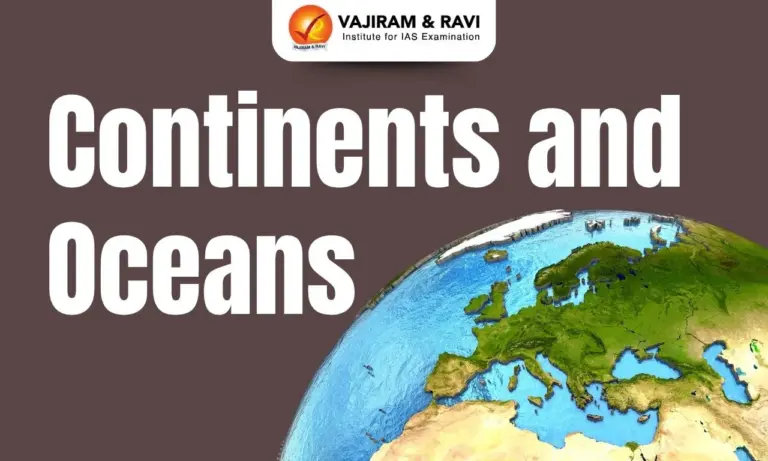
Earth stands as the only known planet in the universe with a distinct combination of land and water. In the late Paleozoic and early Mesozoic eras, the supercontinent Pangea existed, surrounded by the ocean Panthalassa. Over time, Pangea began to break apart due to the movement of tectonic plates which led to the formation of the continents and made up about 29% of the Earth’s surface. The vast oceans, which cover approximately 71% of the Earth’s surface, are the world’s largest water bodies. This article will explore the facts about the 7 Continents and 5 Oceans that make up our planet.
7 Continents and 5 Oceans
The Earth consists of 7 Continents and 5 Oceans. The continents include Asia, Africa, North America, South America, Antarctica, Europe, and Australia. Meanwhile, the oceans cover the globe with the Pacific, Atlantic, Indian, Southern (also known as Antarctic), and Arctic. Each of these landmasses and bodies of water is crucial in influencing the planet’s physical features, weather patterns, and ecological systems.
List of 7 Continents
According to the Continental Drift Theory, the movement of tectonic plates resulted in the formation of 7 Continents of the world from which Asia being the largest one, in term of area as well as population and Antarctica being the smallest one in terms of population and Oceania/ Australia being the smallest one in terms of area. Check out the List of 7 Continents in the table below and the fantastic facts of each continent further the table.
| List of 7 Continents | |||
|
Name of Continent |
Area (Km²) |
Population (2022) |
Countries |
|
Asia |
44,579,000 |
4,723,918,410 |
48 |
|
Africa |
30,370,000 |
1,408,085,198 |
54 |
|
Europe |
10,180,000 |
748,593,065 |
44 |
|
North America |
24,709,000 |
373,640,153 |
23 |
|
South America |
17,840,000 |
438,234,538 |
12 |
|
Oceania/ Australia |
8,486,460 |
43,826,590 |
14 |
|
Antarctica |
14,200,000 |
1000-5000 (Seasonal) |
0 |
Asia
Asia is the largest continent by both size and population, covering about 30% of the Earth’s land area. It has 48 UN-recognized countries, though other territories and islands are included. Key nations like Russia, the largest by area, China, the most populous, and India, the largest democracy, are found here. Russia spans both Asia and Europe, forming the region known as Eurasia.
Also Read: Asian Countries
| Asia | |
|
Area (sq km) |
44,579,000 |
|
Population (approx.) |
4.64 billion |
|
Countries |
49 |
|
Highest Point |
Mount Everest (Nepal/China) |
|
Longest River |
Yangtze River (6,300 km) |
|
Largest Lake |
Caspian Sea |
|
Largest City |
Tokyo, Japan |
|
Dominant Language(s) |
Mandarin, Hindi, Arabic |
|
Main Biomes |
Taiga, Gobi Desert, Himalayas, Rainforests |
|
Economic Activities |
Agriculture, manufacturing, technology |
Africa
Africa is the second-largest continent by both land area and population. It acquires approximately 20% of the Earth’s total landmass, with most of its territory situated in the Eastern Hemisphere. The continent is home to 54 countries, the most of any in the world. The Sahara Desert is the world’s largest desert, and the Nile is the longest river. The continent also hosts some of the hottest regions, including Ethiopia. Due to its location along the Equator, Africa experiences direct sunlight year-round. The largest country in Africa by area is Algeria, while Nigeria holds the title for the most populous country. Seychelles is the smallest country on the continent.
| Africa | |
|
Area (sq km) |
30,370,000 |
|
Population (approx.) |
1.34 billion |
|
Countries |
54 |
|
Highest Point |
Mount Kilimanjaro (Tanzania) |
|
Longest River |
Nile River (6,650 km) |
|
Largest Lake |
Lake Victoria |
|
Largest City |
Lagos, Nigeria |
|
Dominant Language(s) |
Arabic, French, English |
|
Main Biomes |
Sahara Desert, Congo Rainforest, Savannah |
|
Economic Activities |
Agriculture, mining, tourism, oil and gas |
Europe
Europe is the third largest continent in terms of the population and sixth in terms of the land area. It is bordered by the Arctic Ocean, Mediterranean Sea, Asia, and the Atlantic Ocean, with most of its land in the Eastern Hemisphere. Europe has no deserts. Historically, it was the centre of global power and the site of both world wars. Home to 44 countries, primarily Christian, it includes the smallest country, Vatican City. Major cities like London and Paris are renowned worldwide, and 27 nations form the European Union, using the common currency, the Euro.
Also Read: European Countries
| Europe | |
|
Area (sq km) |
10,180,000 |
|
Population (approx.) |
747 million |
|
Countries |
50 |
|
Highest Point |
Mount Elbrus (Russia) |
|
Longest River |
Volga River (3,690 km) |
|
Largest Lake |
Lake Ladoga |
|
Largest City |
Istanbul, Turkey |
|
Dominant Language(s) |
Russian, German, French |
|
Main Biomes |
Mediterranean Forests, Taiga, Grasslands |
|
Economic Activities |
Manufacturing, tourism, finance, agriculture |
Northern America
North America is the third-largest continent by area and ranks fifth in terms of population among the continents. Located primarily in the western hemisphere, it spans across five distinct time zones. The continent is home to 23 countries, with the United States of America (USA) hosting the world’s largest economy. One of its natural wonders, Lake Superior, borders both the USA and Canada, making it the largest of the Great Lakes.
| Northern America | |
|
Area (sq km) |
24,709,000 |
|
Population (approx.) |
597 million |
|
Countries |
23 |
|
Highest Point |
Denali/Mount McKinley (USA) |
|
Longest River |
Mississippi River (6,275 km) |
|
Largest Lake |
Lake Superior |
|
Largest City |
Mexico City, Mexico |
|
Dominant Language(s) |
English, Spanish, French |
|
Main Biomes |
Temperate Deciduous Forests, Prairie, Tundra |
|
Economic Activities |
Agriculture, manufacturing, technology |
Southern America
South America holds the fourth position in both size and population among the continents worldwide. Situated in the western hemisphere, it is connected to North America by the narrow Isthmus of Panama. The continent is home to two of the world’s tallest volcanoes, Mount Chimborazo and Mount Cotopaxi. Brazil, the largest country in South America by land area, is renowned for its coffee production, leading the globe as the top coffee exporter. In addition to its 12 countries, South America is known for its diverse wildlife, including the massive Anaconda, the world’s largest snake species.
| Southern America | |
|
Area |
Approximately 17,840,000 square kilometers |
|
Population |
Around 430 million (as of 2022) |
|
Countries |
12 sovereign countries including Brazil, Argentina, Peru |
|
Highest Point |
Mount Aconcagua in Argentina (6,960 meters above sea level) |
|
Longest River |
Amazon River (Approximately 7,062 kilometers) |
|
Largest City |
São Paulo, Brazil (Population over 12 million) |
|
Major Landmarks |
Machu Picchu (Peru), Christ the Redeemer (Brazil) |
|
Dominant Language |
Spanish and Portuguese (with indigenous languages) |
|
Main Biomes |
Amazon Rainforest, Andes Mountains, Atacama Desert |
|
Economic Activities |
Agriculture, mining, tourism, oil and gas |
Australia/ Oceania
Australia is ranked at the sixth position in terms or land area as well as in terms of population, Located primarily in the Eastern Hemisphere, Oceania is often referred to as the “Island Continent” due to many islands, with the Great Barrier Reef being a prominent feature as the largest coral reef system on Earth. According to United Nations data, Oceania is home to approximately 14 sovereign nations, including Australia, New Zealand, and Papua New Guinea. Australia, the largest country in Oceania, is also the world’s sixth-largest country by land area. Due to its position in the Southern Hemisphere, Oceania is sometimes called the “Land Down Under.”
| Australia/ Oceania | |
|
Area |
Approximately 8.6 million square kilometers |
|
Population |
Around 40 million |
|
Countries |
Consists of a single country: Australia |
|
Highest Point |
Mount Kosciuszko (2,228 meters) |
|
Longest River |
Murray-Darling River (2,508 kilometers) |
|
Largest Lake |
Lake Eyre (when filled, covering 9,500 square kilometers) |
|
Largest City |
Sydney, Australia |
|
Dominant Language(s) |
English |
|
Main Biomes |
Outback, Rainforests, Great Barrier Reef |
|
Economic Activities |
Mining, agriculture, tourism, manufacturing |
Antarctica
Antarctica, the fifth-largest continent, is the smallest in population and is located at the Earth’s southernmost point, housing the South Pole. It is larger than Oceania and is primarily covered by polar deserts. The continent contains 75% of the world’s freshwater in glaciers. The Antarctic Treaty 1959, signed by 52 nations, ensures peaceful management by banning activities such as nuclear waste disposal, nuclear testing, and mining. These regulations help preserve its unique and delicate environment, making it one of the most protected regions on Earth.
| Antarctica | |
|
Area (sq km) |
14,000,000 |
|
Population (approx.) |
Minimal (Research) |
|
Countries |
None (Treaty System) |
|
Highest Point |
Vinson Massif (Antarctica) |
|
Longest River |
None (Glacial Ice) |
|
Largest Lake |
Lake Vostok |
|
Largest City |
McMurdo Station, Antarctica |
|
Dominant Language(s) |
Various |
|
Main Biomes |
Ice Sheets, Tundra, Mountains |
|
Economic Activities |
Research, exploration, fishing |





List of 5 Oceans
The total area of 71% of the Earth is covered with water from which 96% is salty and not ideal for drinking. Originally, the Panthalassa covered much of the Earth’s surface. However, after the breakdown of Pangea, the landmasses were separated, causing the formation of this large water body. As of now, Earth is home to five major oceans. The Pacific Ocean holds the title as the largest and deepest of these, while the Arctic Ocean is the smallest and shallowest. Below is a table having the names and key characteristics of the five oceans of the world, along with the fantastic facts about each of the oceans.
| List of 5 Oceans | ||
|
Names of Ocean |
Area (Km²) |
Share to Earth’s Water Surface Area (In %) |
|
Pacific Ocean |
165,200,000 |
>40% |
|
Atlantic Ocean |
106,400,000 |
>22% |
|
Indian Ocean |
73,556,000 |
20% |
|
Antarctic/ Southern Ocean |
20,327,000 |
15-16% |
|
Arctic Ocean |
13,986,000 |
3-4% |
Pacific Ocean
The Pacific Ocean holds the title of being the largest ocean on Earth, surpassing all others in size. Its vast expanse covers more surface area than all the landmasses combined. Stretching from the western shores of the Americas to the eastern coasts of Asia and Oceania, it is bordered by the Arctic Ocean to the north and the Southern Ocean to the south. Interestingly, the Pacific is home to the Mariana Trench, which contains the deepest point on Earth, the Challenger Deep. The name “Pacific” was named upon this great body of water by the Portuguese explorer Ferdinand Magellan, reflecting its calm nature at the time of his discovery.
| Pacific Ocean | |
|
Characteristic |
Description |
|
Area |
Approximately 168 million square kilometers |
|
Average Depth |
Around 4,280 meters |
|
Deepest Point |
Mariana Trench (Challenger Deep), about 10,994 meters |
|
Location |
Bounded by Asia and Australia to the west, the Americas to the east, the Arctic Ocean to the north, and the Southern Ocean to the south |
|
Major Currents |
North Pacific Gyre, South Pacific Gyre, Kuroshio Current, California Current, Humboldt Current, and the Equatorial Currents |
|
Climate Influence |
Significant impact on global climate patterns, including El Niño and La Niña phenomena |
|
Marine Biodiversity |
Home to a diverse range of marine life, including coral reefs, fish, mammals, and numerous other species |
Atlantic Ocean
The Atlantic Ocean ranks as the second-largest ocean in the world. It spans the distance between the eastern coast of the Americas and the western coast of Europe and Africa. In addition to its main body, it encompasses significant bodies of water such as the Mediterranean Sea, the Gulf of Mexico, and the Caribbean Sea. Like the Pacific, the Atlantic also borders the Arctic and Southern Oceans. Known for its role in global trade, especially the spice trade, the Atlantic was a key route for early European explorers, such as Vasco da Gama, during the Age of Exploration.
| Atlantic Ocean | |
|
Area |
Approximately 85 million square kilometers |
|
Average Depth |
Around 3,646 meters |
|
Deepest Point |
Puerto Rico Trench (Milwaukee Deep), about 8,376 meters |
|
Location |
Bounded by the Americas to the west, Europe and Africa to the east, the Arctic Ocean to the north, and the Southern Ocean to the south |
|
Major Currents |
Gulf Stream, North Atlantic Drift, Canary Current, Brazil Current, Benguela Current, and the South Equatorial Current |
|
Climate Influence |
Influences weather patterns, including the Atlantic Meridional Overturning Circulation (AMOC) and the North Atlantic Oscillation (NAO) |
|
Marine Biodiversity |
Home to diverse marine life including fish, whales, dolphins, and important breeding grounds for many species |
|
Economic Importance |
Crucial for international shipping routes, fishing industries, and natural resources such as oil and gas |
|
Islands |
Includes islands and archipelagos such as the Caribbean islands, the Azores, Canary Islands, Cape Verde, and the British Isles |
Indian Ocean
The Indian Ocean occupies third place in terms of size among the world’s oceans. It stretches between the eastern coastline of Africa, the southern tip of the Indian subcontinent, and the western edges of Oceania. This ocean is also significant for including the Middle Eastern coastlines. Rich in biodiversity, it is home to unique species of plants and animals. Under the United Nations Convention on the Law of the Sea (UNCLOS), India has the exclusive rights to explore the polymetallic nodules in its waters.
| Indian Ocean | |
|
Characteristic |
Description |
|
Area |
Approximately 70 million square kilometers |
|
Average Depth |
Around 3,741 meters |
|
Deepest Point |
Java Trench (Sunda Trench), about 7,258 meters |
|
Location |
Bounded by Africa to the west, Asia to the north, Australia to the east, and the Southern Ocean to the south |
|
Major Currents |
Indian Monsoon Current, Agulhas Current, Somali Current, and the South Equatorial Current |
|
Climate Influence |
Influences the monsoon weather patterns, critical for agriculture in surrounding regions |
|
Marine Biodiversity |
Rich in marine life including coral reefs, diverse fish species, marine mammals, and unique ecosystems |
|
Economic Importance |
Key shipping routes connecting the Middle East, Africa, and East Asia, with significant oil and gas resources and fisheries |
|
Islands |
Includes islands and archipelagos such as Madagascar, the Maldives, Seychelles, Sri Lanka, and the Andaman and Nicobar Islands |
Antarctic (Southern) Ocean
Known as the Southern Ocean or Antarctic Ocean, this body of water is the fourth largest, and also considered as the second smallest ocean. It surrounds Antarctica and stretches into the Southern Hemisphere, linking with the Atlantic, Indian, and Pacific Oceans. The Southern Ocean was officially recognized in the early 21st century by the International Hydrographic Organization. Characterised by its cold waters and strong easterly currents, it is often regarded as the most frigid of all the oceans.
| Antarctic Ocean (Southern Ocean) | |
|
Area |
Approximately 20 million square kilometers |
|
Average Depth |
Around 3,000 to 4,000 meters |
|
Deepest Point |
Unknown |
|
Location |
Surrounds Antarctica |
|
Major Currents |
Antarctic Circumpolar Current |
|
Climate Influence |
Plays a significant role in global climate regulation and oceanic circulation |
|
Marine Biodiversity |
Supports diverse marine life adapted to extreme cold, including fish, seals, and whales |
Arctic Ocean
The Arctic Ocean is the smallest and shallowest of the world’s five oceans. Located within the Arctic Circle, it borders the northern parts of Europe, Asia, and North America, including regions like the Bay of Hudson. In the past, explorers have searched for a passage across this ocean to reach trade routes to Asia, seeking goods like spices, silk, and opium.
| Arctic Ocean | |
|
Area |
Approximately 14 million square kilometers |
|
Average Depth |
Around 1,200 meters |
|
Deepest Point |
Fram Strait (around 5,450 meters) |
|
Location |
Centered around the North Pole |
|
Major Currents |
Transpolar Drift, Beaufort Gyre, East Greenland Current |
|
Climate Influence |
Plays a crucial role in regulating global climate, especially affecting polar regions |
|
Marine Biodiversity |
Supports unique marine life adapted to cold conditions, including polar bears and seals |

 Last updated on March, 2026
→ UPSC Final Result 2025 is now out.
→ UPSC has released UPSC Toppers List 2025 with the Civil Services final result on its official website.
→ Anuj Agnihotri secured AIR 1 in the UPSC Civil Services Examination 2025.
→ UPSC Marksheet 2025 is now out.
→ UPSC Notification 2026 & UPSC IFoS Notification 2026 is now out on the official website at upsconline.nic.in.
→ UPSC Calendar 2026 has been released.
→ Check out the latest UPSC Syllabus 2026 here.
→ UPSC Prelims 2026 will be conducted on 24th May, 2026 & UPSC Mains 2026 will be conducted on 21st August 2026.
→ The UPSC Selection Process is of 3 stages-Prelims, Mains and Interview.
→ Prepare effectively with Vajiram & Ravi’s UPSC Prelims Test Series 2026 featuring full-length mock tests, detailed solutions, and performance analysis.
→ Enroll in Vajiram & Ravi’s UPSC Mains Test Series 2026 for structured answer writing practice, expert evaluation, and exam-oriented feedback.
→ Join Vajiram & Ravi’s Best UPSC Mentorship Program for personalized guidance, strategy planning, and one-to-one support from experienced mentors.
→ Shakti Dubey secures AIR 1 in UPSC CSE Exam 2024.
→ Also check Best UPSC Coaching in India
Continents and Oceans FAQs
Q1. What are the 5 oceans in the world?+
Q2. Which is the largest ocean in the world?+
Q3. What are the 7 continents in the world?+
Q4. How many continents were created by the theory of continental drift?+
Tags: continents and oceans