Convention on Cluster Munitions Latest News
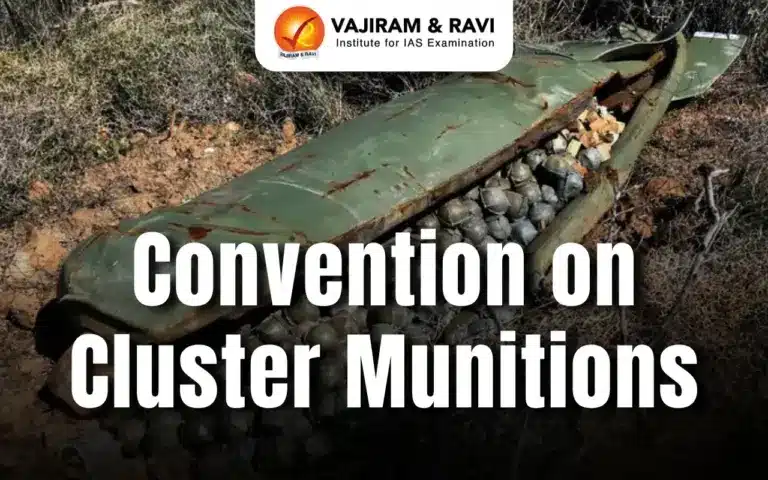
Lithuania recently quit the Convention on Cluster Munitions banning cluster bombs, citing security concerns over neighbouring Russia in a move that has drawn criticism from human rights groups.
About Convention on Cluster Munitions
- Origin: The Convention on Cluster Munitions is an international treaty of more than 100 states, adopted on 30 May 2008, signed on 3 December 2008 and entered into force on 1 August 2010.
- Objective: The Convention prohibits all use, production, transfer and stockpiling of cluster munitions. States Parties are committed to the full universalization of the Convention and to promote its norms, as well as to fully implement it.
- Membership Status: The convention has 112 member states and 12 signatories yet to ratify it, while India, the U.S., Russia, China, Ukraine, and Israel have not signed due to military and strategic concerns.
- The Convention on Cluster Munitions (CCM) was born out of a collective determination to address the humanitarian consequences and unacceptable harm to civilians caused by cluster munitions.
- Its implementation contributes to advancing the achievement of the UN Sustainable Development Goals and the promotion of international peace and security, human rights and international humanitarian law.





Convention on Cluster Munitions FAQs
Q1. What is the Convention on Cluster Munitions?
Ans: The Convention on Cluster Munitions (CCM) is an international treaty banning the use, production, transfer, and stockpiling of cluster bombs.
Q2. When was the Convention on Cluster Munitions adopted?
Ans: It was adopted on 30 May 2008 in Dublin and opened for signature on 3 December 2008 in Oslo.
Q3. What are cluster munitions?
Ans: Cluster munitions are explosive weapons that scatter smaller explosives (“bomblets”) over wide areas, posing risks to civilians.
Q4. Is India a member of the Convention on Cluster Munitions?
Ans: No, India is not a member of the Convention on Cluster Munitions.
Source: TH

 Last updated on March, 2026
→ UPSC Final Result 2025 is now out.
→ UPSC has released UPSC Toppers List 2025 with the Civil Services final result on its official website.
→ Anuj Agnihotri secured AIR 1 in the UPSC Civil Services Examination 2025.
→ UPSC Marksheet 2025 is now out.
→ UPSC Notification 2026 & UPSC IFoS Notification 2026 is now out on the official website at upsconline.nic.in.
→ UPSC Calendar 2026 has been released.
→ Check out the latest UPSC Syllabus 2026 here.
→ UPSC Prelims 2026 will be conducted on 24th May, 2026 & UPSC Mains 2026 will be conducted on 21st August 2026.
→ The UPSC Selection Process is of 3 stages-Prelims, Mains and Interview.
→ Prepare effectively with Vajiram & Ravi’s UPSC Prelims Test Series 2026 featuring full-length mock tests, detailed solutions, and performance analysis.
→ Enroll in Vajiram & Ravi’s UPSC Mains Test Series 2026 for structured answer writing practice, expert evaluation, and exam-oriented feedback.
→ Join Vajiram & Ravi’s Best UPSC Mentorship Program for personalized guidance, strategy planning, and one-to-one support from experienced mentors.
→ Shakti Dubey secures AIR 1 in UPSC CSE Exam 2024.
→ Also check Best UPSC Coaching in India