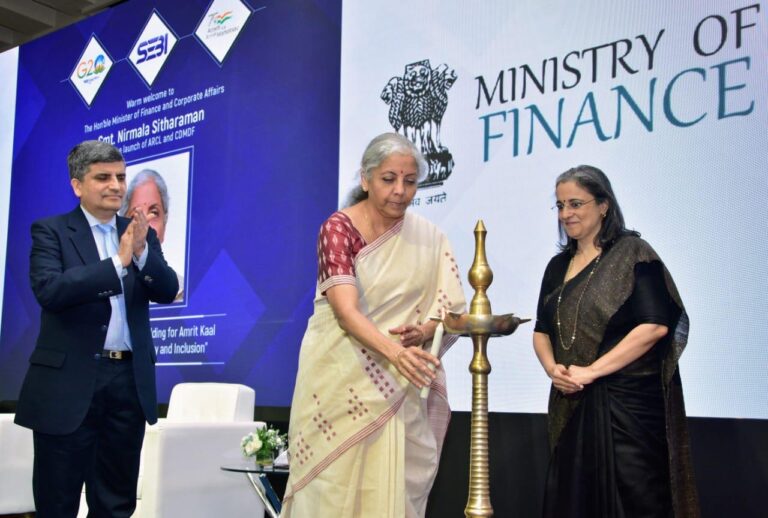
About Corporate Debt Market Development Fund:
- It is a backstop facility for specified debt funds during market dislocations.
- The fund is intended to provide liquidity support in the event of a financial crisis.
- It will be in the form of an alternative investment fund (AIF), meant to instill confidence among the participants in the Corporate Bond Market during times of stress
- The fund has Rs 33,000-crore backstop facility for Mutual Funds.
- Of the Rs 33,000 crore, Rs 30,000 crore will come from the government, while the balance Rs 3,000 crore will be contributed by the Asset Management Companies.
- Contributions to the fund can be done by the specified debt-oriented mutual fund schemes and asset management companies of mutual funds.
- This fund is guaranteed by the National Credit Guarantee Trust Company (NCGTC) and the backstop facility will be managed by SBI Mutual Fund.
- Who can invest?
- Specified debt-oriented mutual fund schemes here are ‘open-ended debt oriented mutual fund schemes, excluding the overnight funds and gilt funds and including conservative hybrid fund’.
- These specified debt-oriented schemes will invest 25 basis points (0.25 per cent) of their asset under management (AUM) in CDMDF units and will increase their contribution when their AUM increases and review it every six months.
- However, there will be no redemption from CDMDF in case their AUM reduces.
- The same applies to the specified schemes of new mutual funds or such new schemes from the existing mutual funds.
- The AMCs are also required to make a contribution of 2 per cent of their specified debt-oriented schemes’ AUM as a one-time contribution.
- The initial contribution for this purpose will be based on the AUM as of December 31, 2022, in the specified schemes of the mutual funds.
What is a Backstop facility?
- A backstop is an act of providing last-resort support or security in a securities offering for the unsubscribed portion of shares.
- When a company is trying to raise capital through an issuance, it may get a backstop from an underwriter or a major shareholder, such as an investment bank, to buy any of its unsubscribed shares.
Q1) What is a mutual fund?
A mutual fund is a type of investment vehicle that pools money from multiple investors to invest in a diversified portfolio of stocks, bonds, money market instruments, and other securities. It is managed by a professional fund manager or a team of managers, who make investment decisions on behalf of the investors.






 Last updated on March, 2026
→ UPSC Final Result 2025 is now out.
→ UPSC has released UPSC Toppers List 2025 with the Civil Services final result on its official website.
→ Anuj Agnihotri secured AIR 1 in the UPSC Civil Services Examination 2025.
→ UPSC Marksheet 2025 is now out.
→ UPSC Notification 2026 & UPSC IFoS Notification 2026 is now out on the official website at upsconline.nic.in.
→ UPSC Calendar 2026 has been released.
→ Check out the latest UPSC Syllabus 2026 here.
→ UPSC Prelims 2026 will be conducted on 24th May, 2026 & UPSC Mains 2026 will be conducted on 21st August 2026.
→ The UPSC Selection Process is of 3 stages-Prelims, Mains and Interview.
→ Prepare effectively with Vajiram & Ravi’s UPSC Prelims Test Series 2026 featuring full-length mock tests, detailed solutions, and performance analysis.
→ Enroll in Vajiram & Ravi’s UPSC Mains Test Series 2026 for structured answer writing practice, expert evaluation, and exam-oriented feedback.
→ Join Vajiram & Ravi’s Best UPSC Mentorship Program for personalized guidance, strategy planning, and one-to-one support from experienced mentors.
→ Shakti Dubey secures AIR 1 in UPSC CSE Exam 2024.
→ Also check Best UPSC Coaching in India