Corporate Investment Slowdown Latest News
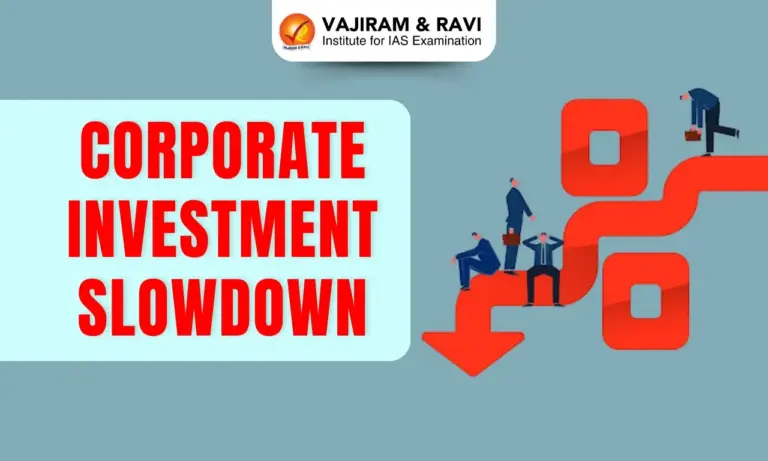
Despite policy efforts, India is witnessing a prolonged slowdown in corporate investment, with recent data showing industrial growth at a nine-month low and private sector capital formation remaining sluggish.
Persistent Investment Slump
- India’s industrial recovery remains tepid, with corporate investment failing to pick up momentum post-pandemic.
- The Index of Industrial Production (IIP) recently registered a nine-month low growth of just 1.2%. This slowdown persists despite the government’s multi-pronged efforts, corporate tax cuts, increased capital expenditure (capex), and accommodative monetary policy.
- Yet, these measures have not translated into significant investment on the ground. The reason lies not in insufficient profits or financing options, but in a fundamental mismatch between investment incentives and aggregate demand in the economy.





The Demand-Investment Nexus
- Investment, by nature, is driven by the demand for goods and services. When demand falters, producers hesitate to expand capacity.
- The Indian corporate sector, despite experiencing strong profits, remains hesitant to invest due to weak consumer demand.
- The 2024-25 Economic Survey noted that while corporate balance sheets are strong, hiring and wage growth have not kept pace, resulting in subdued consumption.
- Between FY20 and FY23, private sector gross fixed capital formation (GFCF) in machinery, equipment, and intellectual property grew by only 35%, a modest figure given India’s ambitious manufacturing targets.
Theoretical Perspectives on Investment Decisions
- The debate between economists provides useful insights into investment behaviour.
- While one school of thought argued that investment can drive profits independently of consumption, another contended that investment is ultimately constrained by demand.
- Under capitalism, individual firms make investment decisions based on their assessment of market conditions.
- In a slow-growth environment, firms are unlikely to invest unless they anticipate demand recovery. Thus, investment becomes reactive rather than proactive, a key reason for the current stagnation.
Limits of Government-Induced Investment
- The Indian government’s strategy has been to stimulate private investment through tax cuts and public infrastructure spending. The assumption is that improved infrastructure will “crowd in” private investment by reducing operational costs and improving market access. However, this approach faces multiple limitations:
- Time Lags: Infrastructure projects have long gestation periods, delaying any investment stimulus.
- Import Leakage: Some capex spending leaks into imports, offering limited domestic demand stimulus.
- Low Labour Intensity: Many infrastructure projects are capital-intensive and generate limited employment, hence reducing their consumption-boosting potential.
- Even the Reserve Bank of India’s interest rate cuts and liquidity measures have not significantly influenced private investment. As Keynes argued, recovery depends on both investor confidence and financial conditions; reducing interest rates alone is insufficient when demand remains weak.
The Path to Recovery: Demand-Led Revival
- Reviving corporate investment in India requires an external stimulus, either robust government spending or export-led growth.
- However, with global demand facing headwinds due to geopolitical tensions and trade wars, the domestic route appears more viable.
- Boosting consumption through increased government expenditure, targeted income support, and employment generation could kickstart the demand-investment cycle.
- This would give businesses the confidence to expand capacity, hire more, and invest in long-term growth.
Conclusion
- India’s corporate investment slowdown cannot be reversed through tax cuts or interest rate adjustments alone.
- The fundamental issue is weak demand, which deters firms from investing even when profits are high and credit is cheap.
- A sustained revival will require bold fiscal measures to stimulate demand, alongside long-term structural reforms that address supply chain inefficiencies and ease of doing business.
- Recognising the interdependence of demand, profits, and investment is crucial to designing effective policy responses. Without a demand-led push, India’s manufacturing ambitions and job creation goals may continue to face delays.
Source : TH

 Last updated on April, 2026
→ UPSC Final Result 2025 is now out.
→ UPSC has released UPSC Toppers List 2025 with the Civil Services final result on its official website.
→ Anuj Agnihotri secured AIR 1 in the UPSC Civil Services Examination 2025.
→ UPSC Marksheet 2025 is now out.
→ UPSC Notification 2026 & UPSC IFoS Notification 2026 is now out on the official website at upsconline.nic.in.
→ UPSC Calendar 2026 has been released.
→ Check out the latest UPSC Syllabus 2026 here.
→ UPSC Prelims 2026 will be conducted on 24th May, 2026 & UPSC Mains 2026 will be conducted on 21st August 2026.
→ The UPSC Selection Process is of 3 stages-Prelims, Mains and Interview.
→ Prepare effectively with Vajiram & Ravi’s UPSC Prelims Test Series 2026 featuring full-length mock tests, detailed solutions, and performance analysis.
→ Enroll in Vajiram & Ravi’s UPSC Mains Test Series 2026 for structured answer writing practice, expert evaluation, and exam-oriented feedback.
→ Join Vajiram & Ravi’s Best UPSC Mentorship Program for personalized guidance, strategy planning, and one-to-one support from experienced mentors.
→ Shakti Dubey secures AIR 1 in UPSC CSE Exam 2024.
→ Also check Best UPSC Coaching in India
Corporate Investment FAQs
Q1. Why is corporate investment slowing down in India?+
Q2. What steps has the Indian government taken to boost investment?+
Q3. Why have these measures not worked as expected?+
Q4. How does demand affect investment decisions in a capitalist economy?+
Q5. What is needed to revive corporate investment in India?+
Tags: corporate investment slowdown mains articles upsc current affairs upsc mains current affairs