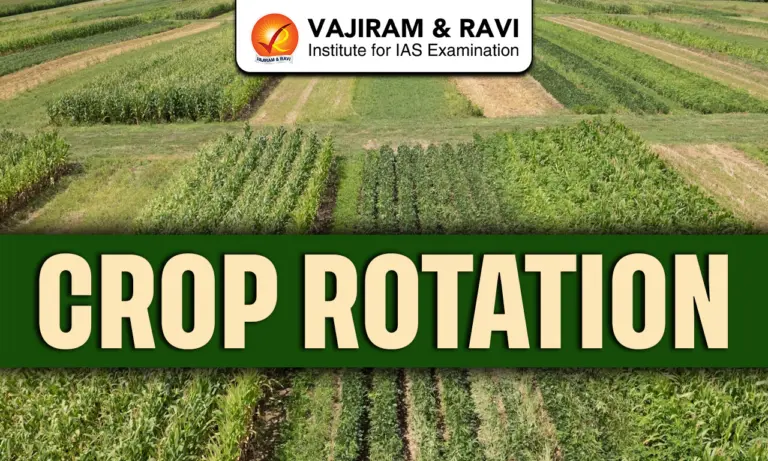
Crop Rotation is an essential agricultural practice developed to maintain soil fertility and ensure sustainable farming without heavy investment. The need for Crop Rotation arises due to continuous cropping depleting soil nutrients and increasing pests and diseases. It helps restore soil balance, improve productivity and reduce dependence on chemical inputs while ensuring long term agricultural sustainability.
Crop Rotation
Crop Rotation is the practice of growing different crops sequentially on the same field over different seasons or years to improve soil health and manage pests. It involves planting crops of different species such as cereals and legumes in a planned cycle, allowing efficient nutrient use, reducing pest cycles and enhancing soil structure through varied root systems.
Crop Rotation Methods
Crop Rotation follows different patterns based on duration, crop types and farming conditions to ensure balanced nutrient use and sustainable production.
Based on Duration:
- One Year Rotation: Crops are grown sequentially within a single year, such as maize followed by mustard, utilizing seasonal variations efficiently.
- Two Year Rotation: Crops are rotated over two years with multiple combinations like corn, potatoes, sugarcane and peas to balance nutrient demands.
- Three Year Rotation: A longer cycle includes multiple crops such as rice, wheat, mung and mustard, ensuring complete nutrient replenishment.
Based on Crop Type:
- Simple Rotation: Involves two or three crops like cereal-legume combinations to maintain soil fertility with minimal complexity.
- Complex Rotation: Includes several crops over extended periods, sometimes incorporating a dozen crops to maximize diversity and productivity.
- Legume Based Rotation: Leguminous crops are included to fix atmospheric nitrogen and enrich soil fertility naturally.






Crop Rotation Significance
Crop Rotation is a crucial agricultural strategy that improves soil health, enhances productivity and ensures ecological balance in farming systems.
- Soil Fertility Improvement: Different crops use and replenish nutrients, especially legumes that fix nitrogen, reducing the need for fertilizers.
- Pest and Disease Control: Rotating crops breaks pest cycles as pests cannot survive without their preferred host plants.
- Efficient Resource Use: Crops with different nutrient and water needs ensure optimal use of soil, water and sunlight.
- Increased Biodiversity: Growing diverse crops supports beneficial organisms, improving ecosystem stability and resilience.
- Economic Stability: Farmers gain stable income by diversifying crops, reducing risks of total crop failure.
- Reduced Soil Erosion: Alternating crops with different root structures improves soil binding and reduces runoff.
Crop Rotation Examples
Crop Rotation is practiced using various crop combinations depending on soil conditions, climate and farming objectives.
- Rice-Wheat Rotation: A common cereal based system providing major calories in India, widely practiced in irrigated regions.
- Maize-Wheat Rotation: Used in northern regions, balancing nutrient use and improving productivity across seasons.
- Rice-Pulse Rotation: Pulses are grown after rice to restore nitrogen and improve soil fertility naturally.
- Cereal-Legume Rotation: Crops like sorghum or millet rotated with pigeon pea or chickpea enhance soil nutrients.
- Green Manure Rotation: Leguminous crops are grown before rice to improve soil organic matter and fertility.
- Multi-Crop Rotation: Systems including oilseeds, pulses and cereals provide balanced nutrient cycling and economic benefits.
Crop Rotation in India
Crop Rotation is widely practiced in India due to diverse agro-climatic conditions and the need for sustainable agriculture.
- Area Coverage: Around 30 million hectares are under Crop Rotation systems which indicates its large scale adoption.
- Farmer Participation: Approximately 12 to 15 million farmers practice Crop Rotation across the country.
- Regional Practice: It is common in semi-arid tropics and practiced in almost all states with location specific variations.
- Dominant Systems: Cereal-cereal rotations like rice-rice and rice-wheat dominate, contributing about 74% of dietary calories.
- Policy Support: Programs like Soil Health Management under National Mission for Sustainable Agriculture (NMSA) promote Crop Rotation practices.
- Legume Importance: Legumes are recommended to cover 30% to 50% of cropping area to maintain soil fertility.
Crop Rotation Impacts
Crop Rotation has significant economic, environmental and social impacts that contribute to sustainable agricultural development.
- Yield Improvement: Studies show yield increases of over 50% in dryland areas due to better soil health and nutrient management.
- Income Growth: Crop Rotation systems can generate returns between ₹40,472 to ₹59,110 per hectare in rice based systems.
- Soil Health Enhancement: Improves soil structure, nutrient availability and microbial activity through diverse root systems.
- Water Efficiency: Crops with different root depths use water efficiently, improving moisture utilization and reducing wastage.
- Reduced Emissions: Certain Crop Rotations show lower carbon emissions compared to monocropping systems.
- Biodiversity Promotion: Diverse cropping systems increase soil organisms and ecological balance, strengthening agroecosystems.
- Resilience Building: Provides stable yields and reduces risk of crop failure, especially in rainfed and climate sensitive regions.

 Last updated on April, 2026
→ UPSC Final Result 2025 is now out.
→ UPSC has released UPSC Toppers List 2025 with the Civil Services final result on its official website.
→ Anuj Agnihotri secured AIR 1 in the UPSC Civil Services Examination 2025.
→ UPSC Marksheet 2025 is now out.
→ UPSC Notification 2026 & UPSC IFoS Notification 2026 is now out on the official website at upsconline.nic.in.
→ UPSC Calendar 2026 has been released.
→ Check out the latest UPSC Syllabus 2026 here.
→ UPSC Prelims 2026 will be conducted on 24th May, 2026 & UPSC Mains 2026 will be conducted on 21st August 2026.
→ The UPSC Selection Process is of 3 stages-Prelims, Mains and Interview.
→ Prepare effectively with Vajiram & Ravi’s UPSC Prelims Test Series 2026 featuring full-length mock tests, detailed solutions, and performance analysis.
→ Enroll in Vajiram & Ravi’s UPSC Mains Test Series 2026 for structured answer writing practice, expert evaluation, and exam-oriented feedback.
→ Join Vajiram & Ravi’s Best UPSC Mentorship Program for personalized guidance, strategy planning, and one-to-one support from experienced mentors.
→ Shakti Dubey secures AIR 1 in UPSC CSE Exam 2024.
→ Also check Best UPSC Coaching in India
Crop Rotation FAQs
Q1. What is Crop Rotation? +
Q2. What is the need of Crop Rotation? +
Q3. Which crops are commonly used in Crop Rotation? +
Q4. How does Crop Rotation improve soil fertility? +
Q5. What is the role of Crop Rotation in pest control? +
Tags: crop rotation geography