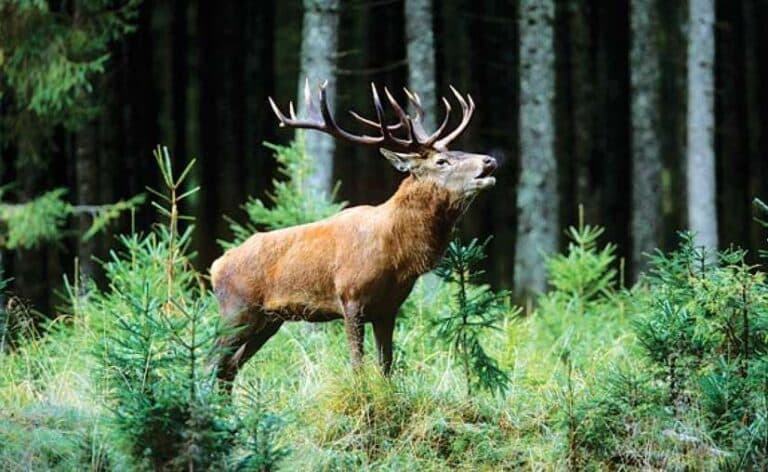
About Dachigam National Park:
- Location: It is located 22 km (kilometers) from Srinagar in Jammu and Kashmir.
- It covers an area of 141 sq km (square kilometers).
- The name literally stands for ‘ten villages’, which could be in memory of the ten villages that were relocated in order to create the park.
- It was initially established to ensure the supply of clean drinking water to Srinagar city.
- A protected area since 1910, it was declared a national park in 1981.
- The park is situated at altitudes ranging from 5500 ft to 14,000 ft.
- The park is best known as the home of the Hangul, or Kashmir stag. It holds the last viable population of the vulnerable hangul in the world.
- Terrain: Ranges from gently sloping grasslands to cliffs and sharp rocky outcrops.
- Flora: Includes wild cherry, apple, pear, peach, plum, apricot, chestnut, willow, walnut, oak, pine, birch, poplar, chinar, and elm.
- Fauna:
- Besides Hangul, Dachigam is also famous for its populations of musk deer, leopard, Himalayan Grey Langur, leopard cat, Himalayan Black Bear, yellow-throated marten, among others.
- It is the residence of raptors such as the Eurasian eagle owl, Lammergeier, Eurasian griffon and white-rumped vulture.
Key Facts about Kashmir Stag:
- It is also called Hangul, which is a subspecies of Central Asian red deer endemic to Kashmir and surrounding areas.
- It is found in dense riverine forests in the high valleys and mountains of Jammu and Kashmir and northern Himachal Pradesh.
- In Kashmir, it is found primarily in the Dachigam National Park where it receives protection.
- A small population has also been witnessed in Overa-Aru Wildlife Sanctuary in south Kashmir.
- Conservation status
- IUCN: Critically Endangered
- CITES : Appendix I
Q1) What is an Eco-sensitive zone?
They are created as “shock absorbers” for the protected areas, to minimize the negative impact on the “fragile ecosystems” by certain human activities taking place nearby. Furthermore, these areas are meant to act as a transition zone from areas requiring higher protection to those requiring lesser protection.
Source: Govt to prepare zonal master plan for eco-sensitive zone around Dachigam National Park






 Last updated on March, 2026
→ UPSC Final Result 2025 is now out.
→ UPSC has released UPSC Toppers List 2025 with the Civil Services final result on its official website.
→ Anuj Agnihotri secured AIR 1 in the UPSC Civil Services Examination 2025.
→ UPSC Marksheet 2025 is now out.
→ UPSC Notification 2026 & UPSC IFoS Notification 2026 is now out on the official website at upsconline.nic.in.
→ UPSC Calendar 2026 has been released.
→ Check out the latest UPSC Syllabus 2026 here.
→ UPSC Prelims 2026 will be conducted on 24th May, 2026 & UPSC Mains 2026 will be conducted on 21st August 2026.
→ The UPSC Selection Process is of 3 stages-Prelims, Mains and Interview.
→ Prepare effectively with Vajiram & Ravi’s UPSC Prelims Test Series 2026 featuring full-length mock tests, detailed solutions, and performance analysis.
→ Enroll in Vajiram & Ravi’s UPSC Mains Test Series 2026 for structured answer writing practice, expert evaluation, and exam-oriented feedback.
→ Join Vajiram & Ravi’s Best UPSC Mentorship Program for personalized guidance, strategy planning, and one-to-one support from experienced mentors.
→ Shakti Dubey secures AIR 1 in UPSC CSE Exam 2024.
→ Also check Best UPSC Coaching in India