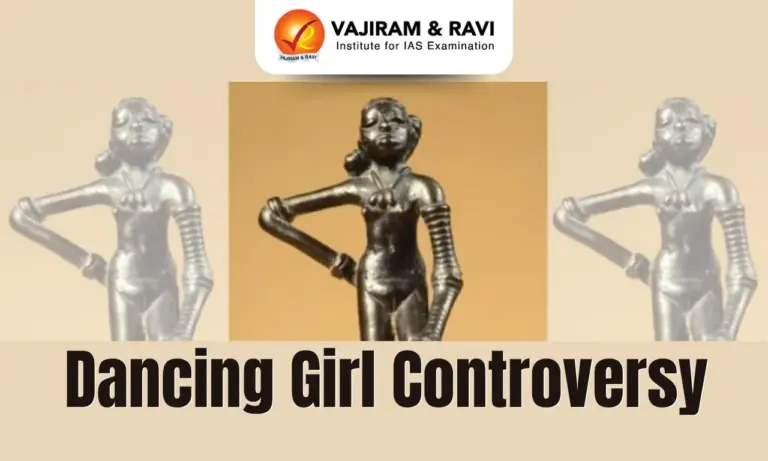
Dancing Girl Controversy Latest News
- NCERT’s Class 9 Arts Education textbook carried a digitally modified image of the iconic Harappan bronze figurine — the ‘Dancing Girl’ — with its torso covered, giving the impression of clothing.
- After widespread criticism, NCERT restored the original image. The episode has reignited a long-standing debate about historical authenticity versus contemporary moral sensibilities in educational content.
About the Artefact: Key Facts
- Civilisation – Harappan (Indus Valley), circa 2600–1900 BCE
- Discovered in – 1926, Mohenjo-daro (present-day Pakistan)
- Discovered by – John Marshall, then Director-General, ASI
- Material – Bronze
- Height – 10.8 cm
- Technique – Lost-wax casting (cire perdue)
- Currently housed – National Museum, New Delhi
- Description – Bare-torso female figure; 24–25 bangles on left arm, 4 on right; necklace; head tilted back, knees slightly bent
- The use of the lost-wax casting technique nearly 4,500 years ago is significant — it demonstrates the advanced state of ancient Indian metallurgy. The technique is still used in many parts of India today.


Why is it Called the ‘Dancing Girl’ — The Colonial Label
- The name was given by John Marshall during the 1926 excavation.
- Marshall described the figurine as a “young aboriginal nautch girl (professional female dancers and courtesans), her hand on hip in half-impudent posture… as she beats time to the music with her feet.”
- This label is now widely contested. Key points:
- No textual or archaeological evidence confirms she was a dancer.
- Historian Upinder Singh writes that the figurine “may not have been dancing at all, and even if she was, she may not represent a professional dancer.”
- Scholar Gregory Possehl also expressed doubt about the dancer identification.
- Historian Ashish Kumar (Panjab University) argues that colonial officials’ personal familiarity with nautch girls may have driven the instant association.
- Marshall also linked the figurine to the devadasi tradition — an attempt to project continuity from Harappan times to his own era, which scholars consider speculative.
- The label reflects colonial interpretive bias, not archaeological evidence. As historians note, labels attached to artefacts must be read in the context of the historical circumstances in which they were created.
Colonial Morality and the ‘Vulgarity’ Controversy
- The association of the figurine with vulgarity and nudity is not a recent development. It is rooted in the colonial value system itself.
- Colonial officials considered nudity in art as “immoral” and “vulgar.” They held Greek and Roman art as superior because it captured anatomy “accurately.”
- Indian representations — multiple limbs, heads, or nude forms — were dismissed as “irrational” and evidence of cultural inferiority.
- By contrast, the many nude terracotta female figurines found at Harappan sites were labelled as representations of the Mother Goddess — a more “respectable” category.
- The bronze figurine alone was singled out as a nautch girl. This double standard reveals how colonial frameworks shaped the interpretation of India’s own archaeological heritage.
Multiple Historical Interpretations
- Scholars have offered several alternative readings of who the figurine represents:
- Mother Goddess / Ritualistic Figure — Some scholars link it to the Mother Goddess cult prevalent across Harappan sites.
- Parvati / Shakti connection — A more recent theory draws on the existing association of Harappan religion with proto-Shiva imagery (the Pashupati seal). Where there is Shiva, there should be Shakti. This interpretation is not unanimously accepted.
- Warrior figure — The left arm shows an empty socket suggesting she may have held an object like a spear. The left arm is more ornamented than the right, which some interpret as the right arm being kept free for combat.
- The absence of written records from the Harappan civilisation means all interpretations remain speculative.
India-Pakistan Dispute Over the Artefact
- The figurine has also been at the centre of a bilateral heritage dispute — historically significant for understanding post-Partition cultural politics.
- At the time of Partition, around 12,000 Harappan objects from Mohenjo-daro were in Delhi, having been brought by Mortimer Wheeler (DG, ASI, 1944–48) for an exhibition. Pakistan demanded them back, claiming the sites lay in Pakistani territory.
- India argued that the Harappan civilisation was a common South Asian heritage, not exclusively Pakistani. Eventually, both countries agreed to a 50:50 division of artefacts from Mohenjo-daro and Chanhu-daro.
- Pakistan wanted both the ‘Dancing Girl’ and the ‘Priest King’. India was willing to part with only one.
- Pakistan chose the Priest King — precisely to avoid domestic backlash over a nude female figure, which officials feared would provoke religious opposition.
The NCERT Controversy and the Textbook Question
- The NCERT episode is not an isolated incident. A pattern of attempts to “clothe” or sanitise the figurine is visible:
- 2023: A fully clothed, colourful “contemporised version” of the Dancing Girl was unveiled as the mascot of the International Museum Expo by PM Modi.
- 2026: NCERT’s Class 9 textbook carried the digitally altered image with the torso covered.
- The core question raised is: should historical artefacts be presented as they are — reflecting the civilisational context in which they were created — or adapted to contemporary moral standards?
- Altering the artefact misrepresents the actual material culture of the Harappan civilisation and imposes present-day value judgements on the past.
Conclusion
- The ‘Dancing Girl’ is more than a 4,500-year-old bronze figurine — she is a mirror reflecting colonial biases, post-Partition politics, and contemporary anxieties about nudity and modernity.
- Altering her image in a textbook does not protect children; it distorts history. Honest engagement with the past, including its complexity, is the foundation of genuine historical education.

 Last updated on Oct, 2026
→ UPSC 2027 Notification will be released on 13 January 2027 at upsconline.nic.in.
→ Check Nobel Prize 2026 Winners List here.
→ Download PIB PRiSM Monthly Magazine 2026 here.
→ Check UPSC Monthly Current Affairs Magazine The Recitals here.
→ Check out the latest UPSC Syllabus here.
→ Download UPSC Model Answers for Mains 2026
→ UPSC Mains Question Paper 2026 is out now for Essay & GS Paper 1, 2, 3 & 4.
→ UPSC Calendar 2027 has been released.
→ Enroll in Vajiram & Ravi’s UPSC Mains Test Series 2027 for structured answer writing practice, expert evaluation, and exam-oriented feedback.
→ Join Vajiram & Ravi’s UPSC Mentorship Program 2027 for personalized guidance, strategy planning, and one-to-one support from experienced mentors.
→ Go through the UPSC Mains Previous Year Papers to enhance your preparation.
→ UPSC has released UPSC Toppers List 2025 with the Civil Services final result on its official website.
→ Also check Best UPSC Coaching in India
Dancing Girl Controversy FAQs
Q1. What is the Dancing Girl Controversy in recent debates?+
Q2. Why is the label central to the Dancing Girl Controversy?+
Q3. What historical interpretations feature in the Dancing Girl Controversy?+
Q4. How is Partition linked to the Dancing Girl Controversy?+
Q5. What educational issue lies at the heart of the Dancing Girl Controversy?+
Tags: Dancing Girl Controversy mains articles upsc current affairs upsc mains current affairs