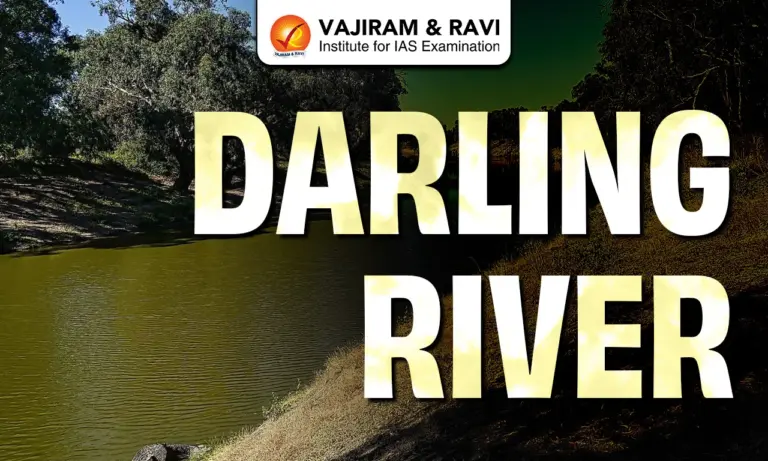
Darling River, located in southeastern Australia, is the third-longest river in the country and forms part of the crucial Murray-Darling Basin, which supports over 40% of Australia’s agricultural production.
Darling River
- The Darling River is located in the eastern and south-eastern part of the continent.
- It flows mainly through the state of New South Wales and forms the northern and western component of the larger Murray–Darling Basin.
- The river drains the western slopes of the Great Dividing Range, which is the major watershed of eastern Australia. Unlike many short coastal rivers that flow eastward into the Pacific Ocean, the Darling River flows inland across semi-arid plains before eventually joining the Murray River at Wentworth in New South Wales.
- The river system plays a central role in supporting inland agricultural regions of Australia.
Darling River Origin and Source
- The Darling River formed by the confluence of the Barwon and Culgoa Rivers near the town of Bourke in New South Wales.
- The Barwon River is formed by the meeting of the Macintyre and Weir Rivers, which rise in the Great Dividing Range in Queensland and northern New South Wales. Therefore, the ultimate source of the Darling River system lies in the Great Dividing Range.
- The river is entirely rain-fed and does not receive any contribution from glaciers or permanent snowfields.
- Its discharge depends heavily on seasonal rainfall patterns in Queensland, making its flow highly irregular and variable.





Darling River Tributaries
The Darling River has an extensive network of tributaries that contribute to its drainage basin.
- Important northern tributaries include the Condamine–Balonne River, the Warrego River, and the Paroo River, which originate in the uplands of Queensland.
- These rivers are strongly influenced by seasonal rainfall and often contribute significant water during flood events.
- However, many of them are intermittent or ephemeral during dry periods.
- In New South Wales, important tributaries include the Macquarie River, the Bogan River, the Culgoa River, and the Barwon River.
- The overall drainage pattern of the basin is predominantly dendritic, developed over ancient sedimentary plains with a gentle slope.
Read about: Loire River
Darling River Basin
- The Darling River forms a major component of the Murray–Darling Basin, which is the largest river basin in Australia. The Darling Basin constitutes the northern and western portion of this larger basin system.
- The entire Murray–Darling Basin covers approximately one million square kilometres, accounting for nearly 14 percent of Australia’s total land area.
- Physiographically, the basin consists mainly of flat to gently undulating plains with extensive alluvial floodplains.
- The river has a very low gradient, which causes it to flow slowly and develop a meandering course.
- Oxbow lakes and floodplain features are common due to periodic flooding.
- The soils in the basin include fertile alluvial soils as well as clay-rich and saline soils in irrigated areas.
- Climatically, the basin lies largely in a semi-arid to arid zone. Annual rainfall is generally low, ranging between 250 to 500 millimetres in many areas.
- The basin is strongly influenced by the El Nino-Southern Oscillation cycle, which leads to alternating drought and flood conditions.
- Economically, the basin is the backbone of inland Australian agriculture. It supports major crops such as wheat, cotton, rice, barley, citrus fruits, and grapes used in the wine industry.
Darling River Ecology
Despite its semi-arid location, the Darling River system supports important ecological zones.
- The river sustains riparian vegetation along its banks and supports floodplain forests and wetlands.
- Parts of the Murray-Darling Basin are designated as Ramsar wetlands due to their ecological importance.
- The basin provides habitat for native fish species such as the Murray cod, golden perch, and silver perch.
- It also supports waterbird breeding colonies during flood periods.
The Darling River has been extensively regulated to support irrigation and water supply. The most significant storage system on the river is the Menindee Lakes system, located near the town of Menindee in New South Wales. This system consists of a series of interconnected natural lakes that have been modified to function as large reservoirs. The lakes are used for irrigation supply, urban water provision, flood control, and flow regulation.

 Last updated on March, 2026
→ UPSC Final Result 2025 is now out.
→ UPSC has released UPSC Toppers List 2025 with the Civil Services final result on its official website.
→ Anuj Agnihotri secured AIR 1 in the UPSC Civil Services Examination 2025.
→ UPSC Marksheet 2025 is now out.
→ UPSC Notification 2026 & UPSC IFoS Notification 2026 is now out on the official website at upsconline.nic.in.
→ UPSC Calendar 2026 has been released.
→ Check out the latest UPSC Syllabus 2026 here.
→ UPSC Prelims 2026 will be conducted on 24th May, 2026 & UPSC Mains 2026 will be conducted on 21st August 2026.
→ The UPSC Selection Process is of 3 stages-Prelims, Mains and Interview.
→ Prepare effectively with Vajiram & Ravi’s UPSC Prelims Test Series 2026 featuring full-length mock tests, detailed solutions, and performance analysis.
→ Enroll in Vajiram & Ravi’s UPSC Mains Test Series 2026 for structured answer writing practice, expert evaluation, and exam-oriented feedback.
→ Join Vajiram & Ravi’s Best UPSC Mentorship Program for personalized guidance, strategy planning, and one-to-one support from experienced mentors.
→ Shakti Dubey secures AIR 1 in UPSC CSE Exam 2024.
→ Also check Best UPSC Coaching in India
Darling River FAQs
Q1. Where is the Darling River located?+
Q2. Which major river does the Darling River join?+
Q3. How is the Darling River formed?+
Q4. Name two important tributaries of the Darling River system.+
Q5. Which major river basin does the Darling River belong to?+
Q6. Which major storage system is built on the Darling River?+
Tags: darling river geography geography notes