Debt Recovery Tribunals (DRTs) Latest News
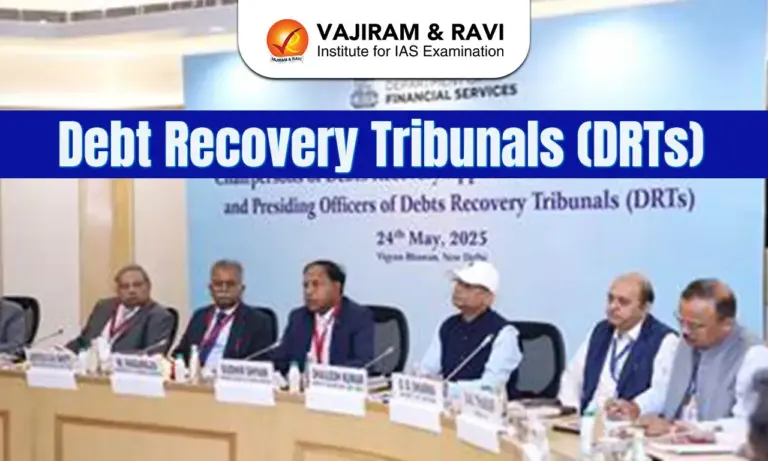
The Department of Financial Services (DFS) under the Ministry of Finance organised a colloquium recently at New Delhi, bringing together Chairpersons of Debt Recovery Appellate Tribunals (DRATs) and Presiding Officers of Debt Recovery Tribunals (DRTs).
About Debt Recovery Tribunals (DRTs)
- Debt Recovery Tribunals (DRTs) are quasi-judicial bodies established under the Recovery of Debts Due to Banks and Financial Institutions Act, 1993.
- Their primary role is adjudicating debt recovery disputes related to banks and financial institutions.
- DRTs handle loan default cases above ₹20 lakh, focusing on secured debts.
- DRTs also hear Securitisation Applications (SAs) filed under the SARFAESI Act, 2002 by borrowers or aggrieved parties.
- There are currently 39 DRTs functioning across India, each headed by a Presiding Officer.
Structure and Powers of DRTs
- A DRT is presided over by a judicial officer qualified to be a District Judge.
- It can also have administrative and technical members appointed by the Central Government.
- Under Section 22(2) of the Recovery of Debts Act, DRTs have powers to:
- Summon and examine witnesses,
- Compel the production of documents,
- Receive evidence on affidavits,
- Review or dismiss applications,
- Conduct ex parte proceedings,
- Issue commissions for document and witness examination.
- Jurisdiction of DRTs: Each DRT has a territorial jurisdiction defined by the Central Government.
- Jurisdiction is limited to cases involving debt recovery by banks and financial institutions.





About Debt Recovery Appellate Tribunals (DRATs)
- DRATs are the appellate authorities for decisions made by DRTs.
- Appeals can be filed by aggrieved parties seeking review of DRT rulings.
- Currently, 5 DRATs are functioning in India, each headed by a Chairperson.
- DRATs ensure judicial oversight and uniformity in debt recovery matters and promote legal clarity on complex recovery disputes.
Debt Recovery Tribunals (DRTs) FAQs
Q1. What are Debt Recovery Tribunals (DRTs)?
Ans: DRTs are quasi-judicial bodies established under the Recovery of Debts and Bankruptcy Act, 1993 to facilitate the expeditious recovery of debts due to banks and financial institutions.
Q2. How many DRTs and DRATs are there in India?
Ans: As of now, there are 39 DRTs and 5 Debt Recovery Appellate Tribunals (DRATs) functioning across India.
Q3. What is the monetary limit for cases to be filed in DRT?
Ans: A bank or financial institution can approach a DRT if the debt amount is ₹20 lakh or more.
Source: PIB

 Last updated on March, 2026
→ UPSC Final Result 2025 is now out.
→ UPSC has released UPSC Toppers List 2025 with the Civil Services final result on its official website.
→ Anuj Agnihotri secured AIR 1 in the UPSC Civil Services Examination 2025.
→ UPSC Marksheet 2025 is now out.
→ UPSC Notification 2026 & UPSC IFoS Notification 2026 is now out on the official website at upsconline.nic.in.
→ UPSC Calendar 2026 has been released.
→ Check out the latest UPSC Syllabus 2026 here.
→ UPSC Prelims 2026 will be conducted on 24th May, 2026 & UPSC Mains 2026 will be conducted on 21st August 2026.
→ The UPSC Selection Process is of 3 stages-Prelims, Mains and Interview.
→ Prepare effectively with Vajiram & Ravi’s UPSC Prelims Test Series 2026 featuring full-length mock tests, detailed solutions, and performance analysis.
→ Enroll in Vajiram & Ravi’s UPSC Mains Test Series 2026 for structured answer writing practice, expert evaluation, and exam-oriented feedback.
→ Join Vajiram & Ravi’s Best UPSC Mentorship Program for personalized guidance, strategy planning, and one-to-one support from experienced mentors.
→ Shakti Dubey secures AIR 1 in UPSC CSE Exam 2024.
→ Also check Best UPSC Coaching in India
Tags: Debt Recovery Tribunals (DRTs) prelims pointers upsc prelims current affairs