Global Shipping Decarbonisation Latest News
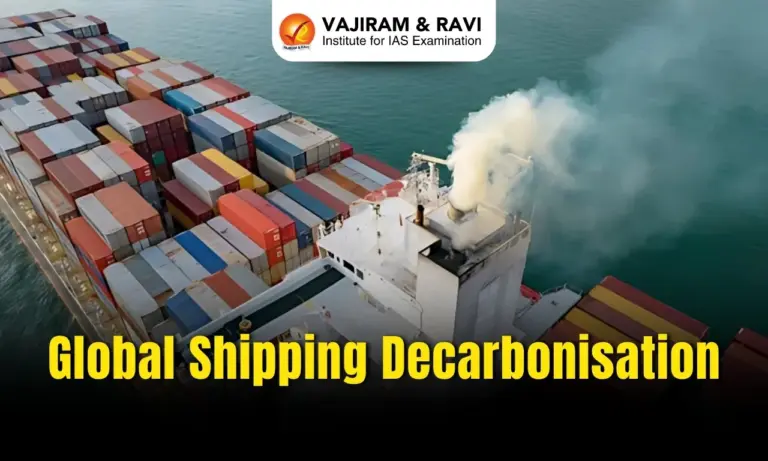
- Global shipping aims for decarbonisation by 2040–50, shifting from Very Low Sulphur Fuel Oil (VLSFO), diesel, and LNG to green fuels like green ammonia, e-methanol, and biofuels.
- This transition offers significant opportunities for India.
Production of Green Fuels
- Green hydrogen is produced via water electrolysis using renewable energy.
- For shipping, more stable alternatives like green ammonia (from green hydrogen and nitrogen) and green methanol (from green hydrogen and industrial carbon dioxide) are preferred.
- India promotes green ammonia to reduce LNG imports in fertilizer production.





Green Methanol as Shipping’s Preferred Transition Fuel
- Shipping is gradually adopting green methanol as its primary decarbonisation fuel due to its ease of use and lower carbon emissions—about 10% compared to conventional fuels.
- Green methanol can largely replace VLSFO without major engine modifications, unlike green ammonia, which, despite emitting no greenhouse gases, requires complex onboard handling.
- Over 360 methanol-capable ships are already operational or on order, supported by major companies like Maersk, CMA CGM, and Evergreen.
- However, green e-methanol is significantly more expensive—costing $1,950 per tonne in Singapore as of February, compared to $560 per tonne for VLSFO.
- This price gap is driven by high renewable electricity requirements (10–11 MWh per tonne of methanol) and the substantial upfront cost of electrolyser facilities.
- Demand for green methanol is projected to exceed 14 million tonnes by 2028, while supply is expected to lag at around 11 million tonnes, adding further price pressure.
India’s Shipping Decarbonisation Strategy and Global Green Fuel Ambitions
- India plans to decarbonise its domestic shipping by promoting green fuels for container ships and establishing green fuel bunkering hubs at ports like Tuticorin (V.O. Chidambaranar) and Kandla.
- The government also aims to produce and export green fuels to Singapore, a major global ship fuelling hub handling nearly 25% of the world’s ship fuel needs.
- With its large solar power capacity and expertise, India is positioning itself as a key global supplier of green fuels to support international shipping’s shift towards sustainability.
Building India’s Green Marine Fuel Hub: Challenges and Solutions
- India aims to become a major producer of marine green fuels like green methanol but faces challenges such as dependence on imported solar panels and electrolysers.
- However, India’s solar power growth—from 2.82 GW in 2014 to 105 GW in 2025—shows how sovereign guarantees and strategic policies can overcome such hurdles.
- Sovereign guarantees help lower project costs by enabling cheaper international financing.
- For large-scale green methanol production, India needs innovative financial tools, including Production-Linked Incentive (PLI) schemes for electrolysers and incentives for carbon capture, utilisation, and storage (CCUS).
- These measures would support local value chains, reduce raw material transport costs, and make green methanol production from captured CO₂ feasible.
- The government’s push to establish 1.5 GW local electrolyser manufacturing capacity and expanded industrial CO₂ sourcing positions India well for developing integrated green fuel hubs.
- Multilateral development banks offering low-interest financing (around 4% compared to 11–12% from Indian lenders) can also be leveraged to scale up efforts.
Reviving Indian Shipbuilding Through Green Fuel Initiatives
- To boost shipbuilding and shipowning, India is offering demand-side support and incentives for foreign partnerships, especially with South Korean and Japanese shipbuilders.
- The focus is on building new ships and retrofitting existing ones for green fuel compatibility.
- India has committed $10 billion to purchase over 110 ships, with plans to ensure 10–20% of these are green fuel-capable, built in Indian shipyards, and fly the Indian flag.
- This strategy aims to scale up local shipbuilding while aligning with global decarbonisation goals.

 Last updated on March, 2026
→ UPSC Final Result 2025 is now out.
→ UPSC has released UPSC Toppers List 2025 with the Civil Services final result on its official website.
→ Anuj Agnihotri secured AIR 1 in the UPSC Civil Services Examination 2025.
→ UPSC Marksheet 2025 is now out.
→ UPSC Notification 2026 & UPSC IFoS Notification 2026 is now out on the official website at upsconline.nic.in.
→ UPSC Calendar 2026 has been released.
→ Check out the latest UPSC Syllabus 2026 here.
→ UPSC Prelims 2026 will be conducted on 24th May, 2026 & UPSC Mains 2026 will be conducted on 21st August 2026.
→ The UPSC Selection Process is of 3 stages-Prelims, Mains and Interview.
→ Prepare effectively with Vajiram & Ravi’s UPSC Prelims Test Series 2026 featuring full-length mock tests, detailed solutions, and performance analysis.
→ Enroll in Vajiram & Ravi’s UPSC Mains Test Series 2026 for structured answer writing practice, expert evaluation, and exam-oriented feedback.
→ Join Vajiram & Ravi’s Best UPSC Mentorship Program for personalized guidance, strategy planning, and one-to-one support from experienced mentors.
→ Shakti Dubey secures AIR 1 in UPSC CSE Exam 2024.
→ Also check Best UPSC Coaching in India
Global Shipping Decarbonisation FAQs
Q1. What is global shipping’s decarbonisation target?+
Q2. Why is green methanol preferred over green ammonia?+
Q3. What is India’s plan for green fuel bunkering?+
Q4. How will India finance green methanol production?+
Q5. How is India reviving shipbuilding through green fuels?+
Tags: global shipping decarbonisation mains articles upsc current affairs upsc mains current affairs