Harappan Script Latest News
- The Union Ministry of Culture will host a conference in New Delhi from September 11 to 13, bringing together archaeologists, scientists, and experts from diverse fields to present findings on the undeciphered Harappan script, a mystery since its discovery in the 1920s.
- The event is being organised by the Indira Gandhi National Centre for the Arts (IGNCA), an autonomous body under the Culture Ministry.
The Enigma of the Indus Valley Script
- Since its discovery in the 1920s by Sir John Marshall’s team, the script of the Indus Valley Civilisation (IVC) has remained undeciphered.
- The civilisation, flourishing between 2600–1900 BCE, covered nearly 800,000 sq. km across present-day Pakistan and north-west India, making it the world’s largest urban culture of its time, with advanced trade, taxation, and drainage systems.
Nature of the Inscriptions
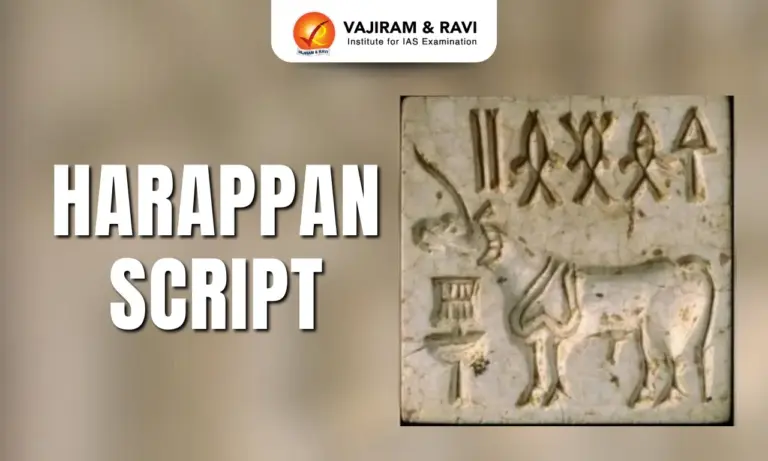
- Indus inscriptions appear on seal stones, terracotta tablets, and occasionally on metal, often combining pictograms with animal or human motifs.
- Scholars continue to debate the total number of signs in the script.
- Estimates vary widely: archaeologist S.R. Rao suggested 62 signs in 1982, Finnish Indologist Asko Parpola proposed 425 signs in 1994, while Bryan K. Wells estimated 676 signs as recently as 2016.
Debates on Linguistic Roots
- The script’s linguistic base remains unresolved.
- Sir Alexander Cunningham, who first reported a Harappan seal, linked the script to Brahmi — the ancestor of over 200 South and Southeast Asian scripts.
- Other scholars supported this Brahmi connection.
- However, Parpola rejects this, arguing instead that Brahmi evolved from the Aramaic script used in the Persian Empire, distancing it from Harappan origins.
- The lack of consensus on both the number of symbols and the language underlying the script underscores why the Indus script remains one of history’s greatest undeciphered puzzles.





Debates on the Harappan Script at Upcoming Conference
- The papers to be presented at the Culture Ministry’s conference on the Harappan script reveal widely differing conclusions.
- This underscores the continuing mystery of the undeciphered language of the Indus Valley Civilisation.
Competing Theories on the Script
- Sanskrit and Vedic Linkages: Some researchers claim the script is based on Sanskrit or even contains Rig Vedic mantras. They argue that Indus seals had primarily religious significance, even identifying references to Puranas — though historians note these texts were composed much later.
- Dravidian Roots: Few experts assert that 90% of the script has been deciphered as Gondi, a Proto-Dravidian language.
- Santali Connection: Many experts link the script to the Santali language, inspired by Indologist Asko Parpola’s research.
Scholarly Challenges
- Historians stress that deciphering the script requires rigorous interdisciplinary methods.
- They note the absence of bilingual inscriptions, the vast geographical spread of the civilisation, and its longevity make it unlikely that a single language underpinned the script.
- The diversity of claims — from Sanskrit and Dravidian to Santali and Gondi — illustrates both the fascination and the difficulty of unlocking the Harappan script.
- Experts agree that no credible breakthrough has yet been achieved, and the task requires more systematic, contextual, and comparative study.
The Politics of Deciphering the Harappan Script
- The search for decoding the Harappan script is not just an academic pursuit but one heavily shaped by political and cultural narratives in India.
- Tamil Nadu CM M.K. Stalin has offered a $1 million award for anyone who can credibly decipher the script.
- A Dravidian-origin conclusion would allow the political party in Tamil Nadu to claim that the subcontinent’s oldest civilisation has southern roots rather than being exclusively northern in origin.
- On the other hand, various groups view the Harappan script as a means to counter the Aryan migration theory.
- They argue that Harappans were Vedic people, pointing to the Ghaggar-Hakra (linked to the Saraswati River of the Rig Veda) as central evidence.
- If proven, the script’s language would be Sanskrit, strengthening the Vedic-Harappan continuity argument.

 Last updated on March, 2026
→ UPSC Final Result 2025 is now out.
→ UPSC has released UPSC Toppers List 2025 with the Civil Services final result on its official website.
→ Anuj Agnihotri secured AIR 1 in the UPSC Civil Services Examination 2025.
→ UPSC Marksheet 2025 is now out.
→ UPSC Notification 2026 & UPSC IFoS Notification 2026 is now out on the official website at upsconline.nic.in.
→ UPSC Calendar 2026 has been released.
→ Check out the latest UPSC Syllabus 2026 here.
→ UPSC Prelims 2026 will be conducted on 24th May, 2026 & UPSC Mains 2026 will be conducted on 21st August 2026.
→ The UPSC Selection Process is of 3 stages-Prelims, Mains and Interview.
→ Prepare effectively with Vajiram & Ravi’s UPSC Prelims Test Series 2026 featuring full-length mock tests, detailed solutions, and performance analysis.
→ Enroll in Vajiram & Ravi’s UPSC Mains Test Series 2026 for structured answer writing practice, expert evaluation, and exam-oriented feedback.
→ Join Vajiram & Ravi’s Best UPSC Mentorship Program for personalized guidance, strategy planning, and one-to-one support from experienced mentors.
→ Shakti Dubey secures AIR 1 in UPSC CSE Exam 2024.
→ Also check Best UPSC Coaching in India
Harappan Script FAQs
Q1. What is the Harappan script?+
Q2. Why is the Harappan script difficult to decipher?+
Q3. What are the main theories about the Harappan script?+
Q4. Why is the Harappan script politicised?+
Q5. What is the goal of the upcoming conference+
Tags: harappan scrip mains articles upsc current affairs upsc mains current affairs