About Deda Method:
- It is a method of preserving seeds that his ancestors handed over to his family.
- How do they preserve?
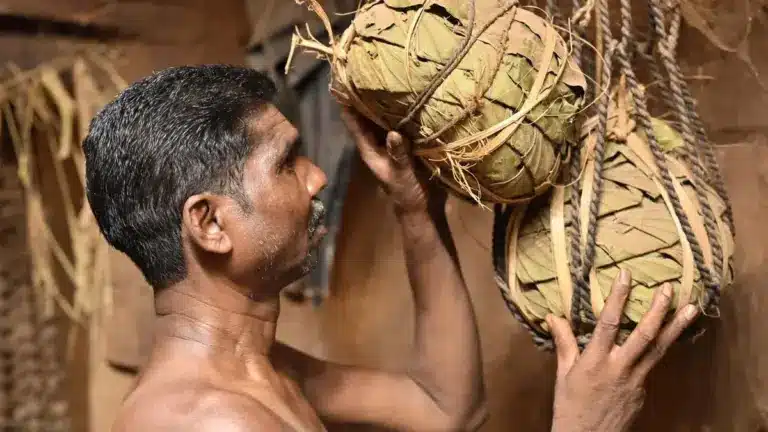
- The seeds are preserved in leaves and packed almost airtight to look like boulders from a distance.
- The packaged seeds are, in turn, woven with Siali leaf (Bauhinia vahlii), which is locally known as ‘addakulu’ to make the deda.
- A deda has three layers. In the first layer, wood ash is spread inside the Siali leaves.
- Later, the ash is covered with lemon leaves to form a casing, and, lastly, the seeds are preserved inside the casing and sealed. Each deda is crafted to support at least 5kg of seeds.
- Advantages
- The deda method guarantees protection of seed from pests and worms.
- In this method, the stored seeds can be used for cultivation for up to five years.
- It helps in preserving the seeds of pulses like the green gram, red gram, black gram and beans.
Key facts about Muria Tribe
- Location: They are located in the states of Telangana, Andhra Pradesh, Chhattisgarh and Odisha. They speak Koya, which is a Dravidian language.
- The Muria settlements are known as habitations of Internally Displaced People (IDPs), whose population is around 6,600 in A.P., and they here are referred to as ‘Gutti Koyas’ by the native tribes.
- They have progressive perspective towards marriage and life as a whole. The biggest example being the Ghotul (a commune or dormitory), which is meant to create an environment for Muria youth to understand their sexuality.
- Gutti Koyas’ The held ST status in Chattisgarh but they were not granted ST status in their migrated states such as Telangana.
Q1: What is the characteristic of Monocot plants?
These are marked by seeds with a single cotyledon, parallel-veined leaves, scattered vascular bundles in the stem, the absence of a typical cambium, and an adventitious root system.
Source: Muria tribes’ own eco-friendly, foolproof seed preservation method






 Last updated on March, 2026
→ UPSC Final Result 2025 is now out.
→ UPSC has released UPSC Toppers List 2025 with the Civil Services final result on its official website.
→ Anuj Agnihotri secured AIR 1 in the UPSC Civil Services Examination 2025.
→ UPSC Marksheet 2025 is now out.
→ UPSC Notification 2026 & UPSC IFoS Notification 2026 is now out on the official website at upsconline.nic.in.
→ UPSC Calendar 2026 has been released.
→ Check out the latest UPSC Syllabus 2026 here.
→ UPSC Prelims 2026 will be conducted on 24th May, 2026 & UPSC Mains 2026 will be conducted on 21st August 2026.
→ The UPSC Selection Process is of 3 stages-Prelims, Mains and Interview.
→ Prepare effectively with Vajiram & Ravi’s UPSC Prelims Test Series 2026 featuring full-length mock tests, detailed solutions, and performance analysis.
→ Enroll in Vajiram & Ravi’s UPSC Mains Test Series 2026 for structured answer writing practice, expert evaluation, and exam-oriented feedback.
→ Join Vajiram & Ravi’s Best UPSC Mentorship Program for personalized guidance, strategy planning, and one-to-one support from experienced mentors.
→ Shakti Dubey secures AIR 1 in UPSC CSE Exam 2024.
→ Also check Best UPSC Coaching in India