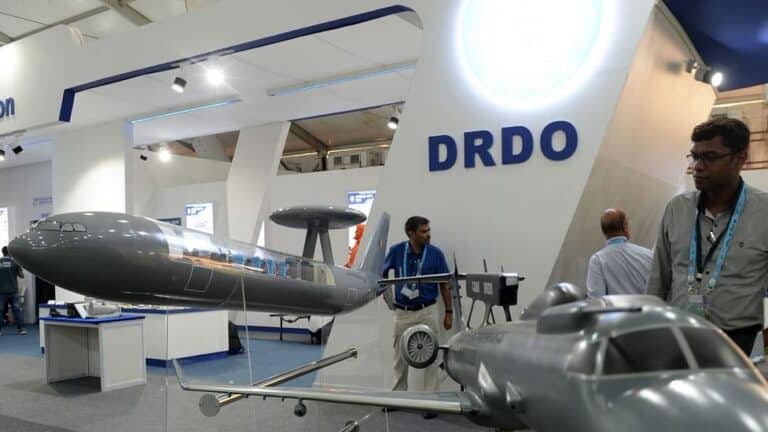
About Defence Research and Development Organisation (DRDO):
- It is the R&D wing of the Ministry of Defence, Govt of India, with a vision to empower India with cutting-edge defence technologies and a mission to achieve self-reliance in critical defence technologies and systems.
- It is India’s largest research organisation.
- Formation: The organisation was formed in 1958 from the amalgamation of the then already functioning Technical Development Establishment (TDEs) of the Indian Army and the Directorate of Technical Development & Production (DTDP) with the Defence Science Organisation (DSO).
- Headquarters: New Delhi.
- It has a network of laboratories engaged in developing defence technologies covering various fields, like aeronautics, armaments, electronics, land combat engineering, life sciences, materials, missiles, and naval systems.
- Major Projects:
- DRDO’s first project for the Indian military was in surface-to-air missiles (SAM) known as Project Indigo. However, it received little success and was therefore discontinued.
- Since being set up, DRDO has achieved many successes in developing major systems and critical technologies like aircraft avionics, UAVs, small arms, artillery systems, EW Systems, tanks and armoured vehicles, sonar systems, command and control systems and missile systems.
- In 2016, It successfully tested its first indigenously developed heavy-duty drone, Rustom 2, which is an unmanned armed combat vehicle developed on the lines of the US’s Predator drone.
- DRDO co-developed INS Arihant, India’s first nuclear ballistic missile submarine, which became operational in 2018.
- In March 2019, DRDO developed India’s first anti-satellite system that made India one of the space superpowers.
- DRDO has also developed several ballistic missiles under its Integrated Guided Missile Development Programme, which includes missiles like Prithvi, Trishul, Agni, Akash and Nag.
Q1) What is an Unmanned Aerial Vehicle (UAV)?
An Unmanned Aerial Vehicle (UAV), often referred to as a drone, is an aircraft that operates without a human pilot on board. UAVs are controlled remotely by a human operator or autonomously by onboard computers. These vehicles can vary greatly in size, design, and capabilities, and they are used for a wide range of applications across various industries.






 Last updated on March, 2026
→ UPSC Final Result 2025 is now out.
→ UPSC has released UPSC Toppers List 2025 with the Civil Services final result on its official website.
→ Anuj Agnihotri secured AIR 1 in the UPSC Civil Services Examination 2025.
→ UPSC Marksheet 2025 is now out.
→ UPSC Notification 2026 & UPSC IFoS Notification 2026 is now out on the official website at upsconline.nic.in.
→ UPSC Calendar 2026 has been released.
→ Check out the latest UPSC Syllabus 2026 here.
→ UPSC Prelims 2026 will be conducted on 24th May, 2026 & UPSC Mains 2026 will be conducted on 21st August 2026.
→ The UPSC Selection Process is of 3 stages-Prelims, Mains and Interview.
→ Prepare effectively with Vajiram & Ravi’s UPSC Prelims Test Series 2026 featuring full-length mock tests, detailed solutions, and performance analysis.
→ Enroll in Vajiram & Ravi’s UPSC Mains Test Series 2026 for structured answer writing practice, expert evaluation, and exam-oriented feedback.
→ Join Vajiram & Ravi’s Best UPSC Mentorship Program for personalized guidance, strategy planning, and one-to-one support from experienced mentors.
→ Shakti Dubey secures AIR 1 in UPSC CSE Exam 2024.
→ Also check Best UPSC Coaching in India