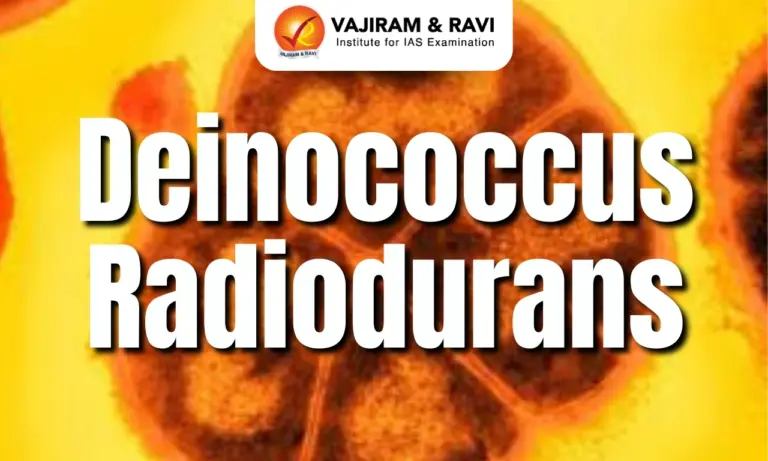
Deinococcus radiodurans Latest News
Researchers recently found that the bacteria Deinococcus radiodurans, famous for being able to survive extreme radiation and dryness, can also survive the intense pressures of being blasted off of a planet’s surface: 14,000-24,000 earth atmospheres.
About Deinococcus radiodurans
- It is a bacterium best known for its extreme resistance to the lethal effects of ionizing radiation.
- This bacterium is gram-positive (which means it has a certain kind of cell wall), doesn’t move on its own (it’s nonmotile), and has a reddish color.
- It was first found in 1956 in canned meat that had been treated with radiation to kill germs.
- Dubbed “Conan the Bacterium” for its extraordinary ability to tolerate the harshest of conditions, D. radiodurans can withstand radiation doses thousands of times higher than what would kill a human.
- It is known as the most radiation-resistant organism on Earth.
- The secret behind this impressive resistance is the presence of a collection of simple metabolites, which combine with manganese to form a powerful antioxidant that is more resistant to radiation.
- D. radiodurans has special ways to fix its own DNA if it gets damaged. An enzyme called thioredoxin reductase helps its cells fix broken DNA strands.
- It can also get rid of damaged DNA parts and has extra copies of its important genes.
- This helps it recover from being very dry (called desiccation) or from not having enough food (called starvation).
- It can live through extreme cold, dehydration, vacuum, and even acid.
Source: TH






 Last updated on March, 2026
→ UPSC Final Result 2025 is now out.
→ UPSC has released UPSC Toppers List 2025 with the Civil Services final result on its official website.
→ Anuj Agnihotri secured AIR 1 in the UPSC Civil Services Examination 2025.
→ UPSC Marksheet 2025 is now out.
→ UPSC Notification 2026 & UPSC IFoS Notification 2026 is now out on the official website at upsconline.nic.in.
→ UPSC Calendar 2026 has been released.
→ Check out the latest UPSC Syllabus 2026 here.
→ UPSC Prelims 2026 will be conducted on 24th May, 2026 & UPSC Mains 2026 will be conducted on 21st August 2026.
→ The UPSC Selection Process is of 3 stages-Prelims, Mains and Interview.
→ Prepare effectively with Vajiram & Ravi’s UPSC Prelims Test Series 2026 featuring full-length mock tests, detailed solutions, and performance analysis.
→ Enroll in Vajiram & Ravi’s UPSC Mains Test Series 2026 for structured answer writing practice, expert evaluation, and exam-oriented feedback.
→ Join Vajiram & Ravi’s Best UPSC Mentorship Program for personalized guidance, strategy planning, and one-to-one support from experienced mentors.
→ Shakti Dubey secures AIR 1 in UPSC CSE Exam 2024.
→ Also check Best UPSC Coaching in India
Deinococcus radiodurans FAQs
Q1. What is Deinococcus radiodurans?+
Q2. Is Deinococcus radiodurans gram-positive or gram-negative?+
Q3. What colour is Deinococcus radiodurans?+
Q4. What helps Deinococcus radiodurans resist radiation damage?+
Tags: deinococcus radiodurans prelims pointers upsc current affairs upsc prelims current affairs