Air Pollution Latest News
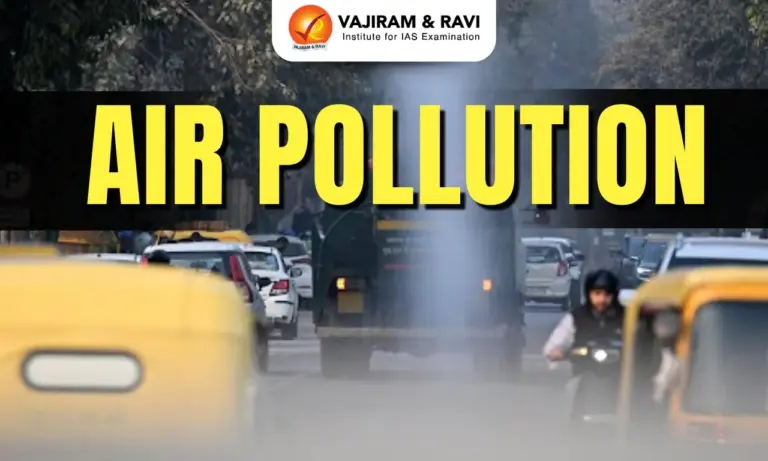
- A recent Delhi-NCR air pollution report tabled in Parliament has highlighted the urgent need to curb vehicular emissions, recommending a comprehensive review of India’s emission standards.
Delhi-NCR Air Pollution: Parliamentary Panel Calls for Stronger Standards and Systemic Reforms
- Air pollution in Delhi-NCR continues to be one of India’s most complex environmental challenges, driven by vehicular emissions, industrial activities, stubble burning, and unfavourable meteorological conditions.
- A recent report by the Parliamentary Standing Committee on Science and Technology, Environment, Forests and Climate Change has made several policy recommendations aimed at strengthening India’s regulatory and technological response to deteriorating air quality.
- These recommendations are designed to guide government action, address existing gaps, and protect vulnerable populations.





Need to Strengthen Vehicular Emission Standards
- Vehicular emissions remain a major contributor to Delhi-NCR’s particulate matter and ozone levels.
- The panel has emphasised that a comprehensive review of India’s vehicular emission standards is necessary to align with evolving scientific knowledge and global best practices.
- While acknowledging the government’s push for ethanol blending to enhance energy security, the panel cautioned against unintended environmental impacts.
- Increased nitrogen oxide (NOx) emissions from ethanol-blended fuels and the problem of evaporative emissions, fuel vapours escaping from vehicles and generating ground-level ozone, require closer scrutiny.
- To mitigate this, the panel recommended adopting more stringent evaporative emission standards, which would require automobile manufacturers to incorporate better emission control systems.
- This is crucial for India’s transition to cleaner fuels and sustainable mobility.
Encouraging Adoption of Electric Vehicles
- The report highlights that while India aims to increase the adoption of EVs, several bottlenecks continue to hinder progress.
- To accelerate EV uptake, the committee suggested a combination of incentives and disincentives:
- Cheaper or free public parking for EVs
- Higher parking rates for petrol and diesel vehicles
- Offering tax incentives on EV loans
- Considering an annual ceiling on the registration of non-electric vehicles in Delhi-NCR
- These measures aim to shift consumer behaviour while simultaneously easing the region’s pollution burden.
Air Purifiers in Schools, Hospitals, and Government Offices
- Children and patients are among the most vulnerable to toxic air. The committee therefore recommended mandatory installation of air purifiers in:
- All public schools in Delhi-NCR
- All public hospitals, especially the critical wards
- All government offices
- It also pointed out that levying GST on air purifiers, devices essential for mitigating public health risks, effectively “monetises a public health failure.”
- The panel suggested abolishing or reducing GST on air purifiers and HEPA filters to increase accessibility.
Upgrading National Ambient Air Quality Standards
- The panel called for the Centre to expedite the revision of National Ambient Air Quality Standards (NAAQS).
- These standards, last updated in 2009, need to reflect new scientific research, health data, and WHO benchmarks.
- The committee also recommended installing pollution-cutting devices in all thermal power plants within a 300-km radius of Delhi-NCR.
- This would ensure a significant reduction in SO₂, NOx, and particulate emissions from one of the region’s largest polluting sources.
- Delhi’s PM2.5 levels, the report noted, must fall by 62% to meet India’s air quality norms and by 95% to meet WHO standards, indicating the magnitude of intervention required.
Monitoring Stubble Burning More Effectively
- Stubble burning remains a recurrent seasonal crisis in North India. The panel expressed concern that some farmers are finding ways to evade satellite detection of crop fires.
- To strengthen enforcement, the committee recommended:
- Launch of a high-resolution ISRO satellite dedicated to monitoring farm fires 24×7
- Integration of satellite data with digital farm records for real-time tracking
- This would help the government respond more effectively while also supporting early warning systems and targeted assistance programmes.
Holistic Approach to Air Quality Management
- The report stresses that no single policy can solve the region’s pollution crisis. Instead, a coordinated approach, combining emissions control, technological investment, regulatory reform, and behavioural incentives, is essential.
- By addressing systemic issues in transportation, energy production, agriculture, and urban infrastructure, the recommendations aim to align Delhi-NCR’s air quality management with global best practices.
Source: IE

 Last updated on March, 2026
→ UPSC Final Result 2025 is now out.
→ UPSC has released UPSC Toppers List 2025 with the Civil Services final result on its official website.
→ Anuj Agnihotri secured AIR 1 in the UPSC Civil Services Examination 2025.
→ UPSC Marksheet 2025 is now out.
→ UPSC Notification 2026 & UPSC IFoS Notification 2026 is now out on the official website at upsconline.nic.in.
→ UPSC Calendar 2026 has been released.
→ Check out the latest UPSC Syllabus 2026 here.
→ UPSC Prelims 2026 will be conducted on 24th May, 2026 & UPSC Mains 2026 will be conducted on 21st August 2026.
→ The UPSC Selection Process is of 3 stages-Prelims, Mains and Interview.
→ Prepare effectively with Vajiram & Ravi’s UPSC Prelims Test Series 2026 featuring full-length mock tests, detailed solutions, and performance analysis.
→ Enroll in Vajiram & Ravi’s UPSC Mains Test Series 2026 for structured answer writing practice, expert evaluation, and exam-oriented feedback.
→ Join Vajiram & Ravi’s Best UPSC Mentorship Program for personalized guidance, strategy planning, and one-to-one support from experienced mentors.
→ Shakti Dubey secures AIR 1 in UPSC CSE Exam 2024.
→ Also check Best UPSC Coaching in India
Air Pollution FAQs
Q1. What major reform did the panel recommend on vehicular emissions?+
Q2. What did the panel suggest regarding air purifiers in Delhi-NCR?+
Q3. How did the committee propose boosting EV adoption?+
Q4. What solution was suggested for tracking stubble burning more accurately?+
Q5. What did the panel highlight about Delhi’s PM2.5 levels?+
Tags: air pollution mains articles upsc current affairs upsc mains current affairs