Delhi Loudspeaker Rules News
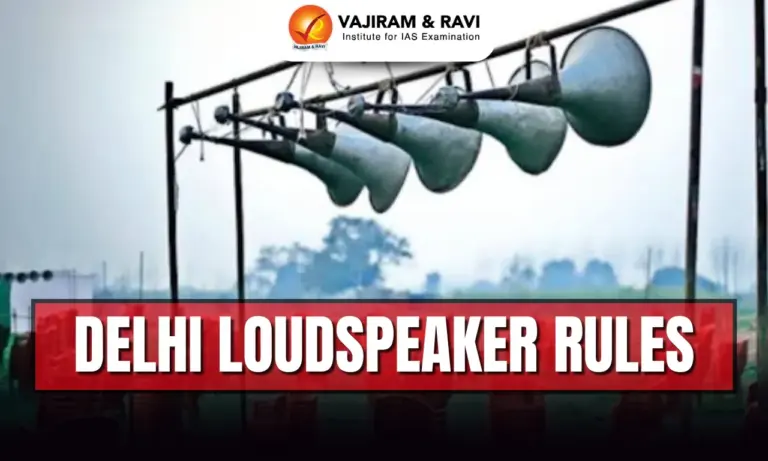
- Delhi CM Rekha Gupta announced that during cultural events like Ramlila and Durga Puja, loudspeaker use will be allowed till midnight, extending the usual 10 pm limit by two hours.
- The move aligns with legal provisions that permit state governments to relax loudspeaker restrictions during festivals and cultural occasions, while still operating within the framework of India’s Noise Pollution (Regulation and Control) Rules, 2000.
Legal Framework Governing Loudspeakers in India
- The Noise Pollution (Regulation and Control) Rules, 2000, under the Environment (Protection) Act, 1986, regulate the use of loudspeakers.
- Rule 5(1) requires written permission from authorities before use, while Rule 5(2) bans their use between 10 pm and 6 am, except in closed premises like auditoriums or conference halls.
- The rules prescribe maximum permissible noise levels for different areas, categorised as industrial, commercial, residential and silence zones.
- For residential areas, the daytime limit (6 am to 10 pm) is 55 decibels (dB) while that for nighttime is 45 dB.
- For context, a whisper is about 30 dB, while normal conversation is about 60 dB.
- For residential areas, the daytime limit (6 am to 10 pm) is 55 decibels (dB) while that for nighttime is 45 dB.
- Importantly, Rule 5(3) allows state governments to relax restrictions, permitting loudspeaker use till midnight for up to 15 days a year during cultural or religious festivities.
- Delhi’s decision to extend the loudspeaker deadline for festivals falls within this legal provision.





Court Rulings on Loudspeaker Use in India
- Over the past two decades, Indian courts have shaped a strong jurisprudence on noise pollution, balancing religious freedom with the fundamental right to a peaceful environment.
Supreme Court: Loudspeakers Not a Fundamental Right
- In 2000, the Supreme Court ruled that no religion mandates prayers by disturbing others, rejecting the use of loudspeakers as a right under Article 25 (freedom of religion).
- In 2005, it further held that the right to a noise-free environment is implicit under Article 21, and “aural aggression” cannot be justified under free speech.
- This ruling established the 10 pm–6 am loudspeaker ban.
- The Court upheld Rule 5(3) allowing exemptions till midnight for up to 15 days annually, but imposed strict conditions: only state governments can grant it, it must apply statewide, and silence zones remain excluded.
High Court Directions
- High Courts have strictly enforced these principles:
- Bombay HC (2016): Loudspeakers not essential to religion; pulled up government for lax enforcement.
- Karnataka HC (2018): Allowed indoor concert use at night, provided boundary noise limits were respected.
- Punjab & Haryana HC (2019): Made written permission mandatory for all religious use, set up complaint mechanisms.
- Allahabad HC (2020): Azaan is essential, but loudspeakers are not historically required.
Recent Ruling: Bombay HC (2025)
- The court introduced a graded penalty system: caution for first offence, fines for repeat, and seizure for continued violations.
- It also mandated considering cumulative noise levels from multiple sources and suggested modern enforcement, such as mobile decibel apps and auto-limiters in speakers.
Concerns Over Delhi’s Loudspeaker Extension
- Environmental experts criticised Delhi’s decision to allow loudspeakers till midnight, calling it a backward step that undermines Noise Pollution Rules designed to protect children, patients, and residents.
- Activists warned that public health is being sacrificed for short-term convenience, noting that citizens already face excessive noise from construction and commercial establishments.
- In 2024, Delhi Police received over 40,000 noise complaints, with 82% linked to DJs and loudspeakers.
- This prompted fresh guidelines in March, requiring written permission for loudspeaker use and booking violators under Bharatiya Nyaya Sanhita Sections 270, 292, and 293.
- The amended order also tightened limits, mandating that private sound systems cannot exceed ambient noise standards by more than 5 dBA, compared to the earlier 10 dBA allowance.

 Last updated on March, 2026
→ UPSC Final Result 2025 is now out.
→ UPSC has released UPSC Toppers List 2025 with the Civil Services final result on its official website.
→ Anuj Agnihotri secured AIR 1 in the UPSC Civil Services Examination 2025.
→ UPSC Marksheet 2025 is now out.
→ UPSC Notification 2026 & UPSC IFoS Notification 2026 is now out on the official website at upsconline.nic.in.
→ UPSC Calendar 2026 has been released.
→ Check out the latest UPSC Syllabus 2026 here.
→ UPSC Prelims 2026 will be conducted on 24th May, 2026 & UPSC Mains 2026 will be conducted on 21st August 2026.
→ The UPSC Selection Process is of 3 stages-Prelims, Mains and Interview.
→ Prepare effectively with Vajiram & Ravi’s UPSC Prelims Test Series 2026 featuring full-length mock tests, detailed solutions, and performance analysis.
→ Enroll in Vajiram & Ravi’s UPSC Mains Test Series 2026 for structured answer writing practice, expert evaluation, and exam-oriented feedback.
→ Join Vajiram & Ravi’s Best UPSC Mentorship Program for personalized guidance, strategy planning, and one-to-one support from experienced mentors.
→ Shakti Dubey secures AIR 1 in UPSC CSE Exam 2024.
→ Also check Best UPSC Coaching in India
Delhi Loudspeaker Rules FAQs
Q1. What are Delhi’s loudspeaker rules during festivals?+
Q2. What do the Noise Pollution Rules 2000 say about loudspeakers?+
Q3. What has the Supreme Court said on loudspeakers?+
Q4. Why are activists opposing Delhi’s relaxation of loudspeaker rules?+
Q5. What enforcement measures are in place against violations?+
Tags: Delhi loudspeaker rules mains articles upsc current affairs upsc mains current affairs