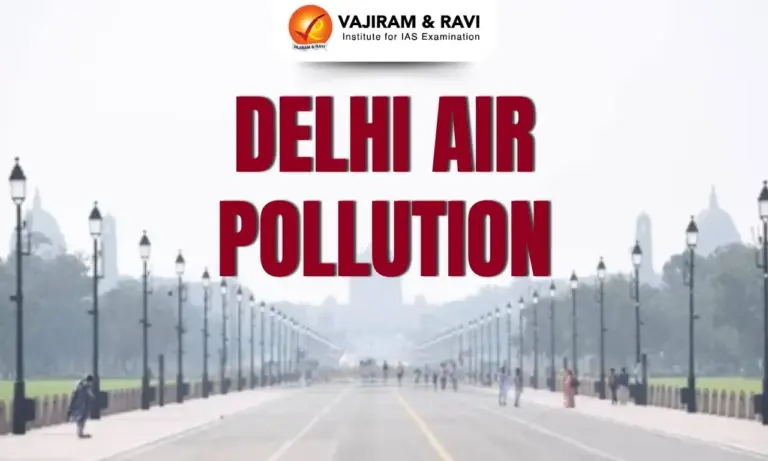
Delhi Air Pollution Latest News
- As Delhi braces for its annual winter air pollution spike, the Decision Support System (DSS) for Air Quality Management has been reactivated.
- Developed by the Indian Institute of Tropical Meteorology (IITM), Pune, the DSS uses numerical models to identify and estimate daily contributions of different pollution sources — including vehicles, industries, dust, and farm fires — to particulate matter levels (PM2.5 and PM10).
- It also projects how various emission-control measures could impact air quality.
- While recent rain and winds have temporarily kept pollution levels low, officials warn that cooler temperatures, shifting wind patterns, and increasing stubble burning in Punjab and Haryana are likely to worsen air quality in the coming weeks.
What’s Choking Delhi’s Air: Farm Fires or Traffic
- According to Decision Support System (DSS) data, farm fires have so far contributed minimally to Delhi’s pollution.
- On October 5, stubble burning accounted for only 0.22% of PM2.5 levels, and on October 6, it contributed nothing at all, based on VIIRS satellite data that track active fire counts.
- VIIRS, or Visible Infrared Imaging Radiometer Suite, is a set of instruments aboard polar-orbiting weather satellites that produce data streams that monitor changes in surface vegetation, including fires.
- Though paddy harvesting has started in Punjab, the Indian Agricultural Research Institute (IARI) reported no residue burning events across six states on October 6, and only 210 fires since September 15 — far below previous years.
- At present, transport emissions are the biggest source of Delhi’s pollution.
- Other contributors include residential sources (4–5%) and industries (3–5%), underscoring that urban emissions, not farm fires, currently dominate Delhi’s air pollution.





How the DSS Tracks and Forecasts Delhi’s Pollution
- The Decision Support System (DSS), developed by IITM Pune, operates on a 10-km horizontal grid to generate five-day forecasts and insights on Delhi’s air quality.
- It quantifies:
- how emissions from Delhi and 19 neighbouring districts affect the city’s air;
- the share of eight key emission sectors (like transport, industries, and households) in Delhi’s pollution;
- the impact of biomass burning in nearby states; and
- how emission-control measures could influence severe pollution events.
- The DSS also uses climatological fire and emission data to predict short-term pollution levels.
- However, it currently runs only during winter, limiting year-round tracking.
- The Council on Energy, Environment and Water (CEEW) has recommended continuous operation and advanced modelling to make it more effective.
DSS Accuracy Questioned Amid Outdated Emissions Data
- Experts have raised concerns over the accuracy of the Decision Support System (DSS) due to its reliance on a four-year-old emissions inventory from 2021, which affects the precision of source-wise pollution estimates.
- According to IITM officials, a new emissions inventory is being prepared to improve forecasting accuracy.
- Environmental researchers stressed that updated, real-time data are vital for implementing targeted pollution-control measures.
- Last year, the Commission for Air Quality Management (CAQM) had temporarily suspended the DSS over data reliability issues, but it remains the only active system providing source-wise pollution analysis for Delhi.
- IITM maintains that once the new dataset is integrated, the DSS’s estimates will become significantly more accurate and reliable.

 Last updated on March, 2026
→ UPSC Final Result 2025 is now out.
→ UPSC has released UPSC Toppers List 2025 with the Civil Services final result on its official website.
→ Anuj Agnihotri secured AIR 1 in the UPSC Civil Services Examination 2025.
→ UPSC Marksheet 2025 is now out.
→ UPSC Notification 2026 & UPSC IFoS Notification 2026 is now out on the official website at upsconline.nic.in.
→ UPSC Calendar 2026 has been released.
→ Check out the latest UPSC Syllabus 2026 here.
→ UPSC Prelims 2026 will be conducted on 24th May, 2026 & UPSC Mains 2026 will be conducted on 21st August 2026.
→ The UPSC Selection Process is of 3 stages-Prelims, Mains and Interview.
→ Prepare effectively with Vajiram & Ravi’s UPSC Prelims Test Series 2026 featuring full-length mock tests, detailed solutions, and performance analysis.
→ Enroll in Vajiram & Ravi’s UPSC Mains Test Series 2026 for structured answer writing practice, expert evaluation, and exam-oriented feedback.
→ Join Vajiram & Ravi’s Best UPSC Mentorship Program for personalized guidance, strategy planning, and one-to-one support from experienced mentors.
→ Shakti Dubey secures AIR 1 in UPSC CSE Exam 2024.
→ Also check Best UPSC Coaching in India
Delhi Air Pollution FAQs
Q1. What is the Decision Support System (DSS)?+
Q2. Which source contributes most to Delhi’s air pollution now?+
Q3. How does DSS forecast pollution?+
Q4. Why is DSS data questioned?+
Q5. How can the DSS be improved?+
Tags: Delhi air pollution mains articles upsc current affairs upsc mains current affairs