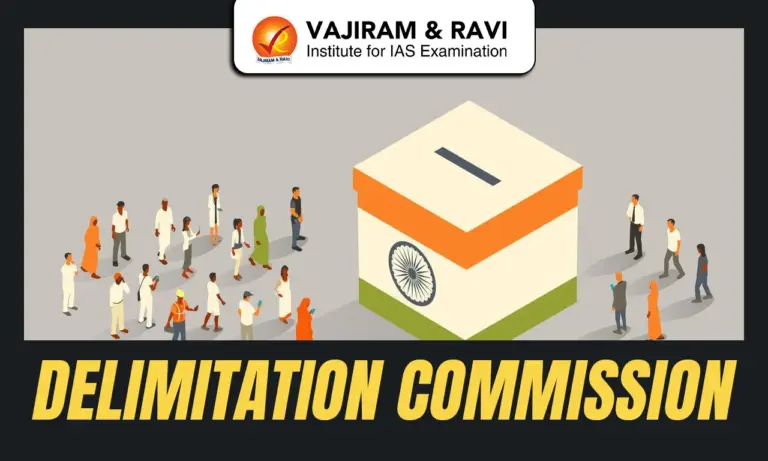
The Delimitation Commission is a statutory body constituted by the Union Government to redraw the boundaries of Lok Sabha and State Assembly constituencies based on Census data, ensuring equal representation. Its formation is guided by Articles 82 and 170, with Articles 330 and 332 covering SC/ST seat reservations. The Commission is chaired by a retired Supreme Court judge, with the Chief Election Commissioner and State Election Commissioners as members.
Delimitation Commission
The Delimitation Commission is a statutory and quasi-judicial body established by the Government of India to redraw the boundaries of Lok Sabha and State Assembly constituencies based on the latest Census. This process ensures that each constituency represents roughly equal population size, maintaining the principle of democratic equality. The Commission’s decisions are final, have the force of law, and cannot be challenged in any court, ensuring independence and integrity in the process.
Delimitation Commission Constitutional Provisions
India’s Constitution contains detailed provisions to ensure population-based representation. These provisions guide how Parliament and the Commission undertake delimitation.
| Delimitation Commission Constitutional Provisions | |
| Article | Provision |
|
Article 82 |
Parliament to enact a Delimitation Act after every Census. |
|
Article 170 |
Readjustment of State Legislative Assembly seats after every Census. |
|
Articles 330 & 332 |
Reservation of seats for SCs and STs based on population proportion. |
|
Article 327 |
Parliament’s power to make laws regarding elections. |
|
Article 329(a) |
Delimitation orders cannot be challenged in any court. |




Delimitation Commission Members
The Delimitation Commission consists of a retired Supreme Court judge as the Chairperson, along with the Chief Election Commissioner and State Election Commissioners as members. This structure ensures neutrality and legal oversight in redrawing constituency boundaries. Associate Members (MPs/MLAs) may participate, but the final authority rests solely with the Commission.
Chairperson: Retired Judge of the Supreme Court
Member: Chief Election Commissioner (CEC) of India
Members: State Election Commissioners of concerned states
Associate Members: Selected MPs/MLAs (consultative only, no voting power)
Decisions: Final and legally binding; cannot be challenged in court
Delimitation Commission Objectives & Functions
The primary objective of the Delimitation Commission is to ensure fair and equal representation by redrawing constituency boundaries based on the latest population data. It aims to correct population imbalances, allocate seats proportionately for SC/ST communities, and improve the administrative coherence of electoral divisions.
Objectives
- Ensure equal population representation across constituencies.
- Allocate SC/ST reserved seats as per their population proportion.
- Maintain electoral fairness by preventing over- or under-representation.
- Promote balanced federal representation among states.
Functions
- Redraw boundaries of Lok Sabha and State Assembly constituencies.
- Fix the total number of seats allocated to each state.
- Determine SC/ST seat reservation based on Census data.
- Ensure compact, contiguous, and administratively coherent constituencies.
- Publish draft proposals, invite public objections, and finalise orders.
- Implement seat rotation for reserved constituencies where applicable.
Delimitation Acts in India
The Delimitation Acts provide the legal framework for periodically redrawing Lok Sabha and State Assembly constituencies based on Census data. These Acts ensure equal population representation, update SC/ST reserved seats, and maintain electoral fairness across states. India has enacted four major Delimitation Acts in 1952, 1962, 1972, and 2002, each corresponding to a national Census and leading to the formation of a Delimitation Commission
| Delimitation Acts in India | |||
| Delimitation Act | Year of Commission | Census Used | Key Features |
|
Delimitation Act, 1952 |
1952 |
1951 Census |
First Delimitation Commission; created initial LS & Assembly constituencies; set SC/ST reserved seats. |
|
Delimitation Act, 1962 |
1963 |
1961 Census |
Redefined constituencies based on population changes; ensured updated SC/ST reservation. |
|
Delimitation Act, 1972 |
1973 |
1971 Census |
Third Commission; boundaries readjusted; total seats later frozen by 42nd Amendment (1976). |
|
Delimitation Act, 2002 |
2002 |
2001 Census |
Fourth Commission; updated boundaries & reserved seats; total seats unchanged due to freeze until 2026. |
Delimitation Commission Amendments
Delimitation in India has been influenced by key constitutional amendments aimed at ensuring fair representation while encouraging population control. These amendments froze or adjusted the number of seats and guided the process of redrawing constituency boundaries. Major changes were brought by the 42nd, 84th, and 87th Amendments, which continue to shape delimitation today.
- 42nd Amendment (1976): Froze total Lok Sabha and Assembly seats until 2001 to promote population control.
- 84th Amendment (2002): Extended the freeze until 2026 and allowed internal readjustments using the 1991 Census.
- 87th Amendment (2003): Mandated use of the 2001 Census for SC/ST seat allocation and constituency rationalisation.
- Impact: Ensures stability in seat allocation but delays adjustment to reflect population changes.
Criteria Used for Delimitation of Constituencies
Delimitation of constituencies is guided by clear criteria to ensure fair representation, administrative efficiency, and electoral equity. The process considers population distribution, geographic contiguity, natural and administrative boundaries, and the proportion of SC/ST population for reserved seats.
- Population Equality: Each constituency should represent roughly the same number of people.
- Geographical Compactness: Constituencies must be contiguous and not fragmented.
- Natural Boundaries: Rivers, hills, and other natural features are considered while drawing boundaries.
- Administrative Convenience: Districts, blocks, and tehsils should not be unnecessarily split.
- SC/ST Representation: Reserved seats are allocated in proportion to the SC/ST population in the area.
- Public Feedback: Draft proposals are published for objections before finalisation.
International Practices Related to Delimitation
Delimitation, or the redrawing of electoral boundaries, is practiced worldwide to ensure fair and equal representation. Different countries adopt various methods, including independent commissions, proportional representation, and legal safeguards to prevent gerrymandering.
| International Practices Related to Delimitation | ||
| Country | Delimitation/Redistricting Authority | Key Features |
|
USA |
State legislatures, some with independent commissions |
Boundaries redrawn every 10 years after Census; gerrymandering is a major concern. |
|
UK |
Boundary Commissions |
Independent commissions review and propose boundaries; public consultations are mandatory. |
|
Canada |
Independent Electoral Boundaries Commissions |
Boundaries reviewed every 10 years; transparency and population equality emphasized. |
|
Australia |
Australian Electoral Commission (Independent) |
Uses strict population quotas; public objections invited; legal challenges allowed. |
|
South Africa |
Independent Electoral Commission |
Reviews boundaries before general elections; ensures minority and regional representation. |
Lessons for India
- Use independent commissions to reduce political bias.
- Ensure public consultation and transparency in the delimitation process.
- Maintain strict population equality with flexibility for geography and administrative convenience.
- Consider minority representation to protect marginalised communities.
Impact of Delimitation on Political Representation
Delimitation significantly influences political representation by adjusting constituency boundaries to reflect population changes. It ensures that each vote has roughly equal value, enhances fair representation for SC/ST communities, and can alter the political strength of parties across regions.
- Equal Representation: Balances voter population across constituencies, upholding the principle of “one person, one vote.”
- SC/ST Reservation Adjustment: Ensures reserved seats reflect current demographic proportions.
- Shift in Political Power: States or regions may gain or lose influence based on population changes.
- Effect on Party Strongholds: Traditional strongholds may be altered, influencing election outcomes.
- Administrative Efficiency: Constituencies become more manageable, improving governance and electoral management.
- Federal Balance: Adjusts representation among states, preserving equity in Parliament and Assemblies.
Impact of Delimitation on Southern & North-Eastern States
Delimitation has had a significant impact on Southern and North-Eastern states due to differences in population growth compared to the national average. Southern states, which successfully implemented population control measures, retained fewer parliamentary seats relative to their population, while North-Eastern states often maintained smaller constituencies due to geographic and administrative considerations.
Southern States (e.g., Kerala, Tamil Nadu, Karnataka, Andhra Pradesh)
- Population control led to smaller seat share relative to Northern states despite stable population growth.
- Political influence in Lok Sabha remains limited due to fixed seat allocation under the freeze (until 2026).
- Encouraged efficient constituency management with relatively smaller populations per seat.
North-Eastern States (e.g., Nagaland, Manipur, Mizoram, Meghalaya)
- Constituencies are smaller in population due to difficult terrain and scattered settlements.
- Seat allocation ensures regional representation despite low population density.
- Helps preserve minority and tribal representation, maintaining political and cultural inclusivity.
Delimitation Commission Issues
Delimitation faces challenges such as population imbalances, unequal constituency sizes, and political resistance from states fearing loss of seats. Delays and outdated boundaries also affect fair representation and SC/ST seat allocation.
- Population Imbalance Across States: Southern states successfully controlled population growth, while Northern states have higher growth, creating disparities in representation. The freeze on seats until 2026 prevents proportional adjustment based on current population.
- Political Sensitivity and Resistance: States fearing loss of seats or political influence often resist delimitation. Redistribution of constituencies may alter party strongholds, causing political friction.
- Unequal Constituency Sizes: Northern states like Uttar Pradesh have overpopulated constituencies, while North-Eastern states have very small populations per seat. This affects voter equality, with some votes carrying more weight than others.
- Delayed Delimitation: Lack of regular delimitation results in stale constituency boundaries that no longer reflect demographic realities.
- SC/ST Reservation Issues: Reserved constituencies for Scheduled Castes and Tribes may not reflect current population distribution, leading to under- or over-representation.
- Geographical and Administrative Challenges: North-Eastern states and hill regions pose terrain and accessibility challenges, complicating boundary rationalization.
Delimitation Commission Way Forward
To ensure fair and equitable representation, delimitation should be conducted after 2026 using the latest Census data. Greater use of technology, periodic reviews, public consultation, and special attention to Southern and North-Eastern states can enhance transparency, accuracy, and political equity.
- Conduct delimitation using the latest Census post-2026.
- Implement periodic delimitation every 10 years.
- Use GIS and digital mapping for precise boundaries.
- Ensure public participation and transparency.
- Protect representation for states with population control.
- Consider terrain, accessibility, and tribal representation in the North-Eastern and hill regions.
Delimitation Commission UPSC Prelims PYQs
Que. How many Delimitation Commissions have been constituted by the Government of India till December 2023? [UPSC Prelims 2024]
a). One
b). Two
c). Three
d). Four
Ans d Four
Explanation: Delimitation Commissions have been established under the Delimitation Acts of 1952, 1962, 1972, and 2002, leading to commissions being set up in 1952, 1963, 1973, and 2002. Notably, no commissions were created following the 1981 and 1991 Censuses due to political considerations and a nationwide freeze on seat allocation aimed at encouraging population control, which was first introduced by the 42nd Amendment (1976).
The process also considers the reservation of seats for Scheduled Castes (SCs) and Scheduled Tribes (STs) as mandated by Articles 330 and 332 of the Constitution, ensuring proportional representation based on population. Delimitation has a direct impact on political representation, electoral competitiveness, and federal balance among states, making it a crucial mechanism in India’s democratic framework. The next major delimitation is expected after 2026, once the freeze on seat allocation ends, potentially reshaping political dynamics across the country.

 Last updated on March, 2026
→ UPSC Final Result 2025 is now out.
→ UPSC has released UPSC Toppers List 2025 with the Civil Services final result on its official website.
→ Anuj Agnihotri secured AIR 1 in the UPSC Civil Services Examination 2025.
→ UPSC Marksheet 2025 is now out.
→ UPSC Notification 2026 & UPSC IFoS Notification 2026 is now out on the official website at upsconline.nic.in.
→ UPSC Calendar 2026 has been released.
→ Check out the latest UPSC Syllabus 2026 here.
→ UPSC Prelims 2026 will be conducted on 24th May, 2026 & UPSC Mains 2026 will be conducted on 21st August 2026.
→ The UPSC Selection Process is of 3 stages-Prelims, Mains and Interview.
→ Prepare effectively with Vajiram & Ravi’s UPSC Prelims Test Series 2026 featuring full-length mock tests, detailed solutions, and performance analysis.
→ Enroll in Vajiram & Ravi’s UPSC Mains Test Series 2026 for structured answer writing practice, expert evaluation, and exam-oriented feedback.
→ Join Vajiram & Ravi’s Best UPSC Mentorship Program for personalized guidance, strategy planning, and one-to-one support from experienced mentors.
→ Shakti Dubey secures AIR 1 in UPSC CSE Exam 2024.
→ Also check Best UPSC Coaching in India
Delimitation Commission FAQs
Q1. What is the Delimitation Commission?+
Q2. Under which constitutional provisions does it function?+
Q3. Who are the members of the Commission?+
Q4. Are its orders legally binding?+
Q5. When was the last delimitation conducted?+
Tags: delimitation commission