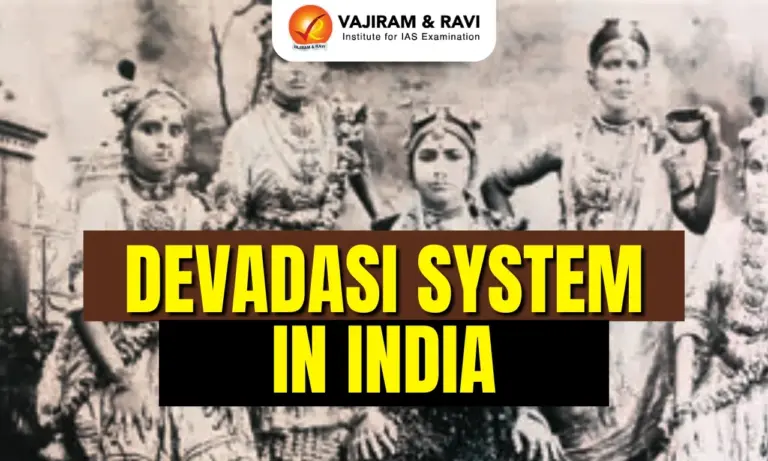
The Devadasi System refers to the ritual dedication of young girls to temples, historically linked with religious service, classical arts, and ritual performances. Over centuries, the system transformed from a respected cultural institution into a mechanism of exploitation, particularly affecting marginalized communities. Despite being legally prohibited across India, multiple academic and governmental studies confirm its continued presence in disguised forms, especially in southern India. Contemporary research highlights systemic failures in law enforcement, rehabilitation, and social awareness, keeping the practice alive despite statutory bans.
Devadasi System
The Devadasi System involves dedicating minor girls to deities through ceremonial rituals, symbolically marrying them to gods. Traditionally, Devadasis performed temple rituals, music, and classical dance forms such as Bharatanatyam and Odissi. Over time, the withdrawal of royal patronage and socio-economic decline pushed many Devadasis into sexual exploitation. Present day manifestations show forced dedication of minors, absence of consent, and systemic abuse, particularly among Dalit and economically vulnerable families in Karnataka, Andhra Pradesh, Maharashtra, and Tamil Nadu.
Devadasi System Historical Background
The Devadasi System evolved from temple based artistic service into exploitation due to political, colonial, and economic disruptions.
- Early Origins: Temple dancers referenced in 3rd century CE texts like Silappadikaram.
- Gupta Period Evidence: Kalidasa’s Meghaduta describes female temple performers.
- Medieval Expansion: 6th – 13th centuries saw royal patronage and social prestige.
- Chola Administration: Brihadisvara Temple maintained 400 Devadasis with land grants.
- Vijayanagara Era: Devadasis accumulated wealth, land, and social status.
- Colonial Decline: British dismantled temple patronage systems.
- Moral Reframing: Colonial authorities equated Devadasis with prostitution.
- Legal Suppression: Bombay Devadasi Protection Act enacted in 1934.
- Post Independence Ban: Madras Devadasi Act passed in 1947.
- Nationwide Prohibition: Formal outlawing completed by 1988.
Also Read: Role of Women in India





Devadasi System in India
The Devadasi System existed under different regional names with varied ritual practices and social outcomes.
- Karnataka Basavi System: Dedicated girls associated with Yellamma cult.
- Odisha Mahari Tradition: Jagannath temple dancers maintained ritual celibacy.
- Andhra Natavalollu: Temple dancers later absorbed into hereditary communities.
- Maharashtra Matangi: Ritual dedication merged with caste based occupation.
- Tamil Nadu Devar Adigalar: Chola era temple servants institutionalized arts.
- Goa Kalavantin: Portuguese records describe dancer communities.
- Local Terminologies: Jogini, Murali, Nailis reflect regional diversity.
Devadasi System Practices
Dedication ceremonies symbolically married girls to deities through publicly sanctioned religious rituals.
- Pottukattu Ceremony: Tali tying ritual marked temple dedication.
- Sadanku Rite: Puberty ceremony formalized lifelong servitude.
- Temple Priest Role: Religious authorities officiated dedication.
- Community Participation: Entire villages celebrated dedication rituals.
- Symbolic Marriage: Girl treated as deity’s spouse.
- Permanent Status: Devadasis called nitya sumangali.
- No Human Marriage: Marriage to mortals prohibited.
- Inherited Practice: Dedication later became hereditary.
Devadasi System Legal Gaps
Existing laws inadequately recognize Devadasi dedication as trafficking, child abuse, or sexual exploitation.
- KDPD Act 1982: Karnataka failed to frame implementation rules.
- JJ Act 2015: Dedicated children excluded from protection category.
- ITPA 1956: Sexual exploitation not acknowledged post dedication.
- POCSO Act 2012: Rarely applied despite minor abuse.
- Trafficking Bill 2018: Dedicated girls excluded as trafficking victims.
- Poor Awareness: Only 48% know dedication is illegal.
- NGO Capacity Gap: Limited legal procedural knowledge.
Devadasi System Impact
There are several social, physical and mental impacts due to the prevalence of Devadasi System in India as given below:
- Mental Trauma: Early abuse causes lifelong psychological harm.
- Economic Marginalization: No stable livelihood opportunities.
- Social Stigma: Persistent caste based discrimination.
- Healthcare Exclusion: Limited access to medical support.
- Educational Deprivation: Schooling disrupted early.
- Inter Generational Cycle: Children face repeat vulnerability.
Devadasi System Reforms
India enacted multiple laws banning Devadasi dedication, but weak enforcement undermines effectiveness. Along with it Grassroots activism plays a crucial role in rehabilitation and prevention of Devadasi dedication.
- Bombay Act 1934: First legal prohibition.
- Madras Act 1947: Post independence reform.
- Andhra Act 1988: State level criminalization.
- National Ban 1988: Formal nationwide outlawing.
- Judicial Support: Courts recognize dedication as exploitation.
- Implementation Deficit: Laws poorly enforced.
- Rehabilitation Gaps: Limited livelihood integration.
- Amy Carmichael: Early rescue efforts during colonial era.
- Sitavva Joddati: Rescued over 4,800 Devadasis.
- MASS NGO: Rehabilitation through education and dignity.
- Youth Vigilance: Community based prevention networks.
- Self Help Groups: Economic empowerment initiatives.
- Awareness Campaigns: Challenging superstition.
Also Read: Women Empowerment
Devadasi System Challenges
Deep rooted social beliefs normalize Devadasi dedication, preventing reporting and enforcement.
- Religious Belief: Dedication seen as divine appeasement.
- Community Pressure: Families coerced into participation.
- Fear of Backlash: Victims avoid reporting abuse.
- Police Inaction: Suo motu action rarely initiated.
- Victim Hostility: Survivors often turn hostile in court.
- Preventive Failure: Focus remains on welfare, not prevention.
- Inter Departmental Gaps: Poor coordination weakens response.
Way Forward: Multi sectoral reforms are essential to eliminate Devadasi dedication permanently.
- Police Suo Motu Action: Immediate registration of cases.
- Regular Surveys: Mapping vulnerable districts.
- Education Drives: Universal school enrolment.
- Legal Awareness: Strengthening legal literacy.
- Vocational Training: Alternative livelihoods.
- Scholarships: Education support for children.
- Community Monitoring: Panchayat level vigilance
Devadasi System Recent Developments
Despite legal prohibition, studies confirm Devadasi dedication continues illegally in multiple Indian states.
- Karnataka Numbers: 80,000 Devadasis identified in 2018 university study.
- Government Estimate: 40,600 recorded in Karnataka in 2008.
- Andhra Pradesh Data: 16,624 Devadasis officially identified.
- Maharashtra Allowance: 2,479 recognized beneficiaries.
- Odisha Status: Government claims eradication.
- Tamil Nadu Claim: State reports zero prevalence.
- Life Expectancy: Rarely exceeds 50 years.
- Child Dedication: Majority dedicated before age 18.
- NLSIU and TISS studies expose systemic exploitation, weak enforcement, and deep social acceptance of Devadasi dedication.
- 92% dedicated below 18 years.
- 53% dedicated between 4 – 12 years.
- 39% dedicated between 13 – 18 years.
- 50% abused sexually during childhood.
- Disabled children face higher vulnerability.
- Predominantly affects oppressed communities.
- Only four cases filed in Karnataka (2011 – 2017).

 Last updated on April, 2026
→ UPSC Final Result 2025 is now out.
→ UPSC has released UPSC Toppers List 2025 with the Civil Services final result on its official website.
→ Anuj Agnihotri secured AIR 1 in the UPSC Civil Services Examination 2025.
→ UPSC Marksheet 2025 is now out.
→ UPSC Notification 2026 & UPSC IFoS Notification 2026 is now out on the official website at upsconline.nic.in.
→ UPSC Calendar 2026 has been released.
→ Check out the latest UPSC Syllabus 2026 here.
→ UPSC Prelims 2026 will be conducted on 24th May, 2026 & UPSC Mains 2026 will be conducted on 21st August 2026.
→ The UPSC Selection Process is of 3 stages-Prelims, Mains and Interview.
→ Prepare effectively with Vajiram & Ravi’s UPSC Prelims Test Series 2026 featuring full-length mock tests, detailed solutions, and performance analysis.
→ Enroll in Vajiram & Ravi’s UPSC Mains Test Series 2026 for structured answer writing practice, expert evaluation, and exam-oriented feedback.
→ Join Vajiram & Ravi’s Best UPSC Mentorship Program for personalized guidance, strategy planning, and one-to-one support from experienced mentors.
→ Shakti Dubey secures AIR 1 in UPSC CSE Exam 2024.
→ Also check Best UPSC Coaching in India
Devadasi System FAQs
Q1. What is the Devadasi System?+
Q2. Is the Devadasi System legally banned in India?+
Q3. Where is the Devadasi System still prevalent?+
Q4. At what age are girls usually dedicated as Devadasis?+
Q5. What are the main challenges in ending the Devadasi System?+
Tags: devadasi system