RAT Deployment Latest News
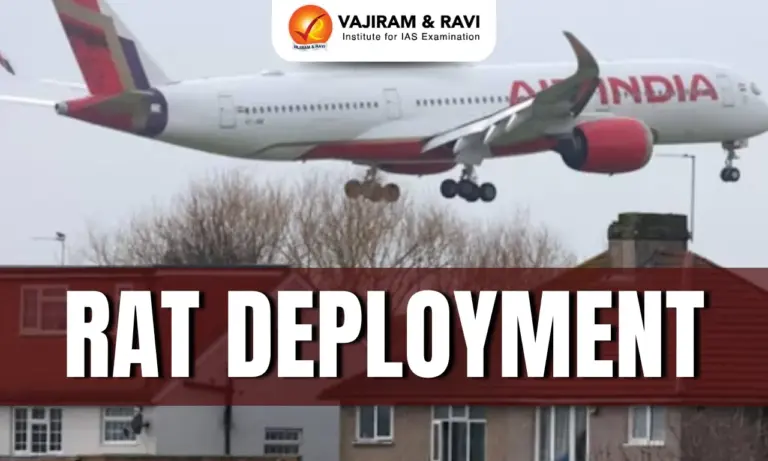
- An Air India Boeing 787-8 (flight AI-117) flying from Amritsar to Birmingham experienced an unexpected deployment of its Ram Air Turbine (RAT) — a last-resort emergency power system — during final approach, despite all electrical and hydraulic systems functioning normally.
- The aircraft landed safely and was grounded for inspection, but no technical anomalies were found. The Directorate General of Civil Aviation (DGCA) has launched a formal investigation into the incident.
- The Federation of Indian Pilots (FIP) has called on the regulator to inspect all Boeing 787s operating in India, suggesting the malfunction could indicate underlying electrical system issues possibly linked to the June 12 Ahmedabad crash that killed 260 people.
Last-Resort Power: How the Ram Air Turbine (RAT) Works on Aircraft
- The Ram Air Turbine (RAT) is a small propeller-like device designed to automatically deploy only in severe emergencies such as dual engine failure or total power loss.
- Its unexpected activation is extremely rare and typically indicates a technical malfunction.
- The RAT harnesses airflow pressure generated by the aircraft’s speed to produce power.
- A similar RAT deployment occurred during the June 12 Ahmedabad crash involving an Air India Boeing 787-8 Dreamliner, which tragically claimed 241 lives, underscoring the system’s role as a last-resort emergency power source.
How It Generates Power
- The RAT functions like a mini wind turbine, using ram pressure — created by the aircraft’s forward motion — to generate electricity.
- The power produced sustains essential flight systems such as flight controls, navigation, and communication equipment.
- In the brief window before RAT deployment, the aircraft’s batteries keep critical instruments running.
- Designed as a last line of defence, the RAT is most effective at high speeds or cruising altitudes, when airflow can generate enough power for emergency operation.
- It allows pilots to maintain control and glide toward a safe landing, though it cannot replace engine power.
- According to experts, this emergency system has helped save over 2,400 lives worldwide over the past five decades, preventing several major aviation disasters by keeping aircraft operational during total power failures.





RAT Deployment on Air India Flight to Birmingham
- During the landing of Air India flight AI117, a Boeing 787 (VT-ANO) flying from Ahmedabad to Birmingham, the aircraft’s Ram Air Turbine (RAT) unexpectedly deployed at just 400 feet, despite no signs of technical abnormality.
- Following comprehensive checks and Boeing-recommended maintenance procedures, no discrepancies were found.
- Boeing confirmed the aircraft was structurally and functionally sound. The plane has since resumed regular operations.
- However, given the highly unusual nature of the uncommanded RAT deployment, the Directorate General of Civil Aviation (DGCA) has ordered a detailed probe.
- Aviation experts suggest the incident may have resulted from a system malfunction, but the exact cause will be known only after further investigation.
Fresh Concerns Over Boeing 787 Systems After Birmingham Incident
- The unexpected RAT deployment on Air India’s Boeing 787 during landing at Birmingham has reignited safety concerns about the aircraft model, occurring just four months after the Ahmedabad crash that killed 260 people.
- In that crash, the RAT had deployed moments after takeoff, when both engines shut down due to fuel control switches shifting from ‘RUN’ to ‘CUTOFF’.
- A detailed technical investigation is still underway.
- The Federation of Indian Pilots (FIP), representing 5,500 pilots, suspects that an electrical fault may have triggered the RAT deployment in the Birmingham flight.
- The FIP suggested the Birmingham incident could be linked to the Ahmedabad crash, arguing that potential electrical system failures were not fully investigated.
- It warned that the Birmingham event could be a pointer to systemic issues, urging immediate regulatory action in the interest of air safety.
- Since its commercial debut in 2011, the Boeing 787 Dreamliner has experienced occasional technical issues, such as battery malfunctions and electrical glitches.
- However, it maintained a strong safety record until June 12, 2025 — the first-ever fatal crash and hull loss of the model worldwide.

 Last updated on March, 2026
→ UPSC Final Result 2025 is now out.
→ UPSC has released UPSC Toppers List 2025 with the Civil Services final result on its official website.
→ Anuj Agnihotri secured AIR 1 in the UPSC Civil Services Examination 2025.
→ UPSC Marksheet 2025 is now out.
→ UPSC Notification 2026 & UPSC IFoS Notification 2026 is now out on the official website at upsconline.nic.in.
→ UPSC Calendar 2026 has been released.
→ Check out the latest UPSC Syllabus 2026 here.
→ UPSC Prelims 2026 will be conducted on 24th May, 2026 & UPSC Mains 2026 will be conducted on 21st August 2026.
→ The UPSC Selection Process is of 3 stages-Prelims, Mains and Interview.
→ Prepare effectively with Vajiram & Ravi’s UPSC Prelims Test Series 2026 featuring full-length mock tests, detailed solutions, and performance analysis.
→ Enroll in Vajiram & Ravi’s UPSC Mains Test Series 2026 for structured answer writing practice, expert evaluation, and exam-oriented feedback.
→ Join Vajiram & Ravi’s Best UPSC Mentorship Program for personalized guidance, strategy planning, and one-to-one support from experienced mentors.
→ Shakti Dubey secures AIR 1 in UPSC CSE Exam 2024.
→ Also check Best UPSC Coaching in India
RAT Deployment FAQs
Q1. What happened to Air India’s Boeing 787 during its Birmingham flight?+
Q2. What is a Ram Air Turbine (RAT)?+
Q3. Why is the DGCA investigating the Air India 787 incident?+
Q4. How is this case linked to the Ahmedabad crash?+
Q5. What action has been taken after the Birmingham incident?+
Tags: mains articles RAT deployment upsc current affairs upsc mains current affairs