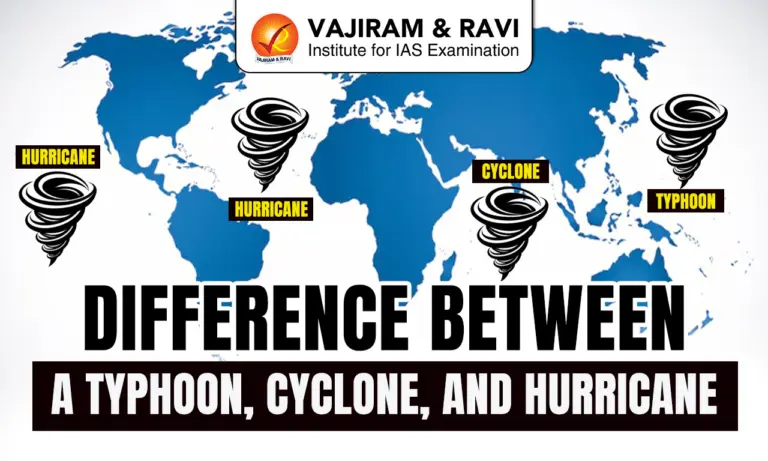
Difference between a Typhoon, Cyclone and Hurricane are closely related intense storm systems that develop over warm tropical oceans. They are all forms of tropical cyclones characterized by organized clouds, thunderstorms, strong rotating winds, and a low-pressure center, but their names differ depending on the geographical region where the storm originates.
Difference between a Typhoon, Cyclone and Hurricane
These are essentially the same tropical storm system, but the Difference between a Typhoon, Cyclone and Hurricane lies in that they are identified with different names depending on the ocean basin and regional meteorological terminology used across the world.
| Difference between a Typhoon, Cyclone and Hurricane | |||
|
Aspect |
Typhoon |
Cyclone |
Hurricane |
|
Meaning |
A Typhoon is a powerful tropical cyclone that forms over warm ocean waters and rotates around a central low pressure system with thunderstorms. |
Cyclone refers to a rotating low pressure storm system with organized clouds and thunderstorms developing over tropical or subtropical waters. |
Hurricane is another name for a tropical cyclone with intense winds and thunderstorms rotating around a central low-pressure eye. |
|
Distribution |
Typhoons occur mainly in the Northwest Pacific Ocean, particularly around East Asia, the Philippines, and nearby island regions. |
Cyclones develop primarily in the Indian Ocean and South Pacific Ocean, including regions near South Asia and Australia. |
Hurricanes form mainly in the North Atlantic Ocean and the Northeast Pacific Ocean near the Americas. |
|
Atmospheric circulation pattern |
Typhoons rotate counter-clockwise in the Northern Hemisphere due to Earth’s rotation and the Coriolis effect. |
Cyclones follow the same rotational pattern in the Northern Hemisphere and clockwise rotation in the Southern Hemisphere. |
Hurricanes rotate counter-clockwise north of the equator and clockwise south of it, following the influence of planetary rotation. |
|
Duration |
Typhoons may last several days over ocean waters but weaken rapidly after making landfall because the supply of warm moisture stops. |
Cyclones similarly lose strength when moving inland as they lose access to oceanic heat and moisture. |
Hurricanes weaken once they move over land, as their energy source from warm ocean water disappears. |
|
Occurence |
Typhoons are mainly concentrated in the western Pacific region, which records some of the world’s most intense tropical storms. |
Cyclones are common across the Indian Ocean basin, especially near the northern Indian Ocean and southern Pacific regions. |
Hurricanes dominate the Atlantic and eastern Pacific basins, where seasonal storm activity occurs during specific months. |
|
Seasonal occurrence patterns |
Typhoon activity often peaks during mid-year months such as July to October, when ocean waters are warmest. |
Cyclones typically occur in two seasonal windows around April-June and September-December in tropical ocean basins. |
Hurricanes usually develop during the June to November season, with highest activity around late summer. |
|
Occurrence in the Indian subcontinent region |
Typhoons rarely affect this region directly because they primarily develop farther east in the Pacific basin. |
Cyclones frequently originate over the Bay of Bengal and Arabian Sea, making the eastern coastline particularly vulnerable. |
Hurricanes do not form in this region because they are limited to Atlantic and northeastern Pacific ocean basins. |
|
Examples |
Super Typhoon Haiyan (2013), Muroto typhoon (1934), etc. |
Cyclone Shakti (2025), Cyclone Montha (2025) |
Hurricane Francine (2024), Hurricane Sally (2020), etc. |






 Last updated on March, 2026
→ UPSC Final Result 2025 is now out.
→ UPSC has released UPSC Toppers List 2025 with the Civil Services final result on its official website.
→ Anuj Agnihotri secured AIR 1 in the UPSC Civil Services Examination 2025.
→ UPSC Marksheet 2025 is now out.
→ UPSC Notification 2026 & UPSC IFoS Notification 2026 is now out on the official website at upsconline.nic.in.
→ UPSC Calendar 2026 has been released.
→ Check out the latest UPSC Syllabus 2026 here.
→ UPSC Prelims 2026 will be conducted on 24th May, 2026 & UPSC Mains 2026 will be conducted on 21st August 2026.
→ The UPSC Selection Process is of 3 stages-Prelims, Mains and Interview.
→ Prepare effectively with Vajiram & Ravi’s UPSC Prelims Test Series 2026 featuring full-length mock tests, detailed solutions, and performance analysis.
→ Enroll in Vajiram & Ravi’s UPSC Mains Test Series 2026 for structured answer writing practice, expert evaluation, and exam-oriented feedback.
→ Join Vajiram & Ravi’s Best UPSC Mentorship Program for personalized guidance, strategy planning, and one-to-one support from experienced mentors.
→ Shakti Dubey secures AIR 1 in UPSC CSE Exam 2024.
→ Also check Best UPSC Coaching in India
Difference between a Typhoon, Cyclone and Hurricane FAQs
Q1. What is the main Difference between a Typhoon, Cyclone and Hurricane? +
Q2. At what wind speed is a storm classified as a hurricane, cyclone, or typhoon? +
Q3. What conditions are necessary for the formation of a Typhoon, Cyclone and Hurricane? +
Q4. Why do Typhoon, Cyclone and Hurricane weaken after landfall? +
Q5. Which of the storms commonly affect the Indian Ocean region? +
Tags: difference between a typhoon cyclone and hurricane typhoon cyclone and hurricane