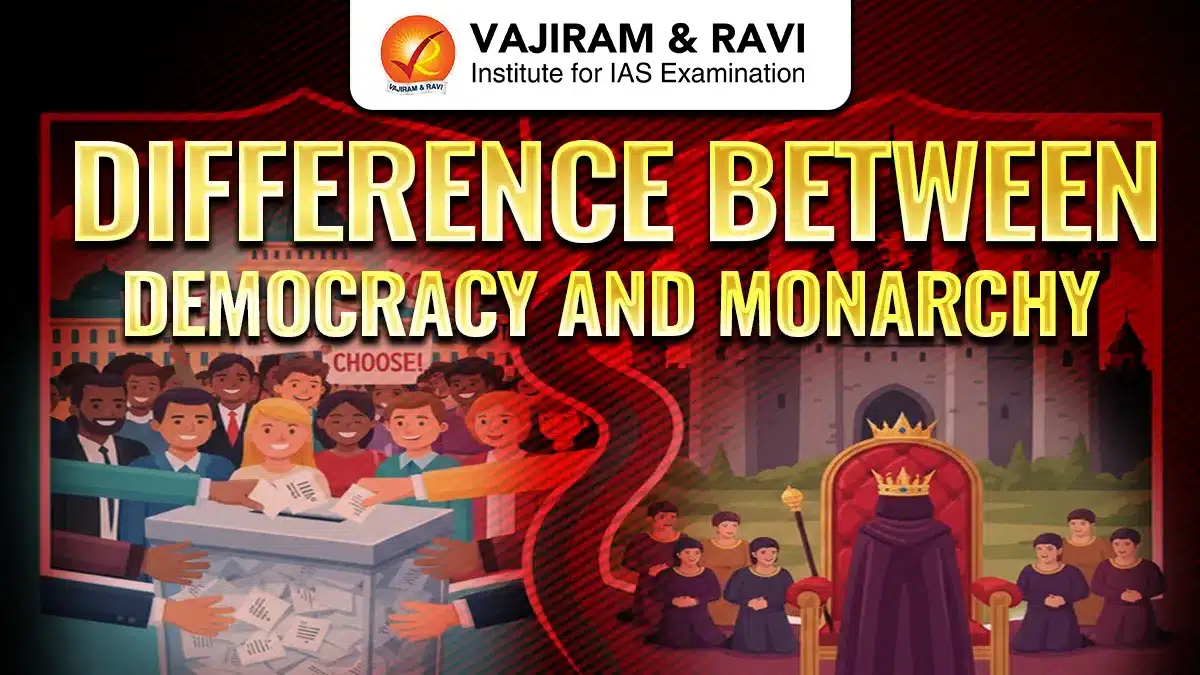
The Difference between Democracy and Monarchy lies in who holds power and how it is exercised. In a democracy, power rests with the people, and leaders are elected through free and fair elections. In a monarchy, authority is vested in a king, queen, or monarch, usually inherited through a royal family.
The detailed difference, along with their definitions, has been discussed below in the article.
What is Democracy?
Democracy is a form of government in which power rests with the people, who exercise it directly or through elected representatives. Citizens have the right to vote, participate in decision-making, and hold leaders accountable. Democracies are guided by the rule of law, equality, and protection of civil liberties, ensuring that governance reflects the will of the people.
What is Monarchy?
Monarchy is a form of government where a single person, usually a king or queen, serves as the head of state, and the position is generally hereditary. Monarchs may exercise absolute power (absolute monarchy) or have a ceremonial role under a constitution (constitutional monarchy).
Other types include semi-constitutional monarchy, subnational monarchy, and commonwealth realms, depending on the distribution of power between the monarch and elected bodies.


Difference between Democracy and Monarchy
The key Difference Between Democracy and Monarchy have been tabulated below.
| Difference between Democracy and Monarchy | ||
| Basis of Comparison | Democracy | Monarchy |
|
Definition |
A system of government where power rests with the people, exercised directly or through elected representatives. |
A system of government where power rests with a king, queen, or emperor, usually inherited through a royal family. |
|
Source of Power |
Derived from the people through elections. |
Derived from hereditary succession within a royal family. |
|
Leadership Selection |
Leaders are elected by citizens through free and fair elections. |
Monarchs inherit their position; selection is based on birthright. |
|
Law-Making |
Elected representatives formulate laws, rules, and policies for public welfare. |
Monarchs or royal councils create laws; citizens have little or no say. |
|
Accountability |
Leaders are accountable to the people; can lose power in elections if public expectations are not met. |
Monarchs generally have limited accountability; citizens cannot remove them if dissatisfied. |
|
Citizen Participation |
Citizens can vote, criticize policies, and influence governance. |
Citizens usually have no role in decision-making. |
|
Rights and Freedoms |
Promotes civil liberties, political rights, and equality among citizens. |
Rights and freedoms vary; in absolute monarchies, citizens may face limited freedoms and oppression. |
|
Equality |
All citizens are considered equal before the law. |
Hierarchical society; citizens may not be considered equal, especially under absolute monarchies. |
|
Rule of Law |
Constitution and laws apply to everyone, including leaders. |
Monarch may be above law in absolute monarchies; in constitutional monarchies, bound by law. |
|
Origin |
Concept originated in Greece; Athenian Democracy is the earliest known form. |
Originated in ancient and medieval times; still exists in some countries today. |
|
Types |
Direct democracy, representative democracy, parliamentary democracy, presidential democracy. |
Absolute monarchy, constitutional monarchy, semi-constitutional monarchy, subnational monarchy, commonwealth realms. |
|
Examples |
India, USA, France, Germany, Japan. |
United Arab Emirates (UAE), Saudi Arabia, United Kingdom (constitutional monarchy), Denmark (constitutional monarchy). |

 Last updated on Oct, 2026
→ UPSC 2027 Notification will be released on 13 January 2027 at upsconline.nic.in.
→ Check Nobel Prize 2026 Winners List here.
→ Download PIB PRiSM Monthly Magazine 2026 here.
→ Check UPSC Monthly Current Affairs Magazine The Recitals here.
→ Check out the latest UPSC Syllabus here.
→ Download UPSC Model Answers for Mains 2026
→ UPSC Mains Question Paper 2026 is out now for Essay & GS Paper 1, 2, 3 & 4.
→ UPSC Calendar 2027 has been released.
→ Enroll in Vajiram & Ravi’s UPSC Mains Test Series 2027 for structured answer writing practice, expert evaluation, and exam-oriented feedback.
→ Join Vajiram & Ravi’s UPSC Mentorship Program 2027 for personalized guidance, strategy planning, and one-to-one support from experienced mentors.
→ Go through the UPSC Mains Previous Year Papers to enhance your preparation.
→ UPSC has released UPSC Toppers List 2025 with the Civil Services final result on its official website.
→ Also check Best UPSC Coaching in India
Difference between Democracy and Monarchy FAQs
Q1. What is the main difference between democracy and monarchy?+
Q2. Can a monarchy exist within a democratic system?+
Q3. Which system provides more citizen participation?+
Q4. Are all monarchies undemocratic?+
Q5. Which system ensures greater accountability of leaders?+
Tags: difference between democracy and monarchy