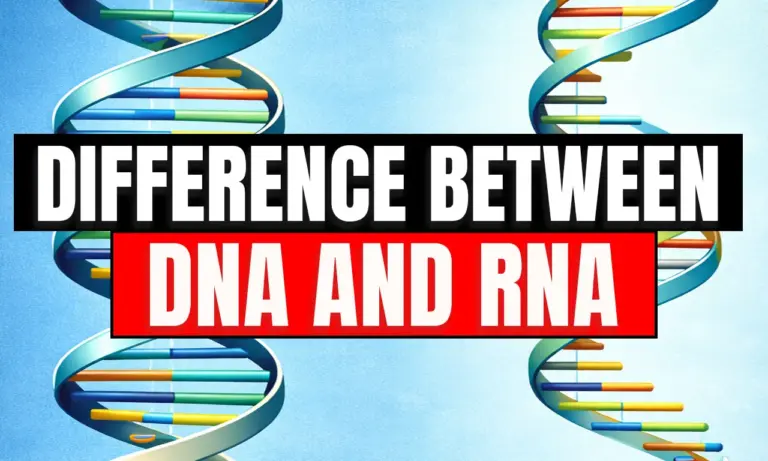
In the field of Genetics and Molecular Biology, two important molecules play a crucial role in the functioning of living organisms: DNA (Deoxyribonucleic Acid) and RNA (Ribonucleic Acid). These molecules are responsible for storing and transmitting genetic information that controls the growth, development, and functioning of all living cells. Understanding the difference between DNA and RNA is essential to know more
Difference between DNA and RNA
The difference between DNA and RNA can be clearly understood by comparing their structure, composition, and functions.
| Difference between DNA and RNA | ||
|
Basis of Comparison |
DNA (Deoxyribonucleic Acid) |
RNA (Ribonucleic Acid) |
|
Full Form |
Deoxyribonucleic Acid |
Ribonucleic Acid |
|
Discovery |
Structure explained by James Watson and Francis Crick in 1953 |
RNA structure and function studied later in molecular biology research |
|
Type of Molecule |
Nucleic acid responsible for storing hereditary information |
Nucleic acid involved in protein synthesis |
|
Structure |
Double-stranded helix structure |
Usually single-stranded |
|
Shape |
Twisted ladder or double helix |
Linear strand that can fold into complex shapes |
|
Sugar Present |
Deoxyribose sugar |
Ribose sugar |
|
Nitrogen Bases |
Adenine (A), Thymine (T), Cytosine (C), Guanine (G) |
Adenine (A), Uracil (U), Cytosine (C), Guanine (G) |
|
Unique Base |
Contains Thymine |
Contains Uracil instead of Thymine |
|
Base Pairing |
A pairs with T, and C pairs with G |
A pairs with U, and C pairs with G |
|
Length of Molecule |
Very long polymer containing millions of nucleotides |
Generally shorter molecules |
|
Location in Cell |
Mainly located in the nucleus |
Found in nucleus and cytoplasm |
|
Presence in Organisms |
Present in almost all living organisms |
Present in all living cells and many viruses |
|
Stability |
More chemically stable |
Less stable due to ribose sugar |
|
Function |
Stores and transmits genetic information |
Transfers genetic information and helps in protein synthesis |
|
Replication |
Can self-replicate during cell division |
Cannot self-replicate; synthesized from DNA |
|
Role in Protein Synthesis |
Provides genetic instructions |
Directly involved in translating genetic instructions |
|
Types |
Only one main type |
Three main types: mRNA, tRNA, rRNA |
|
Occurrence in Viruses |
Some viruses contain DNA |
Many viruses use RNA as genetic material |
What is DNA?
DNA (Deoxyribonucleic Acid) is the primary genetic material found in almost all living organisms. It contains the instructions required for the development, growth, reproduction, and functioning of cells.
DNA is mainly located in the cell nucleus and forms structures known as chromosomes. The structure of DNA is a double helix, which looks like a twisted ladder. This structure was discovered by James Watson and Francis Crick in 1953.
DNA is composed of smaller units called nucleotides, and each nucleotide contains three components: a sugar molecule (deoxyribose), a phosphate group, and a nitrogenous base. The four nitrogen bases present in DNA are Adenine (A), Thymine (T), Cytosine (C), and Guanine (G).





What is RNA?
RNA (Ribonucleic Acid) is another important nucleic acid that plays a key role in protein synthesis. Unlike DNA, RNA is usually single-stranded and can move from the nucleus to the cytoplasm.
RNA helps convert the genetic information stored in DNA into proteins that perform various functions in the body. It acts as a messenger and functional molecule in cells.
RNA is made up of nucleotides containing ribose sugar, a phosphate group, and nitrogenous bases. However, RNA contains Uracil (U) instead of Thymine.
DNA Fingerprinting
DNA fingerprinting is a scientific technique used to identify individuals based on unique patterns in their DNA. While traditional fingerprints at the tips of fingers have long been used for identification, they can sometimes be altered by injury or surgery. DNA patterns, however, remain unique and permanent for each individual.
Uses of DNA Fingerprinting
DNA fingerprinting is widely used in several important fields:
- Forensic science to identify criminals from biological evidence such as blood, hair, or saliva.
- Paternity testing to determine the biological father of a child.
- Identification of dead bodies in accidents or disasters by comparing DNA with relatives.
- Anthropological studies to identify racial or population groups and understand biological evolution.
Recombinant DNA (rDNA)
Recombinant DNA refers to DNA molecules created in the laboratory by combining genetic material from different sources. This process allows scientists to create new DNA sequences that do not naturally occur in an organism.
The technique works because DNA molecules from all organisms share the same basic chemical structure, differing only in the sequence of nucleotides. Organisms that contain recombinant DNA often show normal physical characteristics, although they carry new genetic material.
Methods for Introducing Recombinant DNA
Scientists use several techniques to introduce recombinant DNA into host cells:
- Transformation – Direct uptake of foreign DNA by cells.
- Transfection – Introduction of DNA into eukaryotic cells.
- Electroporation – Using electric pulses to allow DNA entry into cells.
- Microinjection – Injecting DNA directly into cells using a microscopic needle.
- Biolistics (Gene Gun) – Shooting DNA-coated gold or tungsten particles into cells, especially plant cells.
DNA Profiling
DNA profiling is the process of analyzing a person’s DNA characteristics to identify individuals. Modern DNA profiling commonly uses Short Tandem Repeat (STR) analysis, which examines repeated DNA sequences in the genome.
STRs are short DNA sequences that repeat multiple times and vary greatly among individuals, making them extremely useful for identification purposes.
DNA Barcoding
DNA barcoding is a modern technique used to identify species by analyzing a short DNA sequence from a specific gene region. Instead of studying the entire genome, scientists use a small genetic marker that is unique for each species.
Applications of DNA Barcoding
- Identification of plant species even without flowers or fruits.
- Identification of insect larvae and other organisms that are difficult to classify.
- Verification of commercial products derived from plants or animals.

 Last updated on March, 2026
→ UPSC Final Result 2025 is now out.
→ UPSC has released UPSC Toppers List 2025 with the Civil Services final result on its official website.
→ Anuj Agnihotri secured AIR 1 in the UPSC Civil Services Examination 2025.
→ UPSC Marksheet 2025 is now out.
→ UPSC Notification 2026 & UPSC IFoS Notification 2026 is now out on the official website at upsconline.nic.in.
→ UPSC Calendar 2026 has been released.
→ Check out the latest UPSC Syllabus 2026 here.
→ UPSC Prelims 2026 will be conducted on 24th May, 2026 & UPSC Mains 2026 will be conducted on 21st August 2026.
→ The UPSC Selection Process is of 3 stages-Prelims, Mains and Interview.
→ Prepare effectively with Vajiram & Ravi’s UPSC Prelims Test Series 2026 featuring full-length mock tests, detailed solutions, and performance analysis.
→ Enroll in Vajiram & Ravi’s UPSC Mains Test Series 2026 for structured answer writing practice, expert evaluation, and exam-oriented feedback.
→ Join Vajiram & Ravi’s Best UPSC Mentorship Program for personalized guidance, strategy planning, and one-to-one support from experienced mentors.
→ Shakti Dubey secures AIR 1 in UPSC CSE Exam 2024.
→ Also check Best UPSC Coaching in India
Difference between DNA and RNA FAQs
Q1. What is the main difference between DNA and RNA?+
Q2. What does DNA stand for?+
Q3. What does RNA stand for?+
Q4. Is DNA double-stranded and RNA single-stranded?+
Q5. Which sugar is present in DNA and RNA?+
Tags: difference between dna and rna