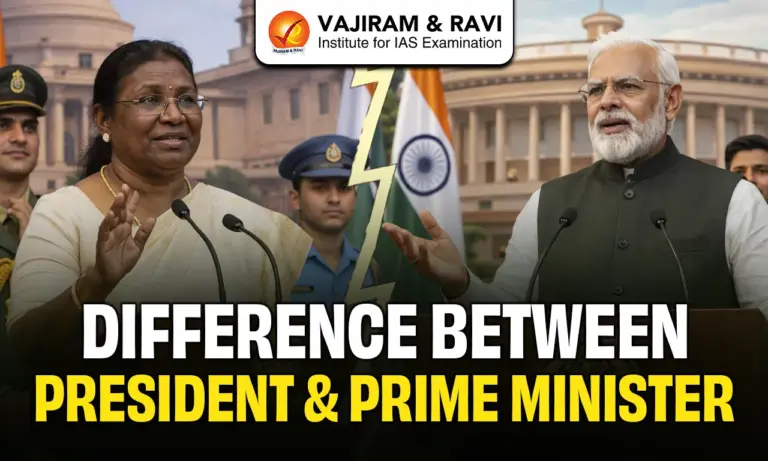
The offices of the President and the Prime Minister form the core of India’s parliamentary executive. While the President is the Constitutional Head of the State, the Prime Minister is the Real Head of Government who exercises actual executive authority through the Council of Ministers.
What is the Difference between President and Prime Minister?
The main Difference between President and Prime Minister lies as: the President functions as the constitutional guardian and formal repository of Union executive authority, while the Prime Minister leads governance, policy direction and administration. The President ensures continuity, neutrality and constitutional compliance, whereas the Prime Minister shapes legislative agenda, coordinates ministries and manages national administration. Together, these offices reflect a carefully designed balance between constitutional form and political substance within India’s parliamentary framework.
Major Difference between President and Prime Minister
Both offices derive authority from the Constitution, yet their roles, powers, tenure, accountability and methods of removal differ significantly in structure and practice. The major Difference between President and Prime Minister has been tabulated below:
| Difference between President and Prime Minister | ||
|
Aspect for Comparison |
President |
Prime Minister |
|
Constitutional Status |
Established under Article 52, the President is the Head of State and first citizen, symbolizing national unity. |
Recognized under Articles 74 and 75, the Prime Minister heads the Council of Ministers and leads the real executive. |
|
Nature of Executive Power |
Under Article 53, executive power of the Union is formally vested in the President. |
Exercises actual executive authority; cabinet decisions guide governance and policy implementation. |
|
Method of Election / Appointment |
Elected indirectly by an Electoral College under Articles 54-55 through proportional representation and single transferable vote. |
Appointed by the President under Article 75(1), usually the leader commanding majority support in Lok Sabha. |
|
Electoral College Composition |
Consists of elected MPs of both Houses and elected MLAs of States, Delhi and Puducherry; nominated members excluded. |
No electoral college; selection depends on majority support in the lower House of Parliament. |
|
Minimum Qualifications |
Must satisfy Article 58: citizen of India, 35 years of age, eligible for Lok Sabha membership, no office of profit. |
Must meet Article 84 and 75 conditions: citizen of India, member of either House, age 25 (Lok Sabha) or 30 (Rajya Sabha). |
|
Oath |
Takes oath under Article 60 to preserve, protect and defend the Constitution and serve the people. |
Sworn in by the President to bear true faith to the Constitution and discharge duties faithfully. |
|
Tenure |
Fixed five-year term under Article 56, eligible for re-election under Article 57. |
No fixed term; continues as long as majority confidence in Lok Sabha is maintained under Article 75(3). |
|
Removal Process |
Can be removed only by impeachment under Article 61 for violation of the Constitution, requiring two-thirds majority. |
Removed through vote of no-confidence in Lok Sabha or resignation; tenure linked to legislative majority. |
|
Relationship with Council of Ministers |
Acts on aid and advice of Council under Article 74(1); advice binding after reconsideration. |
Heads the Council; allocates portfolios, presides over meetings, and can recommend dismissal of ministers. |
|
Legislative Interface |
Summons, prorogues Parliament and dissolves Lok Sabha under Article 85; gives assent to Bills under Article 111. |
Advises President on summoning and dissolution; introduces policies and ensures passage of legislation. |
|
Ordinance Power |
May promulgate ordinances under Article 123 when Parliament is not in session. |
Advises issuance of ordinances and determines policy necessity behind them. |
|
Judicial Powers |
Grants pardons, reprieves and commutations under Article 72, including in death sentence cases. |
Has no independent clemency power; decisions flow through cabinet advice. |
|
Emergency Powers |
Can proclaim National, State or Financial Emergency under Articles 352, 356 and 360 on cabinet advice. |
Advises President during emergencies; leads political and administrative response. |
|
Appointment Authority |
Appoints judges of Supreme Court and High Courts, Governors, CAG and other constitutional authorities. |
Recommends names for such appointments and guides selection through cabinet processes. |
|
Accountability |
Not answerable to Parliament for day-to-day decisions; protected except through impeachment. |
Collectively responsible to Lok Sabha under Article 75(3) and must justify policies before Parliament. |






 Last updated on March, 2026
→ UPSC Final Result 2025 is now out.
→ UPSC has released UPSC Toppers List 2025 with the Civil Services final result on its official website.
→ Anuj Agnihotri secured AIR 1 in the UPSC Civil Services Examination 2025.
→ UPSC Marksheet 2025 is now out.
→ UPSC Notification 2026 & UPSC IFoS Notification 2026 is now out on the official website at upsconline.nic.in.
→ UPSC Calendar 2026 has been released.
→ Check out the latest UPSC Syllabus 2026 here.
→ UPSC Prelims 2026 will be conducted on 24th May, 2026 & UPSC Mains 2026 will be conducted on 21st August 2026.
→ The UPSC Selection Process is of 3 stages-Prelims, Mains and Interview.
→ Prepare effectively with Vajiram & Ravi’s UPSC Prelims Test Series 2026 featuring full-length mock tests, detailed solutions, and performance analysis.
→ Enroll in Vajiram & Ravi’s UPSC Mains Test Series 2026 for structured answer writing practice, expert evaluation, and exam-oriented feedback.
→ Join Vajiram & Ravi’s Best UPSC Mentorship Program for personalized guidance, strategy planning, and one-to-one support from experienced mentors.
→ Shakti Dubey secures AIR 1 in UPSC CSE Exam 2024.
→ Also check Best UPSC Coaching in India
Difference between President and Prime Minister FAQs
Q1. What is the basic Difference between President and Prime Minister?+
Q2. How are the President and Prime Minister chosen?+
Q3. Who has more executive power: President or Prime Minister?+
Q4. How can the President and Prime Minister be removed from office?+
Q5. Do the President and Prime Minister have fixed tenures?+
Tags: difference between president and prime minister