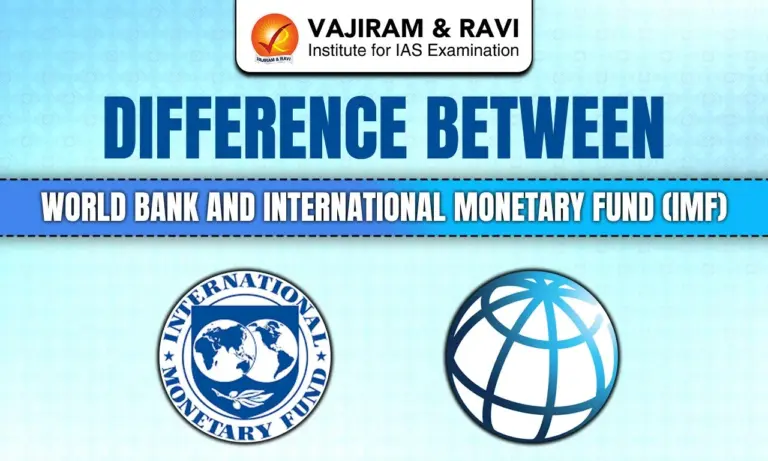
The World Bank and the International Monetary Fund (IMF) are often called the “Bretton Woods twins”, as both were established at the Bretton Woods Conference in 1944. While both aim to promote global economic stability, development, and financial cooperation, their objectives, functions, and methods of assistance differ significantly. The Difference between World Bank and International Monetary Fund (IMF) is discussed below in the article.
Difference between World Bank and International Monetary Fund (IMF)
The Difference between World Bank and International Monetary Fund (IMF) has been highlighted below in the table.
| Difference between World Bank and International Monetary Fund (IMF) | ||
| Aspect | World Bank | IMF |
|
Establishment |
The World Bank was established in 1944 at the Bretton Woods Conference to support post-war reconstruction and development. |
The International Monetary Fund was established in 1944 at the Bretton Woods Conference to promote international monetary cooperation. |
|
Objective |
The World Bank aims to promote long-term development, reduce poverty, raise living standards, and provide finance and technical assistance for infrastructure, environment, and human capital in developing countries. |
The IMF aims to maintain exchange rate stability, ensure balanced international trade, assist countries facing balance of payments problems, provide policy advice, and monitor financial and economic risks. |
|
Membership |
Membership of the World Bank generally requires prior membership of the IMF, although there can be exceptions. The World Bank has 189 members. |
Membership of the IMF is independent, but the quota of each country determines its voting rights, borrowing capacity, and share of Special Drawing Rights. The IMF has 190 members. |
|
Headquarters |
Washington DC |
Washington DC |
|
Source of Funds |
The World Bank raises funds through share capital subscribed by member countries based on their GDP and by issuing bonds in international financial markets, which is its main source of funds. |
The IMF receives its funds primarily from member quotas, which are calculated based on GDP, openness, economic variability, and reserves. Twenty-five percent is paid in SDRs or widely accepted currencies, while the remaining 75 percent is paid in domestic currency. |
|
Lending / Assistance |
The World Bank provides long-term loans, usually 25 to 30 years, and grants for development projects in developing countries. Most of its loans are concessional and are intended for projects that improve infrastructure, human capital, or the environment. |
The IMF provides short-term, conditional loans to member countries, primarily to support policy reforms and stabilize economies. Its loans are generally non-concessional and are not intended for specific development projects. |
|
Voting and Leadership |
Voting in the World Bank is based on basic votes plus one vote per share held by a member, with basic votes equally allocated to all countries. The highest decision-making body is the Board of Governors, under which is the Board of Directors, and the Bank is headed by a President, who is traditionally from the United States. |
Voting in the IMF is based on basic votes plus one vote per quota held in Special Drawing Rights, with basic votes equally allocated to all countries. The Board of Governors is the highest authority, under which is the Executive Board, and the IMF is headed by a Managing Director, who is traditionally from Europe. |
|
Organisational Structure |
All powers of the Bank are vested with the Board of Governors, which is the highest decision-making body under which there is Board of Directors, while the Bank is headed by the President. It is a convention that the President is always from the US. Every member country appoints a governor (Finance minister) and an alternate governor (RBI governor). The board of governors usually meet once in a year. |
All powers of the Bank are vested with the Board of Governors, which is the highest decision-making body under whom there is Board of Directors, while the Bank is headed by the Managing Director. It is a convention that the Managing Director is always from Europe. Every member country appoints a governor (Finance minister) and an alternate governor (RBI governor). Board of governors usually meet once in a year. |
|
Reports |
The World Bank publishes reports such as the World Development Report, International Debt Statistics,and Global Economic Prospects. |
The IMF publishes reports including the World Economic Outlook, Global Financial Stability Report, and Fiscal Monitor. |
|
Role |
The World Bank primarily acts as a financier of long-term development projects aimed at improving living standards and reducing poverty in developing countries. |
The IMF primarily acts as a lender of last resort to help countries overcome short-term financial crises and stabilize their economies. |






 Last updated on April, 2026
→ UPSC Final Result 2025 is now out.
→ UPSC has released UPSC Toppers List 2025 with the Civil Services final result on its official website.
→ Anuj Agnihotri secured AIR 1 in the UPSC Civil Services Examination 2025.
→ UPSC Marksheet 2025 is now out.
→ UPSC Notification 2026 & UPSC IFoS Notification 2026 is now out on the official website at upsconline.nic.in.
→ UPSC Calendar 2026 has been released.
→ Check out the latest UPSC Syllabus 2026 here.
→ UPSC Prelims 2026 will be conducted on 24th May, 2026 & UPSC Mains 2026 will be conducted on 21st August 2026.
→ The UPSC Selection Process is of 3 stages-Prelims, Mains and Interview.
→ Prepare effectively with Vajiram & Ravi’s UPSC Prelims Test Series 2026 featuring full-length mock tests, detailed solutions, and performance analysis.
→ Enroll in Vajiram & Ravi’s UPSC Mains Test Series 2026 for structured answer writing practice, expert evaluation, and exam-oriented feedback.
→ Join Vajiram & Ravi’s Best UPSC Mentorship Program for personalized guidance, strategy planning, and one-to-one support from experienced mentors.
→ Shakti Dubey secures AIR 1 in UPSC CSE Exam 2024.
→ Also check Best UPSC Coaching in India
Difference between World Bank and International Monetary Fund FAQs
Q1. What is the difference between the World Bank and IMF?+
Q2. What are the main objectives of the World Bank and IMF?+
Q3. How do they get their funds?+
Q4. What type of financial assistance do they provide?+
Q5. How are they governed?+
Tags: difference between world bank and international monetary fund