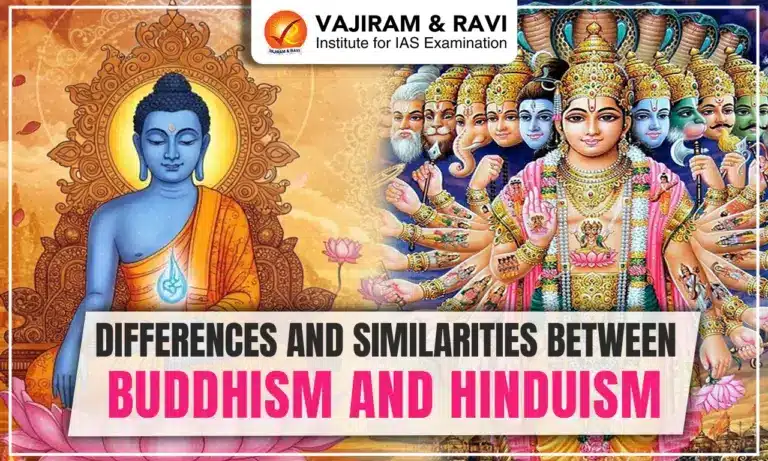
Buddhism and Hinduism are two of the most influential religions that originated in India, yet they differ greatly in their philosophies and practices. Buddhism is centered around the teachings of Gautama Buddha and emphasizes the path to enlightenment through the Four Noble Truths and the Eightfold Path. It rejects rigid rituals, caste distinctions, and the authority of the Vedas.
Hinduism, on the other hand, is considered the world’s oldest living religion and is often described by practitioners as Sanatana Dharma or “the eternal way.” It is a diverse system of beliefs rooted in the Vedas, emphasizing dharma (duty), karma (action), moksha (liberation), and devotion to various deities.
Understanding the Differences and Similarities Between Buddhism and Hinduism is important for grasping the basics of Indian religious thought, as well as their impact on culture, philosophy, and history.
Buddhism
-
- Origin: Founded in the 6th century BCE by Siddhartha Gautama (the Buddha) in present-day Nepal/India.
- Sacred Texts: Tripitaka (Pali Canon), Mahayana Sutras, Tibetan texts.
- Beliefs: Rejects caste system and authority of the Vedas. Emphasizes equality and personal effort in spiritual progress.
- Core Concepts: Four Noble Truths (suffering, its cause, cessation, and path). The Noble Eightfold Path provides the way to overcome suffering. The ultimate goal is Nirvana-freedom from suffering and the cycle of rebirth.
- Practice: Meditation, mindfulness, monastic life, ethical conduct, stupas and monasteries as worship sites.
Hinduism
- Origin: Among the world’s oldest religions; no single founder. Developed in ancient India through gradual assimilation of cultural traditions.
- Monastic System: Monks (male): Bhikkhus, Nuns (female): Bhikkhunis, Community: Sangha (monastic order), Discipline: Monks and nuns practice celibacy; lay followers may marry
-
- Sacred Texts: The Vedas, Upanishads, Bhagavad Gita, Ramayana, and Mahabharata.
- Beliefs: Flexible-includes monotheism, polytheism, pantheism. Major deities include Brahma, Vishnu, Shiva, and Devi.
- Core Concepts: Karma (actions and consequences), Dharma (duty), Samsara (cycle of rebirth). The ultimate goal is Moksha-liberation from samsara.
- Practice: Rituals, devotion (bhakti), yoga, meditation, temple worship, pilgrimages.
- Symbols: Dharmachakra (Wheel of Dharma), Lotus, Conch, Twin fish, Victory banner, Vase, Parasol
- Monastic Titles: Male Monks – Yogis, Sages, Rishis, Gurus, Priests; Female Monks – Sanyasini, Sadhvi, Swamini
- Sacred Texts: Vedas, Bhagavad Gita, Ramayan, Upanishads, Puranas
- Marriage: Marriage allowed; historical instances of polygamy.
- Sins committed deliberately repaid through Karmic consequences; repentance for unintentional sins prescribed





Differences Between Buddhism and Hinduism
Buddhism and Hinduism, though both rooted in the Indian subcontinent, differ widely in their philosophies, practices, and worldviews. Hinduism is considered the world’s oldest religion, with a vast pantheon of deities and scriptures, while Buddhism emerged later as a reformist movement under the teachings of Gautama Buddha. The table below highlights the major Differences Between Buddhism and Hinduism:
| Differences Between Buddhism and Hinduism | ||
| Aspect | Hinduism | Buddhism |
|
Origin |
Originated in India around 2000 BCE or earlier; considered the world’s oldest living religion |
Founded in the 5th–6th century BCE by Siddhartha Gautama (Buddha) in India |
|
Core Belief |
Believes in Brahman (universal soul) and Atman (individual soul) |
Denies permanent soul (Anatta); emphasizes impermanence and non-self |
|
Goal of Life |
Moksha – liberation of the soul from the cycle of birth and death (samsara) |
Nirvana – liberation from suffering and end of rebirth |
|
Deities |
Polytheistic; worship of many gods and goddesses like Vishnu, Shiva, Durga |
Non-theistic; Buddha is revered as a teacher, not a god |
|
Sacred Texts |
Vedas, Upanishads, Bhagavad Gita, Ramayana, Mahabharata |
Tripitaka (Pali Canon), Dhammapada, Mahayana Sutras |
|
Path to Liberation |
Karma, dharma, devotion (bhakti), meditation, and knowledge (jnana) |
Noble Eightfold Path: right view, right resolve, right speech, right action, right livelihood, right effort, right mindfulness, right concentration |
|
Rituals |
Complex rituals, puja, temple worship, festivals |
Meditation, mindfulness, monastic discipline |
|
Caste System |
Strongly linked with caste system in society |
Rejected caste distinctions, promoted equality |
Similarities Between Buddhism and Hinduism
Hinduism and Buddhism, though distinct religions, share a deep historical and cultural connection as both originated in ancient India. Over time, they influenced each other’s philosophies and practices. Their common ground lies in ideas about karma, dharma, reincarnation, and the pursuit of liberation from worldly suffering. The table below highlights the major Similarities Between Buddhism and Hinduism.
| Similarities Between Buddhism and Hinduism | |||
| Aspect | Hinduism | Buddhism | Similarity |
|
Origin |
Emerged gradually in ancient India |
Founded by Gautama Buddha in 6th century BCE |
Both arose in the Indian subcontinent, sharing a common cultural background |
|
Dharma |
Refers to moral, social, and religious duties |
Refers to Buddha’s teachings and universal law |
Both stress righteous living and moral duties |
|
Karma |
Every action has consequences affecting future lives |
Actions shape rebirths and experiences |
Both uphold the law of cause and effect |
|
Reincarnation (Samsara) |
Continuous cycle of birth, death, rebirth |
Cycle of rebirth driven by karma |
Both believe in samsara and rebirth |
|
Liberation |
Moksha: release and union with the ultimate reality |
Nirvana: freedom from suffering and desires |
Both seek liberation from samsara |
|
Concept of Self |
Belief in eternal self (Atman) |
Denies permanent self (Anatta) |
Both stress impermanence of worldly existence |
|
Ethical Teachings |
Emphasis on truth, righteousness, self-discipline |
Four Noble Truths & Eightfold Path as moral guide |
Both promote ethical conduct and detachment |
|
Meditation |
Central practice for self-realization |
Core practice for enlightenment |
Both value meditation and mindfulness |
|
Non-violence (Ahimsa) |
Strong emphasis on ahimsa in thought and action |
Compassion and non-harming central to practice |
Both promote compassion and respect for life |
| Also check other Articles | |
| Indus Script | Jain Literature |
| Upanishads | Sangam Age |
| Vedangas | |

 Last updated on March, 2026
→ UPSC Final Result 2025 is now out.
→ UPSC has released UPSC Toppers List 2025 with the Civil Services final result on its official website.
→ Anuj Agnihotri secured AIR 1 in the UPSC Civil Services Examination 2025.
→ UPSC Marksheet 2025 is now out.
→ UPSC Notification 2026 & UPSC IFoS Notification 2026 is now out on the official website at upsconline.nic.in.
→ UPSC Calendar 2026 has been released.
→ Check out the latest UPSC Syllabus 2026 here.
→ UPSC Prelims 2026 will be conducted on 24th May, 2026 & UPSC Mains 2026 will be conducted on 21st August 2026.
→ The UPSC Selection Process is of 3 stages-Prelims, Mains and Interview.
→ Prepare effectively with Vajiram & Ravi’s UPSC Prelims Test Series 2026 featuring full-length mock tests, detailed solutions, and performance analysis.
→ Enroll in Vajiram & Ravi’s UPSC Mains Test Series 2026 for structured answer writing practice, expert evaluation, and exam-oriented feedback.
→ Join Vajiram & Ravi’s Best UPSC Mentorship Program for personalized guidance, strategy planning, and one-to-one support from experienced mentors.
→ Shakti Dubey secures AIR 1 in UPSC CSE Exam 2024.
→ Also check Best UPSC Coaching in India
Differences and Similarities Between Buddhism and Hinduism FAQs
Q1. What are the similarities and differences between Buddhism and Hinduism?+
Q2. What are the similarities and differences between the goals of life in Hinduism and Buddhism?+
Q3. How are Buddhism, Hinduism, and Christianity alike?+
Q4. What are 5 things Buddhism and Hinduism have in common?+
Q5. What is the difference between Buddhism and Hinduism Samsara?+
Tags: differences and similarities between buddhism and hinduism