Disinvestment Policy Latest News
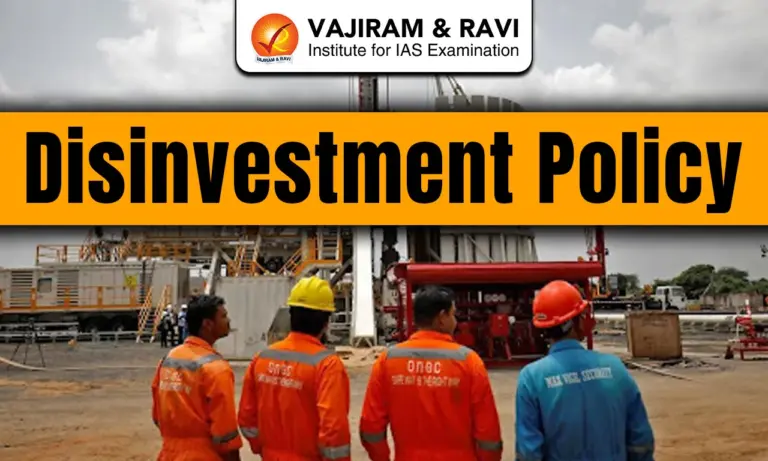
- Since the announcement of the revamped Disinvestment Policy (2020) and the Public Sector Enterprises (PSE) Policy (2021), the Union Government initially emphasized privatisation and strategic disinvestment.
- However, recent policy developments — including the launch of the National Monetisation Pipeline (NMP) 2.0 — indicate a clear shift from asset sales to value extraction and asset monetisation.
- The focus is on dividends and leasing of assets instead of outright privatisation.
Evolution of Disinvestment Policy
- Original privatisation push (2020–21): The Public Sector Enterprises Policy (2021) provides a framework for –
- Government to exit non-strategic sectors.
- Minimum presence in strategic sectors.
- Strategic disinvestment encouraged where private sector capacity exists.
- Policy rationale: Government should minimise direct business operations. The private sector is seen as more efficient in managing enterprises.





Declining Disinvestment Revenues
- Temporary surge: 2022–23 disinvestment revenue (₹35,294 crore), with stake sales in ONGC, LIC, GAIL, and IRCTC, ended a four-year declining trend.
- Subsequent decline: Disinvestment proceeds fell sharply. For example, from a disinvestment revenue of ₹16,507 crore in 2023-24 to ₹10,163 crore (2024-25) and ₹15,562 crore (till date in 2025–26).
- Policy signals:
- Key changes indicate reduced emphasis on privatisation.
- Removal of separate disinvestment category in Budget documents.
- Disinvestment receipts merged into “Miscellaneous Capital Receipts.”
- No annual disinvestment targets.
Reasons for Reduced Privatisation
- Limited private sector interest:
- Key constraints include large employee headcounts, loss-making assets, structural inefficiencies, and political and labour resistance.
- These factors made many Public Sector Enterprises unattractive to private investors.
- Increasing focus on dividend income:
- Consistent Dividend Policy (2020): The Department of Investment and Public Asset Management (DIPAM) advised CPSEs to pay higher dividends, use cash reserves efficiently, and balance capex needs and profitability.
- Capital Restructuring Guidelines (2024): Revised guidelines emphasized value creation in CPSEs, maximising returns for the government.
- Rising dividend receipts: From ₹39,750 crore in 2020–21 to ₹74,128 crore (2024-25) and ₹59,730 crore (so far in 2025-26). Dividend income now significantly exceeds disinvestment proceeds.
Asset Monetisation as the New Strategy
- National Monetisation Pipeline (NMP):
- Launched in 2021 to monetise brownfield infrastructure assets through leasing arrangements. Key features include –
- No transfer of ownership
- Private sector participation
- Revenue generation from idle or underutilised assets
- Performance: About 90% of the target [₹6 lakh crore (2021–25)] achieved.
- Launched in 2021 to monetise brownfield infrastructure assets through leasing arrangements. Key features include –
- National Monetisation Pipeline 2.0 (2025–30):
- Target: ₹16.72 lakh crore
- Focus sectors: Transport infrastructure, energy assets, telecom, warehousing, etc.
- This represents a major expansion of the asset monetisation approach.
Advantages of the New Approach
- Fiscal benefits: Stable and predictable revenue through dividends. Reduced political resistance compared to privatisation. Avoids one-time asset sales.
- Economic benefits: Improves utilisation of public assets, encourages private sector efficiency, and retains public ownership.
- Administrative benefits: Lower complexity compared to strategic disinvestment, and faster implementation.
Challenges and Way Forward
- Fiscal risks: Dividend extraction may reduce reinvestment capacity of CPSEs. Overdependence on dividends can weaken long-term growth.
- Strengthen corporate governance: Professional management of CPSEs, reduced political interference.
- Selective privatisation: Focus on loss-making non-strategic sectors.
- Structural issues: Persistent inefficiencies in CPSE management. Asset monetisation does not address operational problems.
- Balanced public sector reform: Combine strategic disinvestment with monetisation and governance reforms.
- Market risks: Private sector interest depends on economic conditions. Monetisation revenues may fluctuate.
- Efficient asset monetisation: Transparent bidding processes, and strong regulatory oversight.
- Policy inconsistency: Shift from privatisation to monetisation may create uncertainty among investors.
- Sustainable dividend policy: Avoid excessive dividend extraction, and ensure adequate capital expenditure.
Conclusion
- India’s public sector reform strategy is undergoing a significant transition from privatisation to asset monetisation and dividend extraction.
- While this approach provides steady fiscal returns and political acceptability, long-term success will depend on balancing revenue generation with the financial health and competitiveness of CPSEs.
- A calibrated mix of privatisation, monetisation, and governance reforms remains essential for sustainable public sector management.
Source: TH

 Last updated on April, 2026
→ UPSC Final Result 2025 is now out.
→ UPSC has released UPSC Toppers List 2025 with the Civil Services final result on its official website.
→ Anuj Agnihotri secured AIR 1 in the UPSC Civil Services Examination 2025.
→ UPSC Marksheet 2025 is now out.
→ UPSC Notification 2026 & UPSC IFoS Notification 2026 is now out on the official website at upsconline.nic.in.
→ UPSC Calendar 2026 has been released.
→ Check out the latest UPSC Syllabus 2026 here.
→ UPSC Prelims 2026 will be conducted on 24th May, 2026 & UPSC Mains 2026 will be conducted on 21st August 2026.
→ The UPSC Selection Process is of 3 stages-Prelims, Mains and Interview.
→ Prepare effectively with Vajiram & Ravi’s UPSC Prelims Test Series 2026 featuring full-length mock tests, detailed solutions, and performance analysis.
→ Enroll in Vajiram & Ravi’s UPSC Mains Test Series 2026 for structured answer writing practice, expert evaluation, and exam-oriented feedback.
→ Join Vajiram & Ravi’s Best UPSC Mentorship Program for personalized guidance, strategy planning, and one-to-one support from experienced mentors.
→ Shakti Dubey secures AIR 1 in UPSC CSE Exam 2024.
→ Also check Best UPSC Coaching in India
Disinvestment Policy FAQs
Q1. What is the changing approach of the Government of India in managing Public Sector Enterprises (PSEs)?+
Q2. Why has strategic disinvestment in India slowed down in recent years?+
Q3. How does asset monetisation differ from privatisation in public sector reforms?+
Q4. What is the fiscal significance of dividend income from CPSEs?+
Q5. What are the long-term implications of relying on CPSE dividends instead of disinvestment? +
Tags: disinvestment policy mains articles upsc current affairs upsc mains current affairs