Distribution Companies Latest News
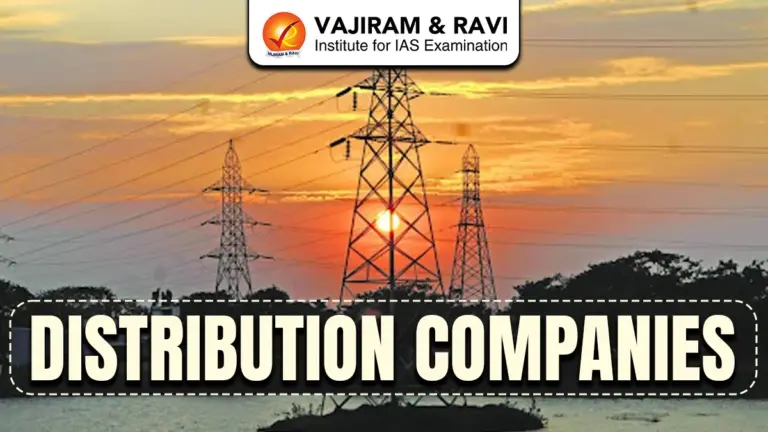
- India’s electricity distribution companies (DISCOMs) have recorded a notable financial and operational turnaround, though concerns remain over their long-term sustainability.
Understanding DISCOMs in India
- Power Distribution Companies, commonly known as DISCOMs, are responsible for the final stage of electricity delivery, distributing power to households, industries, and agricultural consumers.
- India currently has 72 DISCOMs, comprising State-owned utilities, private-sector entities, and power departments.
- Historically, DISCOMs have been the weakest link in India’s power sector, plagued by inefficiencies, mounting losses, and rising debt.
- Two indicators define their financial health:
- Aggregate Technical and Commercial (AT&C) losses, which capture losses from theft, technical inefficiencies, and billing gaps.
- ACS-ARR gap, the difference between the Average Cost of Supply (ACS) and Average Revenue Realised (ARR).
- For decades, high AT&C losses and non-cost-reflective tariffs resulted in persistent deficits, forcing State governments to periodically bail out DISCOMs.





Legacy of Financial Stress
- The roots of DISCOM losses lie in the functioning of earlier State Electricity Boards under the Electricity (Supply) Act, 1948.
- Although the law required utilities to earn modest profits, political interference, subsidised tariffs, and delayed subsidy payments weakened financial discipline.
- Between 2020-21 and 2024-25, accumulated losses rose from Rs. 5.5 lakh crore to Rs. 6.47 lakh crore, while outstanding debt touched Rs. 7.26 lakh crore.
- Non-payment of dues by consumers, delayed State subsidies, and rising power procurement costs worsened the situation.
Signs of a Turnaround
- Recent years have shown measurable improvement. According to official data, DISCOMs collectively recorded a Profit After Tax of Rs. 2,701 crore in 2024-25, a sharp contrast to losses exceeding Rs. 67,000 crore in 2013-14.
- AT&C losses declined from 22.62% to 15.04%, while the ACS-ARR gap narrowed drastically to 0.06 paise per unit, indicating near cost recovery.
- This turnaround reflects better billing efficiency, improved collections, and stronger enforcement of financial discipline.
Role of Policy Reforms
- The improvement has been driven by a series of reforms:
- Revamped Distribution Sector Scheme (RDSS): Links financial assistance to measurable performance outcomes such as feeder metering, loss reduction, and system modernisation.
- Electricity Rules and Late Payment Surcharge Rules: Enabled DISCOMs to clear legacy dues in instalments, preventing snowballing of unpaid liabilities.
- Debt Discipline Measures: Since 2022, legacy dues of nearly Rs. 1.4 lakh crore have been substantially reduced through structured repayments.
- These reforms restored confidence among power generators and fuel suppliers, stabilising the electricity supply chain.
Dependence on State Support
- Despite improvements, financial sustainability remains fragile. Many DISCOMs have posted profits only after receiving tariff subsidies and loss takeovers from State governments.
- For instance, utilities in States like Tamil Nadu and Rajasthan reported profits largely due to direct fiscal support rather than operational surplus.
- This dependence raises concerns about the durability of the turnaround, especially when future liabilities such as employee pay revisions arise.
Structural Challenges Ahead
- Unmetered Agricultural Supply: Lack of accurate data on farm power consumption distorts cost recovery.
- Free or Highly Subsidised Power: Universal free electricity benefits wealthier consumers disproportionately and weakens utility finances.
- Operational Inefficiencies: Not all States have adopted feeder segregation or smart metering at scale.
- Without addressing these structural issues, improvements may prove temporary.
Way Forward
- Long-term sustainability requires deeper reforms.
- Expanding feeder segregation, promoting solar pumps in agriculture, improving metering, and ensuring cost-reflective tariffs are essential.
- Political commitment and professional management must align to transform DISCOMs into consumer-friendly and financially viable utilities.
Source: TH

 Last updated on April, 2026
→ UPSC Final Result 2025 is now out.
→ UPSC has released UPSC Toppers List 2025 with the Civil Services final result on its official website.
→ Anuj Agnihotri secured AIR 1 in the UPSC Civil Services Examination 2025.
→ UPSC Marksheet 2025 is now out.
→ UPSC Notification 2026 & UPSC IFoS Notification 2026 is now out on the official website at upsconline.nic.in.
→ UPSC Calendar 2026 has been released.
→ Check out the latest UPSC Syllabus 2026 here.
→ UPSC Prelims 2026 will be conducted on 24th May, 2026 & UPSC Mains 2026 will be conducted on 21st August 2026.
→ The UPSC Selection Process is of 3 stages-Prelims, Mains and Interview.
→ Prepare effectively with Vajiram & Ravi’s UPSC Prelims Test Series 2026 featuring full-length mock tests, detailed solutions, and performance analysis.
→ Enroll in Vajiram & Ravi’s UPSC Mains Test Series 2026 for structured answer writing practice, expert evaluation, and exam-oriented feedback.
→ Join Vajiram & Ravi’s Best UPSC Mentorship Program for personalized guidance, strategy planning, and one-to-one support from experienced mentors.
→ Shakti Dubey secures AIR 1 in UPSC CSE Exam 2024.
→ Also check Best UPSC Coaching in India
Distribution Companies FAQs
Q1. What are DISCOMs?+
Q2. What is AT&C loss?+
Q3. What is the ACS–ARR gap?+
Q4. Which scheme supports DISCOM reforms?+
Q5. What is the key challenge for DISCOM sustainability?+
Tags: distribution companies mains articles upsc current affairs upsc mains current affairs