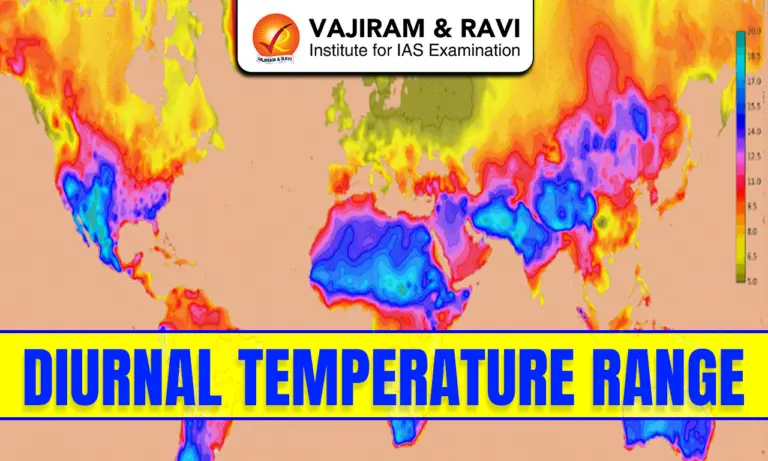
Diurnal Temperature Range (DTR) refers to the difference between the maximum (daytime) temperature and the minimum (nighttime) temperature recorded at a particular place within a 24-hour period. It is an important concept in climatology and meteorology because it helps scientists understand local climate patterns, weather conditions, and environmental changes.
Regions with High and Low Diurnal Temperature Range
Different regions of the world experience varying diurnal temperature ranges (DTR) depending on factors such as humidity, cloud cover, altitude, and distance from large water bodies. Areas with dry air and clear skies usually have a high DTR, while regions with high humidity or coastal influence generally show a low DTR.
| Regions with High and Low Diurnal Temperature Range | |||
|
Region Type |
Diurnal Temperature Range |
Characteristics |
Examples |
|
Desert Regions |
Very High |
Dry air, clear skies, rapid heating during day and rapid cooling at night |
Sahara Desert, Thar Desert |
|
Continental Interiors |
High |
Located far from oceans, land heats and cools quickly |
Central Asia, Interior North America |
|
Mountain Regions |
Moderate to High |
Thin atmosphere and lower humidity cause faster heat loss at night |
Himalayas, Andes |
|
Grassland and Steppe Regions |
Moderate |
Moderate humidity and open landscapes allow noticeable temperature variation |
Central Asia Steppes, North American Prairies |
|
Coastal Areas |
Low |
Oceans absorb heat during the day and release it slowly at night |
Coastal India, Western Europe |
|
Tropical Rainforest Regions |
Very Low |
High humidity, dense vegetation, and frequent cloud cover limit temperature variation |
Amazon Basin, Congo Basin |
Factors Affecting Diurnal Temperature Range
The Diurnal Temperature Range (DTR) is influenced by several geographical and atmospheric conditions that control how quickly the Earth’s surface heats during the day and cools at night.
- Cloud Cover: Clouds reduce DTR by blocking solar radiation during the day and trapping heat at night.
- Humidity: High humidity reduces temperature variation, while dry air allows faster cooling at night, increasing DTR.
- Distance from the Sea (Continentality): Coastal regions experience low DTR due to the moderating influence of oceans, whereas interior regions have higher DTR.
- Latitude: Regions closer to the equator usually have smaller temperature variations compared to subtropical desert regions.
- Vegetation Cover: Dense vegetation moderates temperatures through evapotranspiration, reducing the diurnal temperature range.
- Altitude: Higher altitudes often experience greater DTR because thinner air loses heat quickly after sunset.
- Surface Characteristics: Bare land or desert surfaces heat and cool quickly, leading to higher diurnal temperature variation.





Advantages of High Diurnal Temperature Range
- Better Crop Quality: Certain crops such as fruits, grapes, and vegetables benefit from warm days and cool nights, improving their quality and flavor.
- Efficient Plant Respiration: Cool nights reduce plant respiration, helping plants conserve energy and grow more efficiently.
- Lower Pest Activity: Cooler nighttime temperatures can limit the growth and activity of pests and harmful insects.
- Improved Air Clarity: Dry regions with high DTR often have clearer skies and better atmospheric visibility.
Disadvantages of High Diurnal Temperature Range
- Stress on Plants and Animals: Sudden temperature changes between day and night can cause stress to crops, livestock, and wildlife.
- Human Discomfort: Large temperature variations may create uncomfortable living conditions, especially in desert regions.
- Infrastructure Impact: Extreme temperature differences can cause expansion and contraction of materials, affecting buildings and roads.
- Higher Water Demand: Crops in regions with high DTR may require more irrigation due to high daytime evaporation.

 Last updated on March, 2026
→ UPSC Final Result 2025 is now out.
→ UPSC has released UPSC Toppers List 2025 with the Civil Services final result on its official website.
→ Anuj Agnihotri secured AIR 1 in the UPSC Civil Services Examination 2025.
→ UPSC Marksheet 2025 is now out.
→ UPSC Notification 2026 & UPSC IFoS Notification 2026 is now out on the official website at upsconline.nic.in.
→ UPSC Calendar 2026 has been released.
→ Check out the latest UPSC Syllabus 2026 here.
→ UPSC Prelims 2026 will be conducted on 24th May, 2026 & UPSC Mains 2026 will be conducted on 21st August 2026.
→ The UPSC Selection Process is of 3 stages-Prelims, Mains and Interview.
→ Prepare effectively with Vajiram & Ravi’s UPSC Prelims Test Series 2026 featuring full-length mock tests, detailed solutions, and performance analysis.
→ Enroll in Vajiram & Ravi’s UPSC Mains Test Series 2026 for structured answer writing practice, expert evaluation, and exam-oriented feedback.
→ Join Vajiram & Ravi’s Best UPSC Mentorship Program for personalized guidance, strategy planning, and one-to-one support from experienced mentors.
→ Shakti Dubey secures AIR 1 in UPSC CSE Exam 2024.
→ Also check Best UPSC Coaching in India
Diurnal Temperature Range FAQs
Q1. What is Diurnal Temperature Range?+
Q2. How is Diurnal Temperature Range calculated?+
Q3. Which regions experience the highest diurnal temperature range?+
Q4. Why do coastal areas have a low diurnal temperature range?+
Q5. How does cloud cover affect diurnal temperature range?+
Tags: geography geography notes