Doctrine of Escheat Latest News
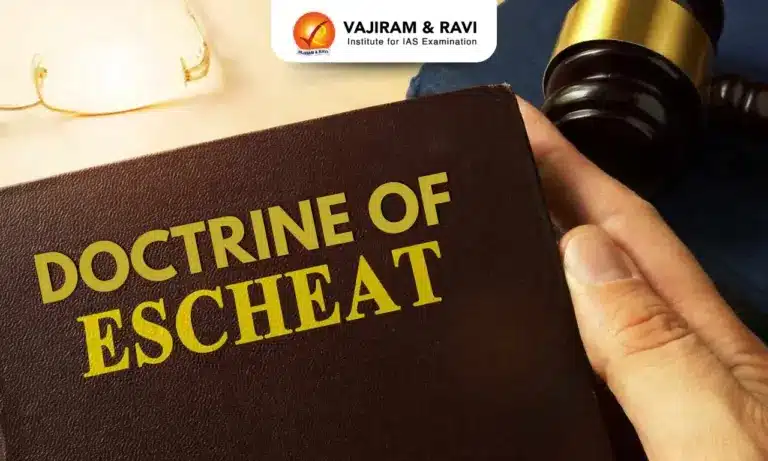
The Supreme Court recently held that a State Government cannot invoke the doctrine of escheat under Section 29 of the Hindu Succession Act once a Hindu male has executed a Will, which has been declared to be valid and has been granted probate by a Court.
About Doctrine of Escheat
- It is a significant legal concept that ensures no property is left without ownership, reverting it to the state if the original owner dies without legal heirs or fails to make a will.
- This legal process addresses the handling of unclaimed assets, protecting societal interests and maintaining order within the legal framework.
- The doctrine addresses two primary situations:
- when a person dies intestate (without a will) and without heirs, and
- when property remains unclaimed or abandoned for a specific period.
- The underlying principle of escheat is that property must always have an identifiable owner, and in the absence of heirs, the government assumes ownership.
- In modern legal systems, escheat serves as a way to maintain orderly succession and prevent assets from being wasted or misused.





Historical Origins of Escheat
- Escheat originates from the Old French word “eschete,” meaning “to fall to”.
- The concept of escheat is rooted in the feudal system of medieval Europe, where land was held by tenants under a lord.
- If the tenant died without an heir or was convicted of certain crimes like treason, the land would escheat, or revert, to the lord.
- This system allowed for continuous control of land, ensuring that property remained within the hierarchy of the feudal structure.
- Over time, this evolved to include the monarch or the state as the ultimate recipient of property without heirs.
Escheat in Modern Legal Systems
- In modern legal systems, escheat ensures that unclaimed or ownerless property does not remain in limbo but is transferred to the state.
- The state assumes ownership of such property, either permanently or temporarily, until rightful claimants can be found.
- Escheat laws vary across jurisdictions, with some countries having well-defined processes for handling unclaimed assets.
- In India, escheat is regulated primarily through Section 29 of the Hindu Succession Act, 1956, and Article 296 of the Constitution.
- These provisions outline the circumstances under which property escheats to the state, safeguarding against unclaimed or abandoned property.
- However, the Supreme Court made it clear that the doctrine of escheat under Section 29 of the Hindu Succession Act, 1956, is a remedy of last resort; it comes into play only when a person dies intestate and without any legal heirs.
- Where a valid will is executed and duly probated, the property must devolve strictly in line with the testator’s intent, leaving no room for the State to assert rights over the estate.
Source: LIVELAW

 Last updated on March, 2026
→ UPSC Final Result 2025 is now out.
→ UPSC has released UPSC Toppers List 2025 with the Civil Services final result on its official website.
→ Anuj Agnihotri secured AIR 1 in the UPSC Civil Services Examination 2025.
→ UPSC Marksheet 2025 is now out.
→ UPSC Notification 2026 & UPSC IFoS Notification 2026 is now out on the official website at upsconline.nic.in.
→ UPSC Calendar 2026 has been released.
→ Check out the latest UPSC Syllabus 2026 here.
→ UPSC Prelims 2026 will be conducted on 24th May, 2026 & UPSC Mains 2026 will be conducted on 21st August 2026.
→ The UPSC Selection Process is of 3 stages-Prelims, Mains and Interview.
→ Prepare effectively with Vajiram & Ravi’s UPSC Prelims Test Series 2026 featuring full-length mock tests, detailed solutions, and performance analysis.
→ Enroll in Vajiram & Ravi’s UPSC Mains Test Series 2026 for structured answer writing practice, expert evaluation, and exam-oriented feedback.
→ Join Vajiram & Ravi’s Best UPSC Mentorship Program for personalized guidance, strategy planning, and one-to-one support from experienced mentors.
→ Shakti Dubey secures AIR 1 in UPSC CSE Exam 2024.
→ Also check Best UPSC Coaching in India
Doctrine of Escheat FAQs
Q1. What does the Doctrine of Escheat primarily deal with?+
Q2. The term “escheat” originates from which language?+
Q3. In modern legal systems, what is the purpose of escheat?+
Q4. Is the doctrine of escheat regulated in India?+
Tags: doctrine of escheat