What’s in Today’s Article?
- Why in News?
- What is a Dollar–Rupee Swap Auction?
- Why do Central Banks Engage in it?
- What is the RBI’s Intent and Impact of Dollar-Rupee Swap Auction?
- News Summary Regarding RBI’s Forex Swap
Why in News?
- With a $5 billion forex swap between the Reserve Bank of India (RBI) and banks set to mature, a majority of lenders have arranged for dollars to be delivered to the RBI.
- In April last year, the RBI conducted a dollar/rupee (USD/INR) sell-buy swap auction for an amount of $ 5 billion, with an agreement to buy back those dollars at maturity, which is October 23.





What is a Dollar–Rupee Swap Auction?
- It’s a forex tool whereby the central bank uses its currency to buy another currency or vice versa.
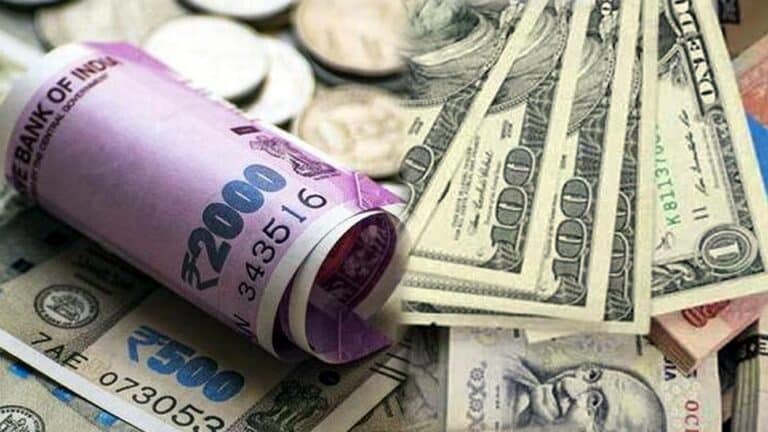
- In a Dollar-Rupee buy/sell swap, the central bank buys dollars (US dollars or USD) from banks in exchange for Indian Rupees (INR) and immediately gets into an opposite deal with banks promising to sell dollars at a later date.
Why do Central Banks Engage in it?
- Surplus liquidity in the system was pegged at Rs 7.5 lakh crore, which needs to be curbed to keep a tab on inflation.
- Usually, the central bank will resort to traditional tools such as increasing the repo rate or increasing the cash reserve ratio (CRR), but this can have a negative implication on the economy.
- Therefore, the RBI used a different toolkit – variable rate reverse repo auction (VRRR) last year.
- However, the recent VRRR auctions were undersubscribed by banks, as the cash market offered instant and better yields.
- This forced the RBI to consider a longer-term liquidity adjustment tool such as forex auctions.
- Forex swaps help in liquidity management and (in a limited way) helps in keeping the currency rates in check.
- A dollar-rupee buy/sell swap injects INR into the banking system while sucking out the dollars, and the reverse happens in a sell/buy swap.
What is the RBI’s Intent and Impact of Dollar-Rupee Swap Auction?
- The intent here is that the central bank acquires dollars from the seller, charging the lowest premium possible for the tenor.
- As the forex swaps are intended for liquidity management, their impact on currency is only incidental.
- Amidst global tension and hardening crude oil prices, it’s important to keep INR under control. The RBI resorting to selling USD will keep a check on Rupee’s volatility and help curb its depreciation to some extent.
- For the bond market, the exercise may have a pronounced impact. This tool leaves room for the central bank to buy bonds when needed. Consequently, the strategy will contain bond yields.
- Will the government gain from the swaps? Usually, RBI makes its dividend payment to the government for the previous fiscal. The surplus from these swaps could be used to supplement the payouts.
News Summary Regarding RBI’s Forex Swap
- The RBI had announced the forex swap last year to elongate the maturity profile of forward book and smoothen the receivables relating to forward assets.
- This also supported the rupee which came under pressure due to the Russia-Ukraine conflict.
- In the immediate aftermath of the war, global commodity prices increased led by oil, and global financial markets too saw heightened volatility.
- A flight to safety occurred, putting pressure on emerging market currencies such as India.
- Hence, while the announcement for the auction was said to be to adjust the maturity profile of RBI’s forward book, it also had an impact on the exchange rate.
- With the maturity of the swap approaching this week, it is almost ironic that the world has once again found itself in the midst of another unforeseen crisis in the form of the Israel-Hamas war.
Q1) What is Variable Reverse repo rate (VRRR)?
VRRR is the rate at which the RBI borrows money from banks for a variable period of time, usually ranging from 14 days to 56 days. It is one of the tools used by the RBI to manage liquidity in the banking system and to influence short-term interest rates.
Q2) What is the cash reserve ratio (CRR)?
CRR is a specified minimum fraction of the total deposits of customers, which commercial banks have to hold as reserves either in cash or as deposits with the central bank.
Source: Forex swap maturity: Banks get ready to return $5 billion to | RBI | BL

 Last updated on March, 2026
→ UPSC Final Result 2025 is now out.
→ UPSC has released UPSC Toppers List 2025 with the Civil Services final result on its official website.
→ Anuj Agnihotri secured AIR 1 in the UPSC Civil Services Examination 2025.
→ UPSC Marksheet 2025 is now out.
→ UPSC Notification 2026 & UPSC IFoS Notification 2026 is now out on the official website at upsconline.nic.in.
→ UPSC Calendar 2026 has been released.
→ Check out the latest UPSC Syllabus 2026 here.
→ UPSC Prelims 2026 will be conducted on 24th May, 2026 & UPSC Mains 2026 will be conducted on 21st August 2026.
→ The UPSC Selection Process is of 3 stages-Prelims, Mains and Interview.
→ Prepare effectively with Vajiram & Ravi’s UPSC Prelims Test Series 2026 featuring full-length mock tests, detailed solutions, and performance analysis.
→ Enroll in Vajiram & Ravi’s UPSC Mains Test Series 2026 for structured answer writing practice, expert evaluation, and exam-oriented feedback.
→ Join Vajiram & Ravi’s Best UPSC Mentorship Program for personalized guidance, strategy planning, and one-to-one support from experienced mentors.
→ Shakti Dubey secures AIR 1 in UPSC CSE Exam 2024.
→ Also check Best UPSC Coaching in India